26/06/2007

Elizabeth Seward

In his Baptist History on p526 John Mockett Crampton speaks about Anne Steele the hymn writer then says
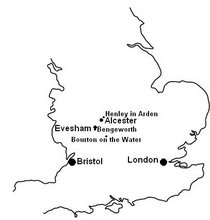
Another lady, Mrs. ELIZABETH SEWARD, widow of Benjamin Seward, Esq, of Evesham, Worcestershire, bequeathed the sum of £4,550, the interest whereof was directed to be annually distributed among the ministers or the poor of several Baptist churches named in the will, in the proportions therein specified.
See here.

Bourton on the Water 0407


Picture sequence found on YouTube

25/06/2007

Hymn Joys of Salvation 190

This is another very experiential hymn that moves from 'God’s cheering presence' withdrawn to 'The wonders of restoring grace'. The phrase 'object of my love' in reference to God is in Dryden.

190 Joys of Salvation LM

God’s cheering presence once withdrawn My life, my joy, my all is gone, Restless from place to place I rove, To seek the object of my love.
2 But when he makes his face to shine, And gently whispers “I am thine”; My joys revive, my fears are fled, And faith lifts up its fainting head.
3 No longer then can I conceal, The rapturous pleasure which I feel; But heart and lips and life express The wonders of restoring grace.

Sermon c 48 Christ's Conflict

Tango7174, CC BY-SA 4.0 <https://creativecommons.org/licenses/by-sa/4.0>,
via Wikimedia Commons

John 14:30 The prince of this world cometh, and hath nothing in me. Christ’s Conflict
No-one since the fall could ever say this. It only was and could be the language of him who was “holy, harmless and undefiled, separate from sinners, made higher than the heavens.” The time was short, the arduous and important work was nearly finished and the most trying season of all was now approaching. The clouds are gathering, the enemy is collecting all his forces and will shortly make a furious onset. But the Saviour is fully prepared and confident of victory: the serpent may bruise his heel, but he will bruise the serpent’s head, and fully destroy the works of the devil.
I. Satan is called The prince of this world 1. Satan is called a prince, which implies power and dominion. 2. He is the prince of this world. Here let us inquire whose subjects are we?
II. The prince of this world cometh His coming implies 1. That he has hitherto kept at a distance 2. He had some particular end in view, which he wished to accomplish 3. His coming would be immediate and without delay He is frequently near to us when we think him at the greatest distance. But we have two things to comfort us - The conflict though sharp will be but short: we shall soon be out of his reach, and he that now comes will come no more - And if we persist, we shall certainly be victorious.
III. The prince of this world cometh and hath nothing in me The sinner cannot say this neither can the saint until he get to heaven. The unspotted purity of Christ’s nature was owing to the following things, all of which were peculiar to himself 1. His miraculous conception 2. He was filled with the Spirit and all the graces were in full maturity 3. As the Son of God he was possessed of a divine nature
(1) This subject may teach us to entertain low thoughts of ourselves (2) Let i teach us to cherish high and adoring thoughts of Christ

07/06/2007

Hymn Divine Presence 448

The juxtaposition of prostration and adoration we have noted in other hymns

448 Imploring the Divine Presence

CLOUDS and darkness interposing, Keep the Saviour from my sight, Wonted joys and pleasures closing, Lord, again restore the light: Scatter thou the storms o’erspreading, And thy lovely face reveal; Oh regard my humble pleading, Nor thy presence hence conceal.
2 Deign to shine with beams resplendent, Fill my heart with sacred joy, All my labouring thoughts employ: I will then in low prostration, At thy sacred footstool fall, And in songs of adoration, Own thee sovereign Lord of all.

Sermon c 47 Divine wrath

Jeremiah 17:17 Be not a terror unto me: thou art my hope in the day of evil
Divine wrath an object of fear
Every believer can adopt the former of these expressions but not the latter. In the one the prophet deprecates God’s wrath; in the other, he declares his confidence in the divine mercy. He spoke the Word to the people but they imprisoned him and so he says to the LORD Be not a terror unto me: thou art my hope in the day of evil This prayer was peculiarly suitable at such a time; and … it is suitable for us - Let us consider what is implied in the petition - and in the confidence which is here expressed.
I. In the petition, the prophet deprecates divine wrath: Be not a terror unto me 1. We may observe that the awful majesty of God is in itself an object of fear and dread 2. Divine chastisements are also to be feared 3. The wrath of god is still more dreadful and therefore most of all to be feared. This is the greatest of all evils. 4. In deprecating wrath, the prophet in effect prays for support and comfort in the time of trial.
II. Notice the confidence that is here expressed thou art my hope in the day of evil 1. The grace exercised is that of hope More particularly observe (1) God is the object of his people’s hope thou art my hope (2) God also is the end of their hope 2. Observe the time when this hope was exercised in the day of evil
(1) We may see from this subject how hopes and fears are often blended together in the experience of the godly
(2) If God be sometimes a terror to his own people, how much more to the wicked!

03/06/2007

Sermon 46 Nearness to God

PSALM 148:14
A people near unto him: praise ye the Lord
Nearness to God
Glorious things are spoken of Zion, the city of God. Glorious promises are made, glorious privileges are given, and glorious titles ascribed to her. Yet nothing can be said of them more for their honour and comfort than what is said in our text: A people near unto him. The world indeed may look upon them with contempt, and regard them only as “the common people” and it may be true that they are generally poor and afflicted people: but their outward meanness is more than compensated by their spiritual privileges - for they are a people near unto God. The words of the text may immediately refer to the Jewish nation, as God’s peculiar people; but as they are applicable to true believers in all ages, we shall consider them in that view; and shall enquire - what is implied in this nearness - and why it is matter of joy.
I. In what respects are true believers near to God? As creatures, God is not far from every one of us; for in him we live, and move, and have our being. But as sinners, he is far from us, and we are free from him. .. But all his people are near to him. That is, 1. The awful breach is healed, and they are reconciled 2. The power of sin is subdued and they are near as to union and likeness 3. They are near as to communion and fellowship 4. They are near to him in a way of endearment, being precious in his sight 5. they are so near to him that they will soon be with him
II. Consider the reasons why this nearness is matter of exultation and joy - A people near unto him: praise ye the Lord 1. This nearness is lasting: those who are thus brought near to God shall be for ever near 2. Those who are near to God have God also near to them 3. They have blessings and privileges that none else can enjoy 4. Being near to God, they are also near to heaven
Improvement (1) How vain are all our hopes of happiness without God! (2) Let us be reconciled to those providences which tend to bring us near. The severest trials are often among the means which God employs to bring us to himself; and had it not been for them we might still have been afar off, and without hope. Nor are we likely to be kept near without a similar discipline. (3) Let nearness to God be the object sought after in every holy duty, both public and private. (4) Not only let us desire to be brought near in a way of interest, but to keep near in a way of communion. Continued nearness to him will be our greatest honour and happiness: it will soften afflictions, heighten our mercies, fortify us against the fear of death, and be our best preparative heaven. (5) If the Lord’s people be near and dear to him; let them be so to us. For thee, my God, may my whole soul, Bound by a thousand ties, Be truly fix’d, and day by day To greater nearness rise. Begone vain world with all thy charms, Nor more disturb my peace; Ye inward lusts, infernal powers, Your fruitless efforts cease. Fly swiftly hence, ye joys of sense, Let every sin depart; The God of heaven asserts his claim And grace commands my heart. (This is an alternative version of Beddome's hymn 763, headed 'Renunciation of the world' To thee, my God, O let my soul Be bound by sacred ties; On thee be fixed, and day by day To greater nearness rise. Be gone vain world with all thy charms, Nor more disturb my peace; Enticing pleasure, wealth and power, Your fruitless efforts cease. Fly swiftly hence, ye gilded scenes, Let every sin depart; The God of heaven asserts his claim And grace commands my heart.)