Showing posts with label Edward Young. Show all posts

02/05/2026

Night Thoughts by Edward Young

Joseph Highmore, Public domain, via Wikimedia Commons

It would be difficult to overstate the impact on Beddome of Edward Young's long poem Night Thoughts, which first appeared when Beddome was in his twenties. Beddome often quotes from it in his sermons. One of the most popular poems of the century, it influenced Goethe, Edmund Burke and many others. The poem, full title The Complaint: or, Night-Thoughts on Life, Death, & Immortality, is best known simply as Night-Thoughts. It was published in nine parts ("nights") between 1742 and 1745. It was later illustrated with notable engravings by Blake in 1797.
The poem is written in blank verse and describes the poet's musings on death over a series of nine "nights" in which he ponders the loss of his wife and friends, and laments human frailties. The best-known line in the poem (at the end of "Night I") is the adage "procrastination is the thief of time", which is part of a passage in which the poet discusses how quickly life and opportunities can slip away. Night-Thoughts had a very high reputation for many years after its publication.
The nine nights are each a poem of their own. They are

"Life, Death, and Immortality" (dedicated to Arthur Onslow)
"Time, Death, Friendship" (dedicated to Spencer Compton)
"Narcissa" (dedicated to Margaret Bentinck)
"The Christian Triumph" (dedicated to Philip Yorke)
"The Relapse" (dedicated to George Lee)
"The Infidel Reclaim'd" (in two parts, "Glories and Riches" and "The Nature, Proof, and Importance of Immortality"; dedicated to Henry Pelham)
"Virtue's Apology; or, The Man of the World Answered" (with no dedication)
"The Consolation" (dedicated to Thomas Pelham-Holles)

In his 1791 book, Life of Samuel Johnson, Boswell called the poem "the grandest and richest poetry that human genius has ever produced".

Edward Young (1683-1765) took holy orders, and wrote many fawning letters in search of preferment, attracting accusations of insincerity. His father, also Edward, became Dean of Salisbury. The son was born at his father's rectory in Upham, near Winchester. Educated at Winchester College, he matriculated at New College, Oxford, 1702 and later migrated to Corpus Christi. In 1708 he was nominated by Archbishop Tenison to a law fellowship at All Souls. He took his degree of Doctor of Canon Law in 1719.
His first publication was an Epistle to ... Lord Lansdoune (1713). This was followed by a Poem on the Last Day (1713), dedicated to Queen Anne; The Force of Religion: or Vanquished Love (1714), a poem on the execution of Lady Jane Grey and her husband, dedicated to the Countess of Salisbury; and an epistle to Joseph Addison, On the late Queen's Death and His Majesty's Accession to the Throne (1714), in which he rushed to praise the new king. The fulsome style of the dedications jars with the pious tone of the poems, and they are omitted from his own edition of his works.
About this time he came into contact with Philip, Duke of Wharton, whom he accompanied to Dublin in 1717. In 1719 his play, Busiris was produced at Drury Lane, and in 1721 his The Revenge. The latter play was dedicated to Wharton, to whom it owed, said Young, its "most beautiful incident". Wharton promised him two annuities of £100 each and a sum of £600 in consideration of his expenses as a candidate for parliamentary election at Cirencester. In view of these promises Young refused two livings in the gift of All Souls College, Oxford, and sacrificed a life annuity offered by the Marquess of Exeter if he would act as tutor to his son. Wharton failed to discharge his obligations, and Young, who pleaded his case before Lord Chancellor Hardwicke in 1740, gained the annuity but not the £600. Between 1725 and 1728 Young published a series of seven satires on The Universal Passion. They were dedicated to the Duke of Dorset, George Bubb Dodington, Sir Spencer Compton, Lady Elizabeth Germain and Sir Robert Walpole, and were collected in 1728 as Love of Fame, the Universal Passion. This is qualified by Samuel Johnson as a "very great performance", and abounds in striking and pithy couplets. Herbert Croft asserted that Young made £3000 by his satires, which compensated losses he had suffered in the South Sea Bubble. In 1726 he received, through Walpole, a pension of £200 a year. To the end of his life he continued to seek preferment, but the king regarded his pension as an adequate settlement.
Young, living in a time when patronage was slowly fading out, was notable for urgently seeking patronage for his poetry, his theatrical works and his career in the church: he failed in each area. He never received the degree of patronage that he felt his work had earned, largely because he picked patrons whose fortunes were about to turn downward.
Though his praise was often unearned, often fulsome, he could write, "False praises are the whoredoms of the pen / And prostitute fair fame to worthless men."
In 1728 he became a royal chaplain, and in 1730 he obtained the college living of Welwyn, Hertfordshire. In 1731 he married Lady Elizabeth Lee, daughter of the 1st Earl of Lichfield. Her daughter, by a former marriage with her cousin Francis Lee, married Henry Temple, son of the 1st Viscount Palmerston. Mrs Temple died at Lyons in 1736 on her way to Nice. Her husband and Lady Elizabeth Young died in 1740. These successive deaths are supposed to be the events referred to in the Night-Thoughts as taking place "ere thrice yon moon had filled her horn."

24/07/2023

References to other writers in Sermons 6

Transferred from en.wikipedia by ronhjones, Public domain,
William Faithorne, CC0, both via Wikimedia Commons

In Volume 6 of his published sermons (Short Discourses Vol 6) Beddome makes reference to these sources

6:1 1 Corinthians 16:13

Henry Newcombe (1627-1695)

An eminently pious minister once said that were it not for his hope in the grace and righteousness of Christ the thoughts of death would drive him distracted.

Ignatius

When the flesh of Ignatius began to be torn by the wild beasts, Now, says he, with a kind of holy exultation, now I begin to be a Christian.

Edward Young (1681-1765)
Night Thoughts

to trifle, is to live:
And is it then a trifle, too, to die?

John Milton (1606-1674)
Paradise Lost

Oh when will Death This mouldering old partition wall throw down
Give beings one in nature, one abode
Oh Death divine that givest us to the skies.

Edward Young (1681-1765)
Night Thoughts

The man immortal, rationally brave,
Dares rush on death - because he cannot die.

6:4 Revelation 2:4
John Chrysostom (d 407)


It is said of the Christians at Antioch that they so valued Chrysostom their excellent pastor that if driven to the alternative they would rather choose to be deprived of the light of the Sun than his ministrations.


6:6 Romans 5:8
Archbishop Ussher (1581-1656)
A word of Christ before we part was the usual saying of pious archbishop Usher to his friends when they had been conversing about the various branches of human literature in which he was so eminently versed.
Edward Young (1681-1765)
Night Thoughts

Behold the picture of earth's happiest man:
"He calls his wish, it comes; he sends it back,
And says he call'd another; that arrives,
Meets the same welcome; yet he still calls on;
Till One calls him, who varies not his call,
But holds him fast in chains of darkness bound,

...

To man the bleeding cross has promised all
The bleeding cross has sworn eternal grace.
Who gave his life, what grace shall he deny?

6:8 Romans 1:6
Westmnster Shorter Catechism

Effectual calling is the work of God's Spirit, whereby, convincing us of our sin and misery, enlightening our minds in the knowledge of Christ, and renewing our wills, he does persuade and enable us to embrace Jesus Christ, freely offered to us in the gospel.

08/07/2023

Beddome on Friendship Part 1

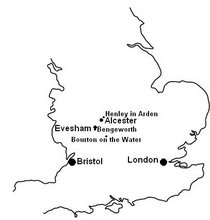
Enumerating God's kindnesses in one of his hymns, the long serving minister at Bourton on the Water, Gloucestershire, Benjamin Beddome (1717-1795) includes not only "constant supplies of outward good, your nightly sleep and daily food", but also
your health and strength and faithful friends,
And happiness that never ends.
In another hymn he acknowledges that his dearest friends he owes to God's goodness.
One hymn (737) is all about friendship in the context of worship
How sweet the interview with friends
Whose hopes and aims are one
All earthly pleasures it transcends
And swift the moments run

Of sympathy and love possessed
Our sorrows we impart
And when with pure enjoyments blessed
They go from heart to heart.

Pursuing still our way to bliss
A weak and feeble band
We trust in Christ our righteousness
Who will our strength command 

Though for a season we must part
As urgent duties call
Still we remain but one in heart
And Jesus is our all

Oh may his glorious cause encrease
And we his wonders tell
Now bid us Lord depart in peace
And now dear friends farewell.
Growing up, Beddome would have been keenly aware of the intense friendship between his father John Beddome (1675-1757) and his life-long bachelor friend Bernard Foskett (1685-1758) who Beddome junior followed both into medicine and the ministry. Beddome senior and Foskett first met in London. They then ministered together in the Midlands before coming together again in Bristol, where, in due time, the two died within a year of each other and were buried alongside each other. Foskett was considered to be a part of the Beddome family and was often with them when they gathered. Benjamin named one of his sons Foskett. Sadly, this son drowned, dying prematurely as a young man. Beddome was asked to speak at Foskett's funeral but felt unable to do it. He was one of the coffin bearers.
The friendship between the older men no doubt informed Beddome when on at least one occasion he preached on the subject of friendship.
Before coming to that sermon we quote a paragraph from another sermon, this one on Zechariah 8:23 in Volume 5 of the short discourses. He says that one of the things we can learn from his text is
That seclusion from all society is neither the Christian's duty, nor his privilege. It was God himself who said, It is not good for man to be alone. Satan imagined that lie had the greatest advantage against our Lord, and that he was most likely to prevail over him, when he found him in a solitary wilderness, unsupported by the presence of a friend. To guard against a similar danger, Jesus afterwards sent out his disciples two and two; not only that out of the mouth of two witnesses every word might be established, but that they might be helpers of each other's joy in the Lord. 
The text of the sermon on friendship is Sermon 59 in a collection of 67 posthumously published sermons. It is on Proverbs 18:24 A man that hath friends must show himself friendly and has been given the title The reciprocal duties of friends.
Beddome begins it by saying
The advantages of real friendship are great and the duties resulting from it many. We have a comprehensive view of them in my text. We should exercise a common civility towards all men neither despising the poor on account of the meanness of their condition nor hating our greatest enemies for the injuries we have received from them but a man that hath friends must show himself friendly. Here we have a privilege spoken of and a duty prescribed.

The privilege of friendship
The sermon is in two parts. Beddome says firstly that a privilege is spoken of. What a privilege to have a friend, says Beddome,
To say that a man is friendless is to denote a complete state of misery. Lover and friend says David hast thou put far from me. This aggravated his troubles and added weight to all his other distresses. On the contrary next to the comforts of religion are those of friendship and society especially when those whom we look upon as our friends are …
And then he lists four qualities in a good friendship. It is

Real and disinterested
Sincerely what they profess to be not acting from selfish motives but making our interest their own. Most men seek their own and do not, as the apostle expresses it in another case, naturally care for the state of others. Here and there perhaps we may find one who will sympathize with us in all our griefs and joys and by all proper means promote our happiness and welfare. Happy is the man that hath such a friend.
Wise and prudent
Able and willing to give us advice when we are at a loss how to act and that without upbraiding our ignorance or despising us for our weakness. It is a happiness to have such friends who are discreet and experienced and at the same time open and communicative. If our friend be weak and silly his folly may plunge us into great inconveniences and let him be ever so sagacious, if he be sullen and reserved his wisdom will do us little service. David was happy in the friendship of Hushai who by his good sense and deep penetration defeated the pernicious councils of Ahithophel and extricated his royal master from a state of the greatest perplexity.
Marked by pious virtue
Pious virtue is the only solid foundation for friendship for he that is not a good man cannot be a good friend. Prayer for friends is one of the most important duties of friendship but he is not likely to pray for us who does not pray for himself. The concerns of the soul are of the most interesting nature but it is not probable that he will be mindful of the spiritual concerns of others who is regardless of his own. Those are the most valuable and desirable friends who are at the same time like Abraham the friends of God. Not the gay sensual and profane but the serious and thoughtful, circumspect and holy whose conversation will be instructive and their example improving whose hearts glow with love to God and whose conduct and behaviour exhibit all the beauties of the religious life. By their means we may be fortified against temptations kept from many an hurtful snare be convinced of sin when we have committed it and rendered more steadfast in the ways of God. As iron sharpeneth iron says Solomon so doth the countenance of a man his friend. We insensibly contract a likeness to those whom we choose for our companions: if they are modest and humble, we grow like them; if they are bold and impudent, we become so too. Give me leave to add, under this head, if a courteous and obliging temper, a natural sweetness of disposition, be added to strict virtue and real piety, it makes the ties of friendship more sweet and more durable. This seems to have been the case with respect to David and Jonathan. That man can never be a friend to others who is a foe to himself.
Faithful and persevering
The fourth and final thing he includes under his first heading, and here he must inevitably have thought of Foskett and his father, is this
Lastly. Faithful and persevering, who will smile when the world frowns, stand by us when others forsake us and adhere to us in the face of the greatest opposition. Thus all Saul's threats and reproaches could not make Jonathan renounce the covenant of friendship he had made with David, whom he loved as his own soul. Such friendships are very rare. My brethren, says Job, have dealt deceitfully as a brook, and as the stream of brooks they pass away. A failing brook is a fit emblem of a false heart. A friend that loveth at all times, who does not change when our circumstances change, but is the same whether we are in a state of affluence or want, in honour or disgrace, is one of the choicest gifts of God.
He quotes Edward Young, one of his favourite authors, from Night Thoughts
Friendship's the wine of life:
A friend is worth all the hazards we can run.
Poor is the friendless master of a world:
A world in purchase for a friend is gain.
Beddome concludes this part of his sermon
This should lead us to think of the Lord Jesus Christ, in whom all these characters meet. He is the greatest, best, and most affectionate, the most disinterested and faithful of all friends, a friend to them that have no other friend; a friend to those who have been his most bitter enemies, and who lives when other friends die; to whom we may justly apply the words following my text: There is a Friend that sticketh closer than a brother. O may each of us be able to say, This is my beloved, and this is my friend!

30/06/2023

References to other writers in Sermons 3


In Volume 3 of his published sermons (Short Discourses Vol 3) Beddome refers to only to two writers, as far as we can see.

3:3 Luke 19:41, 42
Edward Young (1681-1765) The Complaint

In sorrow drowned but not in sorrow lost

3:11 Zechariah 9:12 The sinner's refuge

Probably a reference to Plato

A heathen philosopher blessed God that he was born at Athens and have we not greater reason to bless him that we were born in a Christian country and descended from godly ancestors?


3:12 Acts 9:4 Martin Luther (1483-1586)

It is the general character of unconverted men to be of a persecuting spirit. "Cain," says Luther, "will kill Abel to the end of the world." He might indeed with great propriety make this observation, for few men have been more cruelly harassed or more wonderfully preserved from their enemies than he.

18/11/2022

References to other writers in Sermons 2


In Volume 2 of his published sermons (Short Discourses Vol 2) Beddome refers to a number of writers, as follows.

2:9
Augustine (354-430)
The world troubles ... me, says one of old, and yet I love it. What (should I do) if it did not trouble me?

and

Samuel Rutherford (1600-1661)
I am not myself (myself is not myself, mine own is no longer mine own yet our aiming at this in all we do shall be accepted)

2:12
Edward Young (1683-1765) in Night Thoughts

And why not think on death? Is life the theme
Of every thought and wish of every hour?

2:14
Edward Young (1683-1765) The Congregation?

Not all those Inminaries quenched at once
Were half so sad as one benighted mind
Which gropes for happiness and meets despair

Isaac Watts (1674-1748)

Absent from Thee my guide! my light!
Without one cheering ray
Through dangers fears and gloomy nights
How desolate my way

Oh shine on this benighted heart
With beams of mercy shine
And let thy healing voice impart
A taste of joys divine

2:15
The Marian martyr John Hooper (1495-1555)
A holy man once said "Lord, I am hell but thou art heaven. I am sin but thou art goodness itself. I am nothing but corruption and vileness but thou art a fountain of purity and perfection." This is to be truly poor in spirit and of such is the kingdom of heaven.
(“Lord, I am hell, but Thou art heaven; I am swill and a sink of sin, but Thou art a gracious God and a merciful redeemer. Have mercy, therefore, upon me … according to Thine inestimable goodness.”)

16/01/2022

References to other writers in Sermons 1


In Volume 1 of his published sermons (ie 20 Short discourses Vol 1) Beddome refers to a number of writers, as follows.

1:2
Bernard of Clairvaux (1090-1153) "He that is his own teacher, is sure to have a fool for his master".

1:3
Ebenezer Erskine (1680-1754) "The king is held in the galleries" (reference to a sermon of that name)

1:7
Martin Bucer (1491-1551) Beddome says of him that after long experience, he resolved to despise none in whom there was any thing of Christ.

1:8
Augustine of Hippo (354-430) There are some who would be made clean, but it must be hereafter. Like saint Austin, who prayed to be delivered from his easily besetting sin, but added, “Not yet, Lord!” (Confessions Book 8)

1:13
  • John Tillotson (1630-1694) Archbishop of Canterbury (Sermon 158 Of diligence on our general and particular calling)
Those who are in a low and private condition can only shine to a few but they that are advanced to a great height above others may like the heavenly bodies dispense a general light and influence and scatter happiness and blessings among all that are below them.
  • James Ussher.(1581-1656) It was Archbishop Usher's dying prayer, though he was a man that had wasted his strength, exhausted his spirits and worn out his very life in the service of God "Lord pardon my sins of omission".
1:15
George Herbert (1593-1633)
Love bade me welcome
Yet my soul drew back
Guilty of dust and sin .... (Poem 160 Love I) 

1.17
  • Thomas Manton (1620-1677) (In a sermon on 2 Thess 2:16, 17)
Reconciliation by his death is propounded as more difficult than salvation by his life. Rom v 10 For if when we were enemies we were reconciled to God by the death of his son much more being reconciled we shall be saved by his life
  • Jonathan Edwartds (1703-1758) Beddome calls him a very judicious writer and draws on his Men Naturally are God's Enemies of 1736 on Romans 5:10
  • Stephen Charnock (1628-1680) (Man's enmity to God Part V on Romans 8:7)
As the perfection of love in heaven is a part of heaven's happiness so the perfection of enmity in hell is a part of the damned's misery.

1.18
  • Edward Young (c 1683-1765) (Night Thoughts Night VII) 
Whate'er the Almighty's subsequent command,
His first command is this - Man , love thyself.
  • Robert Leighton (1611-1684) Archbishop of Glasgow (Love the fulfilling of the Law)
In a word, the great disorder and crookedness of the corrupt heart of man consists in self love; it is the very root of all sin both against God and man for no man commits any offence but it is in some way to profit or please himself.
  • Stephen Charnock (1628-1680) (On the existence of God)
Self is great antichrist and antigod in the world that sets up itself above all is called God.