The Baptist Magazine for May 1841 includes an obituary of Thomas Coles by Benjamin Snook Hall. It begins
The memoirs of departed saints are ever dear to surviving relatives and friends; especially the records of Christian ministers whose labours have been abundantly blessed of God in the advancement of his cause; whilst such memorials are read with lively interest by the Christian family at large.
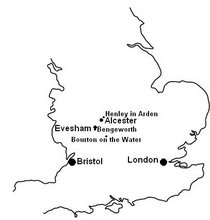
It is with emotions best known to those who have experienced the reciprocation of a David's and a Jonathan's affection, that the writer, after an uninterrupted friendship of thirty-five years, presents a sketch of the life of the late Mr Coles, who, for nearly forty years, honourably filled the pastoral office over the Baptist church at Bourton-on-the-Water.
Thomas was the youngest son of William and Mary Coles, both pious persons, who resided at the time of his birth, which took place August 31, 1779, at Rowell, in the parish of Hawling, near Winchcombe, Gloucestershire. Before he had entered his second year, death deprived the family of its paternal head, which painful providence occasioned the removal of his widowed mother, with her children, to Bourton, in the spring of 1783. His early years were spent at different schools in the village, where he made considerable progress, but what most distinguished those years were the indications he gave of youthful piety. His mind, it appears, was frequently under serious impressions, and its bent and inclination directed to religion. From occasional entries in his pocket-book, we find that in the beginning of the year 1790, when under the age of eleven, he began to take somewhat extended notes of the sermons delivered by his universally revered and much beloved minister, the Rev Benjamin Beddome. This practice he continued for five years, and the last sermon thus taken down was the last the venerable pastor preached; August 23, 1795, from Hosea v. 6.
For three years prior to the death of Mr Beddome, this young disciple was accustomed to read at the weekly prayer-meetings, with much profit to those who attended, the fragments he had gathered from the rich stores of spiritual knowledge, which on the Sabbath had been publicly imparted. Nor was there anything forward, or assuming, in this. Those who knew him best, in after life, can readily conceive that he was actuated by the purest motives, and much encouraged in the undertaking by the desire of the friends, who were gratified by the correctness of his notes, and pleased to foster such hopeful appearances in one so young. On the 2nd of August, 1795, one month before the translation of the aged Elijah to his eternal reward, this youthful Elisha, on whom the mantle was wisely ordained by providence at a subsequent period to fall, gave in his experience to the Christian church.
Many pleasing extracts from the statement he delivered at that interesting period of his life, might be made did our limits admit. "Jane way's Token for Children," given him when a child, appears to have been very useful in producing a sense of his condition as a sinner; whilst he mentions "Erskine's Gospel Sonnets," and "Doddridge's Rise and Progress," as affording greater light in the discovery of his helplessness, and in leading him to embrace the only Way of salvation.
The following memorandum in the church book, written by Mr Beddome, and pinned to the final page of his entries in that book, where it has continued to the present time, will be read with interest, especially when we consider it was the last, and that in a few days afterwards the pastor was no more on earth.
"August 2, 1795. - Master Thomas Coles gave in his experience to the church, and was universally approved; on the 9th, at his own and the church's request, Mr Francis baptized him, with several others, at Shortwood, and he partook of the Lord's Supper there in the afternoon. His reception into the church at Bourton was recognized, and the right hand of fellowship given him on the 16th."
Coles was evidently a youth of much promise, the "love of Christ was shed abroad in his heart," and he felt its predominating influence. There appears to have been from his earliest years an expectation of entering the ministry, probably both on his own part and that of his friends. Whether he accustomed himself to any particular course of study at this time, beyond the continuation of his classical studies, under the late Rev Wm Wilkins, who kindly assisted him after his connexion with Mr Collett's school, and the diligent reading of religious works, in prospect of the ministry, it is not easy to ascertain. That he possessed an eager thirst for knowledge is apparent, from his manuscripts of early prose and verse composition, together with two or three common-place books, containing extracts from a considerable range of authors, chiefly religious, schemes of sermons, synopses, chronological notes, etc, etc, written in this year.
Many of his Christian friends had, it appears, often requested him to exercise his talents among them as a preacher, previously to his going to Bristol Academy; on one occasion only he complied; which he states was opposite to his inclination, feeling conscious of his youthfulness and inexperience.
Following the leadings of divine providence, and the advice of judicious friends, he entered the Academy on the 24th of August, 1795. This was a new era in his life. His diligence was great, and he highly prized the advantages which were afforded him. Dr Ryland was president, the Rev Joseph Hughes tutor; and such was the respect and affection they entertained for him, that they soon commenced a friendship with him on equal and intimate terms, which continued until death removed these valuable men. His first sermon was preached at Fishponds, Nov. 8, 1795, from Luke xv. 2.
The following extract from his journal, written at the close of this year, shows us, that his diversified studies and new associates had not weakened his regard to personal religion, or diverted his mind from the important object he had in view.
"I have this year added to my sins, and have had great additions to my mercies. Oh, were I sufficiently humbled for the one, and thankful for the other! I have made a profession of religion. Lord, enable me to 'walk as becometh the gospel of Christ,' with all well-pleasing. I have entered upon the work of the ministry; the Lord assist me in that great and arduous work."
In the summer vacation of 1796, Mr. Coles visited his mother and friends at Bourton, where he preached three times, and received from the ohurch its sanction to proclaim the glad tidings of salvation wherever providence might call him. Other places, in the neighbourhood and at a distance, were supplied by him.
The following year, an opportunity being afforded him of completing; his studies at Marischal College, Aberdeen, on Dr Ward's exhibition, he, with the advice of his tutors, and the approbation of the Committee, finally left Bristol the next recess.
Several months elapsed, previous to his departure for Scotland, which were profitably and usefully spent, part of the time at Battersea, with his attached friend, Mr Hughes, at whose ordination he was present on the 19th of June, and the remaining part at Bourton. His fervency and zeal in the extension of. the Redeemer's kingdom evidently burst forth during his stay at the latter place: hence, in a letter to a fellow-student, he says, "Think not, my friend, that 1 have at all forgotten or given up the idea of Tillage preaching in this neighbourhood. I came to Bourton, I think I may say, full of religion and the warmest desires for the spread of Christ's interests and kingdom; and I hope 1 have inflamed the hearts of many here. ... Affairs as to the church are, I trust, on the mending hand; but, oh, what a revival is there among the younger part! so many young men so frequently assembling in prayer and experience meetings, oh, it would do your soul good to see! and most of these brought within these two or three years past to the knowledge of the truth; some, more recently than this, who before were bigoted and openly reprobate. Blessed be my dear Saviour! among other instruments I hope he has used me. I mention these things to you, because I well know how you rejoice at any glad tidings of our Immanuel's kingdom.'
The period drawing near for the commencement of the session at Aberdeen, our friend preached his farewell sermon at Bourton, Sept. 24,1797, from Exodus xxxiii. 15; words truly descriptive of the feelings of his mind on leaving his beloved family and endeared Christian friends. He reached Aberdeen on the 20th of October, and immediately entered his new sphere of action and duty. Here he evidently experienced difficulties in carrying out the warmest wishes of his heart. This is apparent, from the following extract taken from his diary: "My situation at Aberdeen is in many respects a perilous one. Lord, preserve me. Oh, may I not become languid and cold. Keep my heart warm in thy cause; may I continually pray for the prosperity of religion throughout all the earth. May I be devising schemes for thy glory. Lord, teach me; and, if I can, may I be permitted to speak a word for my Saviour. 'His name is like ointment poured forth.'
The writer would not be doing justice to the memory of his friend were he not to notice the singleness of purpose Mr Coles maintained with reference to ministerial preparation, in the midst of the great variety of studies in a Scotch university; and the readiness he always showed, although much attached to his college pursuits, and anxious to continue them, even after he had graduated, to subordinate everything to his zeal for practical usefulness.
One of the plans he felt anxious to prosecute, was the spiritual instruction of the children whom he found grossly ignorant of divine things. In this " labour of love" he was much assisted by the late Mr Hey, of Bristol, who was then on a visit to Aberdeen. Arrangements were made for a public meeting of parents and children on the 31st of December, to whom an affectionate and judicious address was given, and the children who had arrived at the age of eight, invited to attend every sabbath evening, for the sole purpose of religious instruction. The children were to read, or repeat from memory, portions of scripture appointed the week before; questions followed tending to impress the mind as to the meaning of these portions: then, the shorter Catechism with proofs, a concise address, and the whole concluded with praise and prayer.
Another extract from his diary, written at this time, will show the fervour with which he entered on this arduous but successful undertaking: "Went with Mr. Hey to the Sunday school; opened it comfortably; many attended. God will bless it. Lord, give me ability for the great work; make me an instrument in converting some poor souls to thyself, and to thee shall be all the praise."
The benefits resulting were great, and clearly show that the great Head of the church took delight in the labours of his servant. In a letter to his mother he thus writes "Our sabbath evening schools flourish exceedingly, and increase in number. I trust they have been blessed to the real conversion of several children, as well as to the outward reformation of all. Last night I had I believe the sixth child, who came to me to converse about the great concerns of his soul, under deep anxiety of mind, saying, ' What must I do to be saved?'"
It must have been peculiarly delightful to the subject of tins memoir, on his visit to Scotland in 1821, on behalf of the Baptist Mission, to find the schools he had established when at college in a prosperous condition, and to hear of several instances of spiritual benefit arising from them of which he had not been previously acquainted.
Some of these children, subsequently, filled useful and important stations m society; one, at least, became a minister, and still lives to unfurl the banners of the cross in this country. etc, etc.