Showing posts with label William Palmer. Show all posts

23/02/2021

Deacon William Palmer 03

We have mentioned deacon William Palmer (1727-1807) previously. It is clear from this link here that he was a draper. What has also not been made clear is that Palmer was married to Mary Boswell (1729-1810) and so was brother-in-law to Beddome's wife, Elizabeth. A third sister, Hannah Palmer (c 1735-1765) was married to William's brother, Thomas Palmer (c 1715-1769) a draper based in Buckinghamshire and the owner of Stayesmore Manor in Carlton near Olney. (William moved from Olney in 1745.) Hannah Palmer unexpectedly died under 12 months after marrying Thomas. John Newton (1725-1807) mentions it in a diary entry for Thursday, October 17, 1765. Newton notes not only that the death was sudden but also remarks on the fact that a messenger was present in the house who had come the day before to say that Thomas Palmer's brother-in-law, John Andrews, the husband of Thomas's (and William's) sister Mary (b 1733) had died in Lutterworth. John and Mary had married in Olney in 1757. In Snooke's diary for 1769 he notes the death of Thomas Palmer in Olney. Newton later reveals that the death of the man in Lutterworth was, disturbingly, suicide by drowning.

20/09/2011

Letter to the Association 1789

This is the letter to the association written by Beddome and his church officers in 1789

To the Ministers and Messengers of the several Baptist Churches designing
to meet in Association at Evesham on the Tuesday and Wednesday maj
The Church of Christ meeting at Burton on the Water holding the Doctrines
usually specified in your annual Letter wisheth Grace Mercy and Peace from
God the Father and our Lord Jesus Christ/
Dearly beloved Brethren
How swift the Revolutions of Time! How soon hath another Year
taken its Flight and left scarcely the shadow of a Trace behind!
Since your last annual Assembly We have gone through a Variety of Changes
with some light Afflictions and Experiences, Multitudes of Mercies met; but
alass how faint are the Impressions made, how soon how easily have they been
eras'd! Yet the same God who gave us Liberty to write then renews it now,
which we would regard as a wonderful Instance of his Patience, Longsuffering
Tenderness and Compassion, considering our neglect a??g provoking Carriage
towards him - We survive the Funeral of many of our Christian Friends,
other churches have lost their dear pastors and are yet unprovided, ours
is continued; and though aged and infirm, is not totally incapacitated and
laid aside: Other Churches have been convuls'd, and almost torn in pieces
by Divisions, Ours enjoys a considerable Measure of Peace; though that oneness
of Heart which is the great ornament of Christianity is too much wanting.
Our Number is neither diminished; nor increas'd; one being added by Baptism
and a very aged Member remov'd by Death - In a Word Luke warm as for
Barrenness, inward Darkness and that though the Children are are brought to
the Birth there is not strength to bring forth, have long bene and still are
the Subjects of our Complaint. Will you pray earnestly to God for us, and may
he hear for his Name's sake and for his Son's sake.
To draw to a Close - as we trust in this yearly Meeting you are
animated with a desire of promoting your own mutual Edification, the
Welfare of the associated Church, and the Glory of God We devoutly
wish you the divine Presence and Influence both in the publick Assembly and
your Private Conferences not being left to a jejeune and trifling Spirit, which
both often render'd such opportunities unpleasant and uninviting.
We sadly feel that a Spirit of error is creeping into some of the Churches,
and that where the Doctrines of the Gospel are not totally rejected
their Importance is not properly attended to: a Word therefore concerning
this in your circular Letter may perhaps be a Word in Season,
And now may the eternal Spirit of God, the Spirit of Life, Love, Peace and
Holiness preside in your Councils, and rule in your Hearts; preserving you
both from carnal contentions and frothy conversation; so that the messengers
of the Churches may be the Glory of Christ, thus pray
Your Brothers in Gospel Bonds
Signed at our Church Meeting May 31st 1789

Benjamin Beddome
James Ashwin
Edward Reynolds
Thomas Cresser
Wm Palmer
Rich Dolby
Joshua Perry
Wm Collett
Samuel Fox

Not knowing whether our Pastor oppress'd as
he is with Infirmities will be able to give
You his Company we have appointed our beloved
Deacon James Ashwin and Wm Palmer
our Messengers on this Occasion.

[The association was in Evesham and apparently Beddome did go. It was to be his last. He preached on Philippians 4:3].

28/06/2011

Hymn Singing in Bourton

As far as we know, in Beddome's day hymn singing was unaccompanied and would have used Beddome's own hymns plus available books. Lining out would have been the norm, led first by Jasper Bailey (c 1740-1782) and later by William Palmer (1726-1807), with William Snooke (1730-1799) standing in on occasion. The hymn book compiled by Ash and Evans appeared in 1769 and Rippon's selection in 1787. Before that the book in general use was Isaac Watts psalm versions, first published in 1719.

In Wikipedia the entry on "lining out" says:
The practice of lined-out psalmody was first documented in England by the Westminster Assembly, which prescribed it in 1644, though only for those congregations with an insufficient number of literate members or printed psalters. It became however the norm in English Dissenting churches of all levels, and American ones as well, even after psalters and then hymn books became more readily available.
Lining out became prevalent in the seventeenth century both in Great Britain and America, gradually developing a distinctive style characterised by a slow, drawn-out heterophonic and often profusely ornamented melody, while a clerk or precentor (song leader) chanted the text line by line before it was sung by the congregation. Though attacked by musical reformers as uncouth, it has survived to the present among some communities and contexts, including the Gaelic psalmody on Lewis, the Old Regular Baptists of the southern Appalachians (USA) and for informal worship in many African American congregations.
The tide turned against lining out in England and New England in the first quarter of the eighteenth century, with greater literacy, improved availability of texts such as New Version of the Psalms of David (1696) by Nahum Tate and Nicholas Brady, and more widely available and better-printed tune collections. Influential clerics in England and America disliked the ragged nature of the singing that resulted as the congregation struggled to remember both the tune and the words from the lining out.
Lining out was in most places replaced by "regular singing," in which either the congregation knew a small number of tunes like Old Hundredth that could be fitted to many different texts in standard metres such as Common Metre, or a tunebook was used along with a word book. There began to be "singing societies" of young men who met one evening a week to rehearse. As time went on, a section of the church was allocated for these trained voices to sit together as a choir, and churches voted to end the lining out system.
Lining out persisted much longer in some churches in the American South, either through theological conservatism or through the recurrence of the conditions of lack of books and literacy, and in some places is still practiced today. In African American churches this practice became known as "Dr Watts Hymn Singing," a historical irony given Watts' disapproval of the practice.

20/06/2011

Deacon William Palmer 02

An obituary for Palmer was placed in the Evangelical Magazine Volume 16, (see page 168). It tells us little about his circumstances except that he came to Bourton from Olney in 1744.
(NB In the official History of the County of Gloucester Volume 6 (1965), pp. 33-49 on Parishes: Bourton-on-the-Water it says that a Thomas Collett was succeeded, in or before 1759, by his son William at Nethercote and in 1765 he sold it to William Palmer. Palmer's son Samuel went bankrupt soon after his father's death. In the late nineteenth century part of the estate and the former manor-house belonged to William Snooke Stenson, who also owned Bourton manor. His son sold the Nethercote estate to Mr E H Cook, the owner in 1962.)
MR WILLIAM PALMER (1714-1807)
On Friday, August 8, 1807, died at Bourton on the Water, Gloucestershire, Mr William Palmer, aged 81. He was born at Olney, of religious parents, whose affectionate instructions were early blessed to him. When about 30 years of age (c 1744), he removed to Bourton, where he enjoyed the able ministry of the late Rev Benjamin Beddome for nearly 40 years. Owing to a great variety of mental conflicts, it was long before he ventured to make a public profession, which at length, however, he did, and was afterwards chosen a deacon of the church; the duties of which office he performed in a conscientious and diligent manner for upwards of 20 years. He uniformly consulted the best interests of Zion, and ardently sought the welfare of the Christian society to which he belonged. Every appearance of seriousness among his young connections gave him unfeigned pleasure and he cherished early piety to the utmost of his power. He had a strong affection to social exercises of prayer and Christian communion; well knowing that such meetings are, generally speaking, an index of the spiritual state of a church he was often called upon to lead the devotions of his brethren on those occasions, which he did with deep humility and spiritual ardour, much to their satisfaction and advantage.
Till within a year or two of his death, he was scarcely confined from the house of God a single Sabbath, during the space of 50 years. His heart devised liberal things, and he was ever ready to devote his property towards the private and public support of the cause of Christ. He had made it a point from his youth, on no ocsasion to be without a Bible in his pocket. This he mentioned on his deathbed, stating, that he had found it highly beneficial to him, especially in his journies and strongly recommending it to others. His intimate acquaintance with the Scriptures and his close walk with God rendered his conversations very spiritual and edifying. Firmly established in the truth, he felt a holy indignation at all those sentiments which were derogatory to the infinite dignity of his Lord; yet this was connected with tender compassion towards those who had unhappily imbibed them, and with great candour towards all his brethren who differed from him in lesser matters. In the glorious doctrines of the gospel he had a permanent source of sacred delight, which did not altogether fail in his worst seasons of temptation and distress; at the same time, his soul abhorred the thought of their being abused to lull professing Christians into supineness, or to serve the cause of licentiousness. Maintaining a very deep impression of personal guilt and depravity, of extreme unworthiness and innumerable imperfections, it was his supreme desire habitually to make use, by faith, of the atonement and intercession of his adorable Lord; and he often groaned in spirit that the exercise of his faith was so weak, so that consequently his spiritual enjoyments were so variable: nevertheless, amidst all changes of frame, he was enabled to rejoice in the unchangeablencss of a covenant God. In an exclusive reliance on the blood and righteousness of Christ, he lived and died; often mentioning, with joy and admiration, the glorious name given both to Christ and his Church - "The Lord our Righteousness"; Jer xxiii. 6; and also Prov. ix. 1-6 and Ps. lxviii. 18. These passages, with many others, very frequently formed the interesting subjects of his delightful contemplation and Christian converse. With the gradual decay of nature, he had all the supports and consolations which are to be desired; and, according to his frequent wish, he left to his family and friends strong testimonies of the fidelity and kindness of his Saviour, in upholding him to the end.

Deacon William Palmer 01

In Brooks' Pictures of the Past he says at one point
 
During the period now under review, the church had been deprived of two valuable deacons - Mr Boswell [Beddome's father-in-law] and Mr Joseph Strange, and on the sixth of April, 1781, four other brethren were called to that office, viz: William Palmer, James Ashwin, Thomas Cresser, and Edward Reynolds [there had been previous deacons by the name of Cresser and Reynolds].

Later he says

In this year, August 28, [1807] the Church was deprived by death of Mr William Palmer. He had been 26 years a deacon of the Church (since 1781), and so used the office as to purchase to himself a "good degree." His pastor says, "he was a steady friend to the spiritual interests of Zion, and long had the chief management of its temporal concerns, which he was ever solicitous to transact with diligence and fidelity." He had witnessed many, and painful changes. He had been in the vessel of the Church during a most tempestuous and trying period. The wind (like the Euroclydon) seemed to blow from all quarters. They were "exceedingly tossed with a tempest." It was a dark and dreary time; and all through that season William Palmer was at the helm. There were some who did not fail to attribute all their disasters to his want of skill. Painful position! But he lived through it. He had "faith in God" He believed that (not Caesar but) Christ was on board Eight glad was he to perceive the return of fair weather. He knew how to prize the blessing of peace. Shortly before his death, he recorded his sentiments and wishes, intermingling a few weighty counsels to his brethren. The veritable paper is preserved in the Church Book. Having spoken of himself, he says :
 
"As to the cause of God and of Christ, it is in safe hands. He will take care of it as his own. As to my dear and honoured Pastor, Mr Coles, I wish him all possible success in his ministry, in the building up the Church here, and in the conversion of sinners at home and abroad, and to live in love with his people, and they with him. As to the Church at large, I wish them love, unity, and peace, that they may strive together for the faith of the gospel, and for peace with one another. Especially to love, serve, and fear to grieve one another, as also their dear minister, who, in love labours for their souls' good and prosperity. As to the deacons of the Church, that they may join heart and hand, in filling up their place more to the glory of God than I have done— where I have erred, may they take warning, and learn wisdom, and abundantly excel unworthy me. When new officers are chosen, may they be such as are humble, tender hearted, full of faith and of the Holy Ghost. That this Church may be increased, and peace rest on and with this part of God's Israel. 'See that ye fall not out by the way.' Strive, my dear friends, to live in love and peace. And may the Lord help you to speak often one to another. Keep up prayer-meetings; don't cover sin in any one, neither 'make a man an offender for a word.' Let your light so shine before men, that your heavenly Father may be glorified. The eye of God is upon you; the eye of Satan and of the world is upon you - be watchful. Farewell.
Your friend and well-wisher,
William Palmer.
Thus died this good and honoured man, in the eighty-second year of his age."

21/05/2011

Calendar of Letters 03

Letter 41
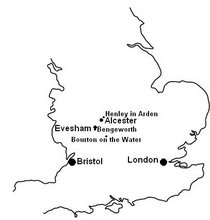
On (Sunday) May 31, 1789, the church at Bourton-on-the-Water wrote to the Association meeting at Evesham.
It begins with "Greetings". It says that the Bourton Church "enjoys a measure of peace ... though Oneness of Heart is too much wanting." It complains that "the Spirit of Error is creeping into some of the churches, and that where the great doctrines of the Gospel are not totally rejected their importance is not properly attended to" and asks the Association to face this in their Circular·Letter.
The letter is signed by Beddome (who was ill), with James Ashwin, Edward Reynolds, Thomas Cressor, William Palmer, Richard Dalby, Joshua Parry, William Collett and Samuel Fox.