Showing posts with label Hymns. Show all posts

02/06/2025

Hymns for the sacraments

Mr Pickles points out, interestingly, that whereas Beddome's hymn book contains 38 hymns on baptism, there are only four on the Lord's Supper. I wonder if that is because of the way the hymns were prepared - as accompaniments to the sermon. Baptisms would part of the service ending with an appropriate hymn. When the Lord's Supper was celebrated once a month it usually took place after the main service and normally included no singing. (This is a guess).

27/06/2019

Six hymns not in the collection


These six hymns appeared in The Baptist Annual Registry in 1801 and do not appear to have made it into the final collection

ORIGINAL POETRY

HYMNS BY MR BEDDOME

Exodus iii. 4.—And when the Lord saw, etc.
WITH true devotion come,
And stand before the Lord;
With earnestness invoke his aid,
With rev'rence hear his word.

2 Look well unto your feet,
Lest you should step aside:
Take heed of indolence and sloth,
Hypocrisy and pride.

3 Of wand'ring eyes and thoughts,
Of idle words beware:
Watch every motion of the heart,
And keep your lips with care.

4. Where God his presence grants,
No evil should be found;
Sin should be banish’d far from thence,
For 'tis his holy ground.

ON THE SAME
BEHOLD the burning bush,
A glorious type of Christ;
Who his own soul an off'ring made,
And was himself the priest.

2 The bush tho' all on fire,
Yet unconsum’d remains;
Thus he endur'd God's fiercest wrath,
And death's acutest pains.

3 Yet from the dreary grave,
Did Christ the conq'ror rise;
And he, who suffered here below,
Now reigns above the skies.

Exodus x. 16, 17.— Then Pharaoh called for Moses and Aaron in haste, etc.
PHARAOH, and Saul and others have
Confest how vile they've been;
And yet their hearts were unrenew'd,
And lust bare rule within.

2 They promis'd fair, but soon forgot
The promises they made:
And when thy rod was once remov’d,
They ceas'd to be afraid.

3 Almighty God, thy piercing eye
My inmost thoughts surveys;
Purge from hypocrisy and guile
My heart and all my ways.

ON THE SAME
WITH warm affections let us come
Before the Lord our God;
Tremble beneath his threaten’d wrath,
And his uplifted rod:

2 Sue for the pardon of our sins,
So many and so great;
And seek the tokens of his love
Before it is too late.

3 With bitter eyes and flowing tears,
Let us his grace implore,
And when that grace is once obtained,
Let us offend no more.

Exodus xxviii. 36.- Holiness to the Lord.
INSCRIB'D upon my heart,
And ev'ry thing I do,
Let holiness unto the Lord
Appear in open view.

2 This Aaron's motto was;
O be it also mine;
Whilst justice, truth, and piety
In my whole conduct shine.

3 Thus placing all my hope
On Jesu's pard'ning blood
With courage, strength, and steadiness
I'll tread the heavenly road.

ON PEACE
AH more benign than morning's azure sky,
Late from the wrath of midnight tempers freed,
Than tear drops streaming from compassion's eye,
When at her feet the sons of fortitude bleed.

Yes, more benign, more sweet, the bated breath, -
Diffusive wafted from Britannia's Isle
That calls her children from the sickle death,
To her own vales, that cloth'd with pleasure smile.

'Twas he that bids the rage of battle cease:
In her deep wound the healing pour'd;
And with the breath of everlasting peace
Hush'd the wild waves of discord as they roar’d.

14/07/2014

1771

We have some knowledge of Beddome's preaching and the hymns sung in 1771 from a notebook in the Angus library.

Fe 17     1 Cor 6.13c To Thee tho' rightful Lord of all
24          Gen 7.23b When in the waters of ye flood
Mr 10    1 Chr 29:14b Great God whate'er we give to Thee
31          Ps 119.19 All earthly glory fades
Ap 7      Gen 49.19 Our help is in the Lord
Ma 19   Ps 6.2,3 Go wicked man boast of thy wealth
Jl 7       1 Sam 15.32 The midnight shadows are withdrawn
14         Eze 20.41 part Jehovah from his mercy seat
21         1 Thess 5.24 Great God, Thy love and truth conjoin'd
Au 11   Matt 5.48 How perfect Lord art Thou
18         Philemon 17 Engaged in the same common cause
Sp 1      Prov 19.3b Why should I murmur or repine*
15         2 Kings 4.26 a And now my soul what sayest thou
No 24   Isa 37:4c In humble prayer I always find
De 15   1 Jn 5.1a Amidst the floods of deep distress

*This appears to be the only hymn in the hymn book. It is 238.

29 1 Jn 5.18a Oh, what a hateful thing

12/07/2014

Rippon's Selection

These are the hymns by Beddome in Rippon's Selection. There appear to be more than other sources suggest.
  1. Wait, O my soul, thy Maker's will 11
  2. Great God my Maker and my King 18
  3. Great God of providence! 35
  4. Astonished and distressed 40
  5. What is the world? A wildering maze 43
  6. God in the gospel of his Son 54
  7. My rising soul with strong desires 97
  8. Great God 'tis from thy sovereign grace 111
  9. When by the Tempter's Wiles Betrayed 122
  10. Ye worlds of light that roll so near 160
  11. Jesus, my love, my chief delight 171
  12. Come, Holy Spirit, come 211
  13. Faith! 'tis a precious grace 217
  14. Lord, incline my wandering heart 226
  15. Let party names no more 255
  16. O blest society 258
  17. Dear Lord, though bitter is the cup 264
  18. The Mighty God will not despise 273
  19. Why, O My Soul, Why Weepest Thou? 274
  20. My times of sorrow and of joy 276
  21. If secret fraud should dwell 283
  22. If God is mine, then present things 287
  23. Ye trembling souls, dismiss your fears 288
  24. If duty calls, and suffering too 293
  25. While carnal men with all their might 293
  26. Is there in heaven or earth who can 294
  27. Strait the Gate, the Way is Narrow 294
  28. The wandering star and fleeting wind 310
  29. Great god! oppressed wit guilt and fear 330
  30. Prayer Is the Breath of God in Man 353
  31. Unto thine altar, Lord 356
  32. How free and boundless is the grace 362
  33. Ye messengers of Christ 420
  34. Go forth ye saints, behold your king! 421
  35. Father of mercies bow thine ear 426
  36. Shout, for the blessed Jesus reigns! 429
  37. How great, how solemn is the work 453
  38. Jesus! When faith with fixed eyes 477
  39. So fair a face bedew'd with tears 484
  40. On Britain, long a favoured isle 530
  41. Death! 'tis an awful word 580
  42. To the eternal three (Doxology) 592

11/07/2014

1770

We have some fragmentary knowledge of Beddome's preaching and the hymns sung in 1770 from a notebook in the Angus library.
We know of eight sermons he preached in Bourton - on Job 36:7a (April 8), Gen 28:17 (June 17), Matt 23:37 (July 1), 1 Cor 12:6 (Sep 26), Joshua 3:3, 4 (Oct 13 a funeral sermon for a Mr Lowingdon) and then at the end of the year on 1 Thessalonians 5, including verses 16, 17 and 21 and perhaps others (Nov 4, 11 and Dec 23).
Hymns sung included That God who form'd Heav'n, Earth and seas; How sweetly awful is the place; Tho wrath alarm and love invites; In various ways, by various means; When Israel thro the wilderness (339) God's gracious Presence once withdrawn (190); The secret sob, the pensive sigh and  “Prove all things” thus doth God command. Of these only two (those with numbers marked in brackets) made it to the hymn book. Here's the one from the funeral.
 
When Israel through the wilderness
 had passed at God’s command,
 From Jordans banks, their wishful eyes,
 Beheld the promised land.

But still a river lay between,
 Whose waters overflowed;
 And through the deeps they needs must go,
 The only way allowed.

Death is the Jordan we must pass;
 Lord, this divides from thee!
 But if thine ark move on before,
 Safe will the passage be.

NB We also know that in his library he had, bund with other titles, a book called Practicall divinity: or A helpe to leade men more to looke within themselves, and to unite experienced Christia[n]s, in the bond and fellowship of the Spirit. : Delivered in sundry exercises lately spoken by Cap. Paul Hobson, upon these texts... The truth is one, and never rightly understood by any, till they be one with it ... Published by Ralph Harford (at the Bible in Queenes head alley in Pater-noster-row) this was a second edition corrected, and much enlarged. The publication Date was 1646.
Bound in blind tooled calf, the text block edges sprinkled red, Beddome's name is in the book. It says "Benja. Beddome perfectum ... Decer: 1770" (he finished it December 1770).

07/05/2012

List of hymns

A list of hymns by Beddome can be accessed at Hymnary.org here

Entry in Julian's Dictionary

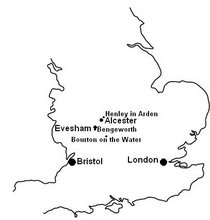
Beddome, Benjamin, MA. This prolific hymnwriter was born at Henley-in-Arden, Warwickshire, Jan 23, 1717, where his father, the Rev John Beddome, was at that time Baptist Minister. He was apprenticed to a surgeon in Bristol, but removing to London, he joined, in 1739, the Baptist church in Prescott St. At the call of this church he devoted himself to the work of the Christian ministry, and in 1740 began to preach at Bourton-on-the-Water, in Gloucestershire. Declining invitations to remove to London or elsewhere, he continued pastor at Bourton until his death, on Sep 3, 1795, at the age of 78. Mr Beddome was for many years one of the most respected Baptist ministers in the West of England. He was a man of some literary culture. In 1770 he received the degree of MA from Providence College, Rhode Island. He was the author of an Exposition of the Baptist Catechism, 1752, in great repute at the time, and reprinted by Dr C Evans in 1772. It was his practice to prepare a hymn every week to be sung after his Sunday morning sermon. Though not originally intended for publication, he allowed thirteen of these to appear in the Bristol Baptist Collection of Ash & Evans (1769), and thirty-six in Dr Rippon's Baptist Selection (1787), whence a number of them found their way into the General Baptist Hymn Book of 1793 and other collections. In 1817, a posthumous collection of his hymns was published, containing 830 pieces, with an introduction by the Rev Robert Hall, and entitled "Hymns adapted to Public Worship or Family Devotion, now first published from the Manuscripts of the late Rev B Beddome, MA."
Preface dated "Leicester, Nov. 10, 1817." Some of the early copies bear the same date on the title page. Copies bearing both the 1817 and 1818 dates are in the British Museum. The date usually given is 1818. Some hymns are also appended to his Sermons, seven volumes of which were published l805-1819; and over twenty are given in the Baptist Register of various dates.
Beddome's hymns were commended by Montgomery as embodying one central idea, "always important, often striking, and sometimes ingeniously brought out." Robert Hall's opinion is just, when in his "Recommendatory Preface" to the Hymns, etc, he says, p. vii.:—
"The man of taste will be gratified with the beauty and original turns of thought which many of them ex¬hibit, while the experimental Christian will often perceive the most secret movements of his soul strikingly delineated, and sentiments pourtrayed which will find their echo in every heart."
With the exception of a few composed for Baptisms and other special occasions, their present use in Great Britain is limited, but in America somewhat extensive. One of the best is the Ordination Hymn, "Father of Mercies, bow Thine ear." Another favourite is "My times of sorrow and of joy," composed, by a singular coincidence, to be sung on Sunday, Jan 14, 1778, the day on which his son died, most unexpectedly, in Edinburgh. "Let party names no more," is very popular both in Great Brit, and America. "Faith, His a precious gift," "Witness, ye men and angels, now," and the hymn for Holy Baptism, "Buried beneath the yielding wave," are also found in many collections. Beddome's popularity is, however, now mainly in America.

[Rev. W. R. Stevenson, M.A.]
In addition to about 40 of Beddome's hymns in common use which are annotated in this dictionary under their respective first lines, there are also the following 69, all of which are in use either in Great Britain or America, in the former to a limited extent and in the latter somewhat extensively. ...
Beddome is thus seen to be in common use to the extent of about 100 hymns. In this respect he exceeds every other Baptist hymnwriter; Miss Steele ranking second.

The authorities for Beddome's hymns are: (1) A Collection of Hymns adapted to Public Worship, Bristol, W. Pine, 1769, the Collection of Ash & Evans; (2) Dr Rippon's Selections 1787, and later editions; (3) Sermons printed from the Manuscripts of the late Rev Benjamin Beddome, MA, ... with brief Memoir of the Author, Dunstable & Lond, 1805-1819; (4) Dr. Rippon's Baptist Register, 1795, etc; (5) The Beddome Manuscripts, in the Baptist College, Bristol; (6) and Hymns adapted to Public Worship, or Family Devotion now first published, from Manuscripts of the late Rev B Beddome, AM With a Recommendatory Preface by the Rev R Hall, AM Lond, 1817. In his Preface, Mr Hall gives this account of the Beddome Manuscript:— "The present Editor was entrusted several years ago with the MSS, both in prose and verse, with permission from the late Messrs S & B Beddome, sons of the Author, to publish such parts of them as he might deem proper. He is also indebted to a descendant of the Rev W Christian, formerly pastor of the Baptist Church at Sheepshead, Leicestershire, for some of the Author's valuable hymns, which had been carefully preserved in the family. From both these sources, as well as others of less consequence, the present interesting volume has been derived."

01/03/2012

Beddome's hymns criticised

In The Hymn Lover William Garret Horder says
I cannot agree with the praise bestowed by James Montgomery and Robert Hall on the hymns of Benjamin Beddome, MA  (1717-1795), pastor of the Baptist Church at Bourton-on-the-Water, Gloucestershire. The former praises him for preserving the unity of each hymn. This he does, but there is a didactic tone, and an absence of the lyric element, which are fatal faults in a hymn. This is partly due to the fact that they were written to be sung after his sermons, to which they are a kind of application. This is not the true office of hymns. The mind of their writers should not be occupied with the thought of the edification of the people, but of praise to God. This is the defect of most of his hymns, as will be seen even in his most popular, "Did Christ o'er sinners weep?" "Faith, 'tis a precious grace," and "Let party names no more." The fault is least evident in his Ordination hymn, "Father of mercies, bow Thine ear." He was the author of the large number of eight hundred and thirty hymns.

Interesting anecdote

The London congregation of Rev Mr Wilson, who had been his pastor, and under whom he had united with the Church in 1739, desired to secure Mr Beddome as successor, but he declined to go. The church in Goodman's Fields had not only sent the call, but had deputed a gentleman to carry it, who went down to Bourton on horseback.
A poor parishioner of Mr Beddome, having been intrusted with the care of his horse, discovered the errand, and brought the animal to the door, saying to the London emissary, "Robbers of churches are the worst sort of robbers." He then turned the horse loose, to the discomfiture of its rider, "I would rather honour God," said Mr Beddome, "in a station even much inferior to that in which he has placed me, than intrude myself into a higher without his direction." He died, September 3, 1795, having laboured at Bourton for 52 years. (Not sure how authentic the anecdote is. It is in S W Duffield's 2003 work English hymns: their authors and history and probably relies on Charles Seymour Robinson in 1893).

28/06/2011

Hymn Singing in Bourton

As far as we know, in Beddome's day hymn singing was unaccompanied and would have used Beddome's own hymns plus available books. Lining out would have been the norm, led first by Jasper Bailey (c 1740-1782) and later by William Palmer (1726-1807), with William Snooke (1730-1799) standing in on occasion. The hymn book compiled by Ash and Evans appeared in 1769 and Rippon's selection in 1787. Before that the book in general use was Isaac Watts psalm versions, first published in 1719.

In Wikipedia the entry on "lining out" says:
The practice of lined-out psalmody was first documented in England by the Westminster Assembly, which prescribed it in 1644, though only for those congregations with an insufficient number of literate members or printed psalters. It became however the norm in English Dissenting churches of all levels, and American ones as well, even after psalters and then hymn books became more readily available.
Lining out became prevalent in the seventeenth century both in Great Britain and America, gradually developing a distinctive style characterised by a slow, drawn-out heterophonic and often profusely ornamented melody, while a clerk or precentor (song leader) chanted the text line by line before it was sung by the congregation. Though attacked by musical reformers as uncouth, it has survived to the present among some communities and contexts, including the Gaelic psalmody on Lewis, the Old Regular Baptists of the southern Appalachians (USA) and for informal worship in many African American congregations.
The tide turned against lining out in England and New England in the first quarter of the eighteenth century, with greater literacy, improved availability of texts such as New Version of the Psalms of David (1696) by Nahum Tate and Nicholas Brady, and more widely available and better-printed tune collections. Influential clerics in England and America disliked the ragged nature of the singing that resulted as the congregation struggled to remember both the tune and the words from the lining out.
Lining out was in most places replaced by "regular singing," in which either the congregation knew a small number of tunes like Old Hundredth that could be fitted to many different texts in standard metres such as Common Metre, or a tunebook was used along with a word book. There began to be "singing societies" of young men who met one evening a week to rehearse. As time went on, a section of the church was allocated for these trained voices to sit together as a choir, and churches voted to end the lining out system.
Lining out persisted much longer in some churches in the American South, either through theological conservatism or through the recurrence of the conditions of lack of books and literacy, and in some places is still practiced today. In African American churches this practice became known as "Dr Watts Hymn Singing," a historical irony given Watts' disapproval of the practice.

18/06/2011

Beddome's verse improved

I am enjoying the book on Rippon by Ken R Manly Redeeming love proclaim (Volume 12 in the SBHT series). On page 94 he points out how in his Selection Rippon improves a hymn by Beddome by the simple expedient of lengthening some of the lines. The hymn appears in the Beddome collection with a 7s metre. It is 206. Rippon turns it into a long metre hymn (264).

206 (Beddome)

LORD, though bitter is the cup,
Thy kind hand deals out to me,
Cheerful I would drink it up,
Nought can hurt which comes from thee.

2 Dash it with unchanging love,
Let no drops of wrath be there;
Saints now ever blessed above,
Oft were most afflicted here.

3 From thy blessed incarnate Son,
True obedience I would learn;
When thy will on earth is done,
I shall then no longer mourn.

264 (Rippon)
DEAR Lord! though bitter is the cup
Thy gracious hand deals out to me,
I cheerfully would drink it up;
That cannot hurt which comes from thee.

2 Dash it with thy unchanging love,
Let not a drop of wrath be there!—
The saints, for ever bless'd above,
Were often most afflicted here.

3 From Jesus, thy incarnate Son,
I'll learn obedience to thy will;
And humbly kiss the chastening rod,
When its severest strokes I feel.

31/05/2011

Beddome Hymntime

These are the hymns by Beddome lsited on Hymntime here

  1. All Glo­ry Be to Him Who Came
  2. Almighty God, We Cry to Thee
  3. And Shall I Sit Alone?
  4. Arise, Thou Bright and Morn­ing Star
  5. Ascend Thy Throne, Al­mighty King
  6. Awake, Awake, My Heart and Tongue
  7. Awake, Awake, Thou Mighty Arm
  8. Behold the Day Is Gone
  9. Behold the Eunuch, When Baptized
  10. Burdened with Guilt and Pale with Fear
  11. Buried Beneath the Yielding Wave
  12. Can Sin­ners Hope for Hea­ven?
  13. Come Ho­ly Spir­it, Come
  14. Come, Je­sus, Hea­ven­ly Teach­er, Come
  15. Come, Thou Eter­nal Spir­it, Come
  16. Come, Ye Humble, Contrite Souls
  17. Death, ’Tis an Aw­ful Word
  18. Did Christ o’er Sin­ners Weep?
  19. Dost Thou My Profit Seek?
  20. Each Other We Have Owned
  21. Eternal Source of Ev­ery Good
  22. Faith, ’Tis a Pre­cious Gift
  23. Father of Mer­cies, Bend Thine Ear
  24. Fountain of Bless­ing, Ev­er Blest
  25. From Thy Dear Pierced Side
  26. Go Forth, Ye Saints, Be­hold Your King
  27. God, in the Gos­pel of His Son
  28. Great God, ’Tis from Thy Sov­er­eign Grace
  29. Great God, to Thee I’ll Make
  30. Great God of Providence, Thy Ways
  31. Great God, My Mak­er and My King
  32. How Free and Boundless Is the Grace
  33. How Great, How Sol­emn is the Work
  34. How Great the Wis­dom
  35. How Ma­ny Doubts and Fears Prevail
  36. If Sec­ret Fraud Should Dwell
  37. In All My Ways, O God
  38. In Duties and in Suf­fer­ings, Too
  39. Jesus, De­lightful, Charming Name
  40. Jesus, My Love, My Chief De­light
  41. Jesus, My Sav­ior, Bind Me Fast
  42. Jesus, My Sav­ior, Let Me Be
  43. Jesus, When Faith with Fixed Eyes
  44. Let Party Names No More
  45. Lord, Incline My Wandering Heart
  46. Lord, Though Bitter Is the Cup
  47. Lord, with a Grieved and Ach­ing Heart
  48. Love Is the Fountain Whence
  49. Mighty God Will Not Despise, The
  50. My Few Revolving Years
  51. My Rising Soul with Strong De­sires
  52. My Times of Sor­row and of Joy
  53. O Blest Society
  54. O Lord, Thou Art My Lord
  55. O Lord, Thy Per­fect Word
  56. On Britain, Long a Favored Isle
  57. On Wings of Love the Christ­ian Flies
  58. Pray­er Is the Breath of God in Man
  59. Shout, for the Blessed Je­sus Reigns
  60. So Fair a Face Bedewed with Tears
  61. Sprinkled with the Reconciling Blood
  62. Straight the Gate, the Way is Narrow
  63. There Is a World of Per­fect Bliss
  64. This World’s a Dreary Wilderness
  65. Wait, O My Soul, Thy Mak­er’s Will
  66. Wandering Star, the Fleeting Wind, The
  67. When Adam Sinned, Through All His Race
  68. When by the Tempter’s Wiles Betrayed
  69. When Is­ra­el Through the Desert Passed
  70. When Storms Hang o’er the Christ­ian’s Head
  71. Where’er the Blustering North Wind Blows
  72. Why, O My Soul, Why Weepest Thou?
  73. Witness, Ye Men and An­gels, Now
  74. Ye Trembling Souls, Dis­miss Your Fears
  75. Ye Worlds of Light That Roll So Near
  76. Your Work, Ye Saints, Is Not Comprised

29/07/2010

Preface to the hymns

This is the preface to the hymn book of 1818. We have produced Hall's preface before but not the preface by the editor.

THE venerable Author of the following Hymns did not compose them with the view of their being published. During a long-continued and highly useful ministry, he was in the habit of preparing a few verses suited to the subject of his pulpit discourses, and which were sung in his own congregation, more or less frequently, at the close of the public services. Many of these compositions were afterwards given away in manuscript; others were taken down by some of the hearers at the time of delivery, and disposed of in a similar way; so that in process of time, several hundreds of them were in private circulation among the friends of the Author, and some few found their way into the periodical publications of the day.
Some years previous to his death, Mr Beddome collected and arranged a large proportion of these poetical effusions, and inserted them in a closely written MS for the use of his own family after his decease, as also several volumes of Sermons, but still without any design of their being printed. At the request of some of his friends, he permitted several of his Hymns to appear in a general Collection, intended chiefly for the use of his own denomination; and some years after his decease, several others were mserted in the same performance, without any due acknowledgement.
The present Editor was entrusted several years ago with the MSS, both in prose and verse, with, permission from the late Messrs S and B Beddome, Sons of the Author, to publish such parts of them as he might deem proper. He is also indebted to a descendant of the Rev W Christian, formerly pastor of the Baptist church at Sheepshead, Leicestershire, for some of the Author's valuable hymns, which had been carefully preserved in that family. From both these sources, as well as others of less consequence, the present interesting volume has been derived.
It will readily be perceived, that so large a quantity of original matter, not having been intended for publication, nor having had the benefit of- revision from its ingenious and learned Author, must appear under great disadvantages, such as to claim no ordinary degree of indulgence from the critical and candid Reader. The Editor has endeavoured to distribute the whole mass of materials into a form best adapted to modern use, and to the existing circumstances of the christian church, especially that section of it to which Mr Beddome belonged, and of which he was one of the brighest ornaments.
A variety of Hymns on the properties of Scripture, scattered throughout the MSS, have been collected and arranged, under the title of 'Bible Societies,' though these pious and benevolent institutions had no existence till sometime after the Author's death. The same may be said of 'Missions,' and of other departments of the christian church, which at the present time are occupied with honour and usefulness. The Hymns on 'Baptism,' it is presumed, will be found a real acquisition to those for whose use they are more immediately intended, while the sincere and ardent piety which pervades them will be sufficient to secure the serious and candid attention of such as are differently minded.

12/07/2010

POTP 12

In Chapter 5 Brooks reviews Beddome's ministry and says

We know not to give flattering titles to men, but we are bound to say, that the individual whose life we have now traced to its close was no ordinary man. He was highly respected, and, on the whole, eminently useful. In the Midland Association his influence was great, and most usefully employed. He had the happiness of seeing several members of the church at Bourton enter the Christian ministry, and honourably discharge its onerous duties.

The Rev John Ryland, sen, AM, was settled at Warwick (in 1750).
The Rev Richard Haines at Bradford, Wilts (1750).
The Rev John Reynolds, AM, in Cripplegate, London (1766).
The Rev Nathanael Rawlings at Trowbridge (1766).
The Rev Richard Strange at or near Stratton, Wilts (1752)
and the Rev Alexander Payne (place and date uncertain).

Although Mr. Beddome was an indefatigable writer he published but little - his Catechism, in 1752, which he employed at Bourton among adults as well as children, and which was recommended by the Association to other churches, in 1754, and the Circular Letter of 1765, were the only things he thus gave the world. Nevertheless, his fame had passed beyond the Atlantic. So that, in 1770, the Senatus Academicus of Providence College (now Hope University), Rhode Island, conferred on him the title of AM, as a token of their esteem for his talent and learning.
Since he departed this life he has become more widely known through the publication of several volumes of sermons published from his manuscripts. These have been very highly prized both by episcopalian and nonconformist Christians. One volume had reached the sixth edition in the year 1824, and another the fifth in 1831, while in 1835 a much larger volume was published, containing 67 sermons. Admired for their evangelical sentiments and practical tendency, they are scarcely less pleasing in the simplicity and clearness of their style. And yet, we must not forget, that the author had not dreamed that they would be given to the public through the press. They were mere channels dug for his thoughts to flow in, skeletons to be clothed with flesh and receive the breath of life as spoken from the pulpit. In the pulpit he is said to have been emphatically at home. And in some sort he was always there, the pulpit was "in all his thoughts." The goal of one duty was the starting point of the next. We are told that he generally selected on the sabbath evening the topics for the discourses of the next.
We have before observed, that for many years he composed a hymn to be sung after each sermon. These, if collected, would fill several volumes. A selection was made from them, and published for the use of the Baptist denomination, in 1818. This volume contains 830 hymns, and is supplied with a valuable "Index of Scriptures," as well as a general index of subjects. These verses will be ever new, "And sung by numbers yet unborn, On many a coming sabbath morn;" for our ''New Selection" (as well as "Rippon's" and many others used by various denominations), is enriched by many a spiritual song having attached to it the name "Beddome." The hymn-book of which we have spoken was ushered into the world by a recommendatory preface by the late Rev. Robert Hall, ...
As a pastor Mr Beddome seems to have been no less excellent than as a preacher. He evidently felt that "Tis not a cause of small import, The pastor's care demands."*
In this capacity he evinced great assiduity, tender care, and faithful affection. And the church upheld him in the exercise of a scriptural discipline. Very instructive are the records touching this matter. Fifty years would witness many and various scenes and circumstances to wound the pastor's heart. But discipline was exercised with a beautiful combination of gentleness and firmness. Take the following specimen of suaviter in modo, fortiter in re (gentle in manner, firm in matter).

"March 8, 1761 Took notice of the conduct of our sister Hetty Reynolds, who has absented herself from the house of God for several months, and agreed to let her know, that unless she gave satisfactory reasons for her conduct this day month, we shall proceed against her as directed by the divine word."

Accordingly, Mr Beddome sent her the following letter

"March 8, 1761
Sister Reynolds - The Church over which I am pastor, have this day come to a resolution, that if you do not appear before them this day month, to give an account of your irregular conduct in absenting yourself for so many months from the house and table of the Lord, they shall then take your case into consideration, and proceed as they shall think most for the honour of religion. That you may be convinced of your sin in the neglect of God's worship, and breaches of his Sabbath, is the desire, and shall be the prayer of
You grieved pastor,
Benjamin Beddome."

"April 4, 1761 Sister Hetty Reynolds appeared and behaved with a great deal of confidence, and without the least appearance of remorse or sorrow. She pretended to have been offended and injured by some of the Church, and said that she had already, in part, and should conform to the Establishment. After talking very solemnly to her, with which she seemed not at all affected, she was desired to withdraw, and upon her return was told, that having wilfully absented herself for months together, from God's Word and ordinances, and discovering no repentance, but purposing to persist in the same course, she had, in effect, cut herself off from the society, and, therefore we no longer looked upon her as a member thereof - though we should continue to pray for, and whenever the Lord should graciously open her heart, and effectually convince her of her error, there was a door into the Church as well as out of it. Then Mr Beddome prayed for her, but neither one thing nor another seemed to impress her mind."

Take another instance, with, a somewhat better issue.

"Feb 3 1751 Brother John Adams, having absented himself from the Lord's-table, and also from public worship, for sometime past. It being also publicly known, that he had frequented ale-houses - mis-spent his time, and acted very imprudently in courting a young girl - the affair was brought before the Church, when our minister certified that he had sent to the said John Adams, and by other methods endeavoured to come to the speech of him, but in vain. It was, therefore, ordered that our brother Richard Edgerton do in the name of the Church accuse him of idleness, tippling, sabbath-breaking, and great imprudence in the management of his secular concerns; and tell him that next Lord's-day we shall proceed definitively against him, when his presence is required."

"Feb 10 1751 John Adams appeared, and the charges against him were renewed, to which he answered, that as for idleness, it was a thing that he abhorred, and had never before been accused of; but that he had been unable to work by reason of a rheumatic pain in his arms. As for tippling, he said that while unable to work, he had frequented the public houses more than formerly, but had sometimes had nothing there but a pint of small beer. (The first reference to the New Inn in Bourton, a coaching inn, goes back to 1714; the Porch House in Stow is also old and not far away). With respect to Sabbath breaking, he endeavoured to excuse his absence from public worship by alleging illness, a visit to see his friends round about Chedworth (10 miles away), etc. But it appearing that he was not at Chedworth meeting, when in that country, and that one Lord's-day, when he went up to Stowe, seemingly to attend the service there, he spent the time in an ale-house, instead of at the meeting; as also that he absented himself from Bourton-meeting another Sabbath, of which he could give little or no account, the Church apprehended his excuses to be insufficient. With respect to his imprudent courtship, he said he humbly apprehended, it was not a matter cognizable by the church. He being desired to retire, the Church considered his case.
"As to the first charge, they apprehended his excuse might be sufficient, as to the second they were doubtful, as to the third and fourth, they were of opinion that he deserved censure; but as he behaved modestly and submissively before the Church, and confessed with seeming concern, that it had not been with him of late "as in months past," and that he hoped and wished for a revival - the Church unanimously agreed not immediately to exclude him, but to desire him to withdraw from special ordinances till they can be satisfied to re-admit him to the re-enjoyment of them."

Whatever else may appear in these cases, they clearly shew us that the church looked with tender concern upon the honour of religion, and would not suffer open sin to rest on any member unreproved. They felt that they were a jury who should "well and truly try, and true deliverance make between" their sovereign Lord and Lawgiver and their fallen friends. And they did it, and so doing maintained the honour of the Saviour's name, and strengthened their pastor's hands. Many instances might be given of the happy issue, but we forbear.

We must not, however, suppose that Mr Beddome was surrounded by none but sympathizing friends in the church and congregation. There were those who dared to oppose and openly withstand him. Before we pass from the period of his ministry, we must give one other "picture" - not of any common occurrence, but of a scene which has no parallel in the history of this church, and we fancy, not in that of many others, at least in modern times.

"Feb 25th, 1764 At the desire of one or two friends Mr Beddome preached from Rev 1:10 "I was in the spirit on the Lord's-day". He meddled with the change of the Sabbath as little as he could to do justice to his text. He did not assert that the Christian Sabbath was intended, but only said that it was generally supposed to be so, assigning some reasons for it. When he had done, before singing, Jonathan Hitchman, of Notgrove, stood up in the face of the whole congregation and opposed him. He asked several questions, and made some objections, to which Mr Beddome answered; but finding there was no likelihood of being an end, he at length told him that his conduct was both indecent and illegal - and that it was no wonder that he, who had so little regard to the Lord himself, as to deny his divinity, and set aside his righteousness, should have as little regard to his day. He replied, he knew no other, righteousness of Christ than obedience to his gospel - to which Mr Beddome answered, that Christ's righteousness was not our obedience to the gospel, but his own obedience to the law. And so the dispute ended."

Great excitement must have been occasioned by this incident. Strange tales would no doubt be told of the scene at the chapel. Had we looked in on that day we might have seen "the village in an uproar." Now all have passed away, let us hope that Jonathan Hitchman did not retain his mistaken views of the righteousness of Christ. Some years after, Mr Beddome recording the death of Mrs Hitchman says - "She was a good woman, a savoury Christian, and not at all tainted with her husband's views." (She was Ann nee Collett and they married in 1742. Hitchman was a cordwainer, a maker of shoes. Perhaps he was related to WIlliam Hitchman at Hillsley near Stroud).

* He is quoting  a hymn by Doddridge

POTP 11

Chapter 4 concluded
In the year 1777, when Mr Beddome had attained his sixtieth year, it became necessary to procure for him some assistance in his ministerial labours; and the church, at his suggestion, obtained an assistant, or co-pastor, in the Rev William Wilkins, of Cirencester. This gentleman had studied sometime in the Bristol Academy, and afterward completed his education in Scotland. He entered upon his stated services at Bourton, August 3, 1777, and from that time to Midsummer, 1792, the labours and emoluments of the pastorate were equally divided between him and Mr Beddome. A plurality of ministers is not always the most conducive to the comfort of the parties most deeply interested. It is, therefore, pleasing to find that for the most part, the pastors in this case laboured together with cordiality and comfort. After Mr Wilkins, an assistant was found in Mr Reed. During the period now under review, the church had been deprived of two valuable deacons - Mr Boswell and Mr Joseph Strange, and on the sixth of April, 1781, four other brethren were called to that office, viz William Palmer, James Ashwin, Thomas Cresser, and Edward Reynolds.
If we turn from the church to the domestic circle, we shall find that in addition to that which came upon him daily, in the care of the church, Mr Beddome was called to endure a great night of afflictions in his family. In 1757 he was bereaved of his father, and thus lost "an excellent counsellor and a constant friend" that, however, was an event not unlooked for. In 1765 he was severely tried by the death of his son, John, in his fifteenth year. This loss was, happily, greatly mitigated by the calmness and good hope that attended his early death. But the year 1778 opened with one of the severest afflictions he ever had to endure, in the loss of his son Benjamin, who died of a putrid fever, after a few days illness, at Edinburgh, January 4, of that year, in the twenty-fifth year of his age. He had been trained to the medical profession, and very early rose to eminence in his studies. He made himself master of the Hebrew, Greek, and Latin languages, before he went from Bourton to London, and afterwards acquired a competent knowledge of the French and Italian. He was admitted a member of the Medical Society of Edinburgh before the usual time, and took his doctor's degree at Leyden, September 13, 1777. It is said his inaugural thesis was much admired, as displaying great ingenuity and extensive research. It was on "The Varieties of the Human Species, and the Causes of them." If high endowments, smiling prospects, and numerous and endeared connexions could protect from the shafts of death, he had not died. On the very day his son died (though he had not heard even of his illness), Mr Beddome preached from Psalm 31:15, "My times are in thy hand" and, as his custom was for many years to compose a hymn, and give it out to be sung after sermon, he composed for this service and gave out one singularly suited, not only to the sermon, but to his own situation, though he knew it not. This hymn has since become precious to many who never knew its history.
Brooks then quotes it.

After the mournful intelligence had arrived, Mr Beddome, recording these singular and painful events, says, "Alas, how much easier it is to preach than to practise! I will complain to God, but not of God. This is undoubtedly the most afflicting loss I have ever sustained in my family. Heavenly Father! let me see the smiles of thy countenance, while I feel the smart of thy rod. ' Thou destroyest the hope of man.'

Six more years had run their round, and he was bereaved of his beloved wife. For 34 years she had been the sharer of his sorrow and his joy. Mrs Beddome died, January 21, 1784, of a fever, then prevalent in the village. She appears to have been a woman of eminent piety, and amiable disposition; while her patience under suffering excited the admiration of all. Generally beloved while living, her death was deeply lamented. Just completing his sixty-seventh year, this must have been a severe trial to the bereaved husband. But before the year had closed, "the clouds returned after the rain." His son, Foskett, fell into the Thames near Deptford, and was drowned, in the twenty-sixth year of his age. He also had been educated for the medical profession. We can readily imagine that he had, during a period of forty years, witnessed the departure of many of his earliest friends at Bourton. Among these none were missed more than the late William Snook, Esq. The very ground of his fixing upon Bourton as his dwelling-place, as he assured Mr Beddome, was the very great regard he had for him as a friend and a minister. He appears to have been a liberal supporter of the cause of Christ, both at Bourton and in many other places.
In the year 1789 the Association met at Evesham. Mr Beddome preached on that occasion, the seventeenth time in forty-six years. This was the last Association service in which he engaged; and the estimation in which he was held by his brethren, may be inferred from the fact, that he had preached before the Association as many times as the rules allowed.
In 1792 he visited his children and friends in London, where he preached with undiminished acceptance. Infirmities were increasing upon him, still his ministrations were lively and attractive. To preach the word was to him a labour of love. Possessing ample means, he did not continue in the office that he might "eat a piece of bread," but, always liberal, during the last six years of his life he expended all he received from his people on charitable purposes. It was his earnest desire that he might not be long laid aside from his beloved employ, and this was granted ; for having for some time been carried to and from the chapel, where he preached sitting, he was confined to the house only one Lord's Day, and was composing a hymn for public worship only an hour before his death. Of this he had actually written the following lines:

"God of my life, and of my choice, Shall I no longer hear thy voice ? O let that source of joy divine With rapture fill this heart of mine !
"Thou openedst Jonah's prison doors, Be pleased, O Lord, to open ours; Then will we to the world proclaim The various honours of thy name."

In the immediate prospect of this event, he was calm and resigned, in full assurance of hope. Among his last words were these - "Is not this a brand plucked out of the fire?" - "In my father's house are many mansions." Thus he fell asleep in Jesus, September 3, 1795, in the 79th year of his age, - 55 years from the commencement of his ministry at Bourton, and 52 years from the period of his ordination. A funeral sermon was preached by his old friend, the Rev Benjamin Francis, of Horsley, from Philippians 1. 21. "For to me to live is Christ, and to die is gain."

01/07/2010

Preface to the Hymn Collection

This is the preface to the collection of Beddome's hymns by Robert Hall of Leicester dated November 10, 1817.

Far be it from me to indulge the presumptuous idea of adding to the merited reputation of Mr Beddome, by my feeble suffrage. But having had the pleasure of a personal acquaintance with that eminent man, and cherishing a high esteem for his memory, I am induced to comply the more cheerfully with the wishes of the editor, by prefixing a few words to the present publication. Mr Beddome was on many accounts an extraordinary person. His mind was cast in an original mould; his conceptions on every subject were eminently his own; and where the stamina of his thoughts were the same as other men's (as must often be the case with the most original thinkers) a peculiarity marked the mode of their exhibition. Favoured with the advantages of a learned education, he continued to the last to cultivate an acquaintance with the best writers of antiquity, to which he was much indebted for the chaste, terse, and nervous diction, which distinguished his compositions both in prose and verse. Though he spent the principal part of a long life in a village retirement, he was eminent for his colloquial powers, in which he displayed the urbanity of the gentleman and the erudition of the scholar, combined with a more copious vein of attic salt than any person it has been my lot to know. As a preacher he was universally admired for the piety and unction of his sentiments, the felicity of his arrangement, and the purity, force, and simplicity of his language, all of which were recommended by a delivery perfectly natural and graceful. His printed discourses, taken from the manuscripts which he left behind him at his decease, are fair specimens of his usual performances in the pulpit. They are eminent for the qualities already mentioned; and their merits, which the modesty of the author concealed from himself, have been justly appreciated by the religious public. As a religious poet, his excellence has long been known and acknowledged in dissenting congregations, in consequence of several admirable compositions inserted in some popular compilations. The variety of the subjects treated of, the poetical beauty and elevation of some, the simple pathos of others, and the piety and justness of thought which pervade all the compositions in the succeeding volume, will, we trust, be deemed a valuable accession to the treasures of sacred poetry, equally adapted to the closet and to the sanctuary.—The man of taste will be gratified with the beautiful and original turns of thought which many of them exhibit; while the experimental christian will often perceive the most secret movements of his soul strikingly delineated, and sentiments portrayed which will find their echo in every heart. Considerable pains have been taken to arrange the hymns in such a manner as is best adapted to selection, from a persuasion, which we trust the event will justify, that they will be found the most proper supplement to Dr Watts that has yet appeared.

29/06/2010

Acknowledgement and hymns

Among the items found in Bristol are a note that reads as follows

Dec 26 1758
Acknowledge the receipt of two
Book (viz:) of Benjamin Beddome
Anti: his of Rome}
Family Instructor}
Mary Bright
Mary was Beddome's sister. Mr Bright was her second husband.
On the reverse of this paper are five hymns not known from elsewhere
Earth's vanities farewell
How greatly honourable Israel was
Nor dark nor clear nor Night nor Day
How excellent thy drawings are
I'm tired of living here below
The book references appear to be to Antiquities of Rome by Basil Kennett first published in 1690 and Daniel Defoe's enormously popular Family Instructor first published in 1715.

Sources - what's where

I have now been able to visit both the Angus Library, Oxford, and the Bristol Baptist College Library, where most of the primary source materials for Beddome are housed. Both have printed copies of his catechism.
The main things the Angus Library has are
1. Beddome's printed sermons in several volumes
2. The relevant Bourton on the Water Baptist Church books
3. A copy of Beddome's will (and perhaps the will itself)
4. A letter from Beddome to Richard Hall
5. Beddome's Library of 600 or more volumes
6. Manuscript hymns
7. Notes to an unpublished sermon
8. Memorabilia belonging to and compiled by grandson Samuel Beddome in an informative notebook
9. Letters by Beddome (?)
10. A copy of his son Benjamin's thesis in Latin
11. Minutes of the Midland Association for the appropriate period
 
In Bristol the main things are
1. A letter from Beddome's parents when he was studying in London
2. Three volumes of manuscript hymns plus some others loose
3. Three books of lecture notes donated to the library by him in 1794
4. A family tree
Bristol also has two letters to John Beddome and Bernard Foskett and what looks to be a fascinating 1755-1790 diary by Mary Jackson nee Ludlow (1738-1807) a member of John Beddome's congregation in Bristol.
A copy of Brooks' history of the Bourton Church can be found in the Dr Williams Library here in London. This is also now available online through Google Books.
At the Gloucestershire Record Office transcripts of four diaries of William Snooke can be found with several references to Beddome.
There are also some few letters by Beddome in the National Library of Wales Mann collection.

Bristol Baptist College


I made me a long promised trip to Bristol Baptist College yesterday. I set out nice and early in the sunshine and headed along the familiar route west. My grandmother (nee Hazleton) was born in Bristol and I still have relatives there but I don't know the city at all and have rarely been there. My AA directions were fine and I found the way across to the college easily enough. It is in leafy Clifton near Clifton College. This is not the building that I visited as a teenager on a "Greek class outing" to see the Tyndale Testament. The Bible was sold to the British Library (1994) and they are now in premises new to them. Not an over large building, it has lecture rooms, offices, library, chapel, etc, but no accommodation (I think). The students are down now but some youth ministry students were still around.
The purpose of my visit was to consult the Benjamin Beddome materials they have (see my Beddome blog for more on that). The librarian Shirley Shire was very helpful. It was good too to meet honorary archivist Roger Hayden, author of several items on Baptist history including his book Continuity and Change: Evangelical Calvinism among 18th century Baptist Ministers trained at Bristol Baptist Academy, 1690-1791. I was glad to meet him and chat a little and buy a signed copy.
I had to pay for the privilege but given what I was getting plus lunch, free parking and what I saved on the postage with the Hayden book I was quids in except for the petrol to get there. I'll probably need to go again but it was good to see what is actually there.

19/06/2008

More Hester on Beddome

Hester goes on to say:
Benjamin Beddome was a poet, a teacher and a preacher. His beautiful hymns are familiar to all. There is a singular sweetness and a delightful melody in his songs. Most of his hymns seem to have been composed in connection with his sermons, and sung after the sermon was delivered. This method of gathering up the contents of the sermon in a poetical form has been adopted with considerable effect by some modern preachers. Some who visited Devonshire Square in Mr Hinton's days, were highly delighted with the manner in which he sometimes embodied the leading ideas of the sermon in the closing hymn.
Mr Beddome published a "Catechism of Divinity." This work was based on his own catechetical teaching, a work of which he was very fond, and in which he excelled. Mr Beddome took great interest in the young, and often dwelt on the importance of parental instruction. One of his most striking sermons is on the text, Train up a child in the way he should go, etc. Prov 22:7. This sermon contains many judicious counsels to parents and instructors of youth:
"Having laid the foundation of their future improvement," he says, "in the first principles of religion, we must proceed to train them up in all the relative and social duties, both towards God and man, encouraging them to pray for what they want, especially to call upon the Lord in the day of trouble, and to praise Him for all their mercies and deliverances.'
"Many parents," he says, "betray their children into the awful sin of lying, by abrupt and severe interrogations, which afford sufficient intimation to the offender that if the evil be discovered it is to be visited with punishment; and to avoid this a habit of prevarication is fatally established." "Wicked parents are their children's corruptors, and therefore are not fit to be their correctors."
"By avoiding everything capricious, and maintaining a steady and well-regulated authority, some parents can do more with a word or look than others can do with the hardest blows."
"Religious instruction may begin too late, but it can scarcely begin too soon ; it is out of the mouth of babes and sucklings that God ordaineth praise."
"Give all your instructions with gentleness and tenderness. Consider the different capacities of children, and lead them on as they are able to bear it, as Jacob did his flock, and as Christ did His disciples."
"Do not overburden them with religious duties and services, as some have done, till being surfeited with piety, they have afterwards rejected it with scorn. A yoke that is rigorously imposed will gall the neck of him that wears it, and like Ephraim he will wait his opportunity to cast it off. When a parent gives his children the austerities of religion, instead of meekness, gentleness, and kindness, he offers him a stone instead of bread. Religious instruction should as much as possible be given in the form of similitudes, or by any other means that may render it inviting and alluring; and care must be taken not to urge it too frequently or unreasonably, lest their souls should loath the heavenly manna."
Beddome's sermons were published after his death in eight small volumes. (An octavo volume containing 47 sermons, with a memoir of Beddome, was published 1835). They have always been held in high estimation. They are short, but remarkable for their neatness, accuracy and elegance of expression. A high authority has said they "are among the most popular village sermons ever printed." Robert Hall, a great authority on preachers and preaching, in his preface to Beddome's hymns, says "As a preacher he was universally admired for the piety and unction of his sentiments, the felicity of his arrangements, and the purity, force and simplicity of his language, all of which were recommended by a delivery perfectly natural and graceful. His printed discourses, taken from the manuscripts he left behind him at his decease, are fair specimens of his usual performances in the pulpit."