Showing posts with label Foskett. Show all posts

08/07/2023

Beddome on Friendship Part 1


Enumerating God's kindnesses in one of his hymns, the long serving minister at Bourton on the Water, Gloucestershire, Benjamin Beddome (1717-1795) includes not only "constant supplies of outward good, your nightly sleep and daily food", but also
your health and strength and faithful friends,
And happiness that never ends.
In another hymn he acknowledges that his dearest friends he owes to God's goodness.
One hymn (737) is all about friendship in the context of worship
How sweet the interview with friends
Whose hopes and aims are one
All earthly pleasures it transcends
And swift the moments run

Of sympathy and love possessed
Our sorrows we impart
And when with pure enjoyments blessed
They go from heart to heart.

Pursuing still our way to bliss
A weak and feeble band
We trust in Christ our righteousness
Who will our strength command 

Though for a season we must part
As urgent duties call
Still we remain but one in heart
And Jesus is our all

Oh may his glorious cause encrease
And we his wonders tell
Now bid us Lord depart in peace
And now dear friends farewell.
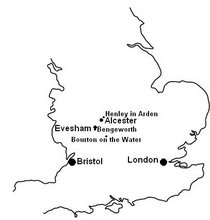
Growing up, Beddome would have been keenly aware of the intense friendship between his father John Beddome (1675-1757) and his life-long bachelor friend Bernard Foskett (1685-1758) who Beddome junior followed both into medicine and the ministry. Beddome senior and Foskett first met in London. They then ministered together in the Midlands before coming together again in Bristol, where, in due time, the two died within a year of each other and were buried alongside each other. Foskett was considered to be a part of the Beddome family and was often with them when they gathered. Benjamin named one of his sons Foskett. Sadly, this son drowned, dying prematurely as a young man. Beddome was asked to speak at Foskett's funeral but felt unable to do it. He was one of the coffin bearers.
The friendship between the older men no doubt informed Beddome when on at least one occasion he preached on the subject of friendship.
Before coming to that sermon we quote a paragraph from another sermon, this one on Zechariah 8:23 in Volume 5 of the short discourses. He says that one of the things we can learn from his text is
That seclusion from all society is neither the Christian's duty, nor his privilege. It was God himself who said, It is not good for man to be alone. Satan imagined that lie had the greatest advantage against our Lord, and that he was most likely to prevail over him, when he found him in a solitary wilderness, unsupported by the presence of a friend. To guard against a similar danger, Jesus afterwards sent out his disciples two and two; not only that out of the mouth of two witnesses every word might be established, but that they might be helpers of each other's joy in the Lord. 
The text of the sermon on friendship is Sermon 59 in a collection of 67 posthumously published sermons. It is on Proverbs 18:24 A man that hath friends must show himself friendly and has been given the title The reciprocal duties of friends.
Beddome begins it by saying
The advantages of real friendship are great and the duties resulting from it many. We have a comprehensive view of them in my text. We should exercise a common civility towards all men neither despising the poor on account of the meanness of their condition nor hating our greatest enemies for the injuries we have received from them but a man that hath friends must show himself friendly. Here we have a privilege spoken of and a duty prescribed.

The privilege of friendship
The sermon is in two parts. Beddome says firstly that a privilege is spoken of. What a privilege to have a friend, says Beddome,
To say that a man is friendless is to denote a complete state of misery. Lover and friend says David hast thou put far from me. This aggravated his troubles and added weight to all his other distresses. On the contrary next to the comforts of religion are those of friendship and society especially when those whom we look upon as our friends are …
And then he lists four qualities in a good friendship. It is

Real and disinterested
Sincerely what they profess to be not acting from selfish motives but making our interest their own. Most men seek their own and do not, as the apostle expresses it in another case, naturally care for the state of others. Here and there perhaps we may find one who will sympathize with us in all our griefs and joys and by all proper means promote our happiness and welfare. Happy is the man that hath such a friend.
Wise and prudent
Able and willing to give us advice when we are at a loss how to act and that without upbraiding our ignorance or despising us for our weakness. It is a happiness to have such friends who are discreet and experienced and at the same time open and communicative. If our friend be weak and silly his folly may plunge us into great inconveniences and let him be ever so sagacious, if he be sullen and reserved his wisdom will do us little service. David was happy in the friendship of Hushai who by his good sense and deep penetration defeated the pernicious councils of Ahithophel and extricated his royal master from a state of the greatest perplexity.
Marked by pious virtue
Pious virtue is the only solid foundation for friendship for he that is not a good man cannot be a good friend. Prayer for friends is one of the most important duties of friendship but he is not likely to pray for us who does not pray for himself. The concerns of the soul are of the most interesting nature but it is not probable that he will be mindful of the spiritual concerns of others who is regardless of his own. Those are the most valuable and desirable friends who are at the same time like Abraham the friends of God. Not the gay sensual and profane but the serious and thoughtful, circumspect and holy whose conversation will be instructive and their example improving whose hearts glow with love to God and whose conduct and behaviour exhibit all the beauties of the religious life. By their means we may be fortified against temptations kept from many an hurtful snare be convinced of sin when we have committed it and rendered more steadfast in the ways of God. As iron sharpeneth iron says Solomon so doth the countenance of a man his friend. We insensibly contract a likeness to those whom we choose for our companions: if they are modest and humble, we grow like them; if they are bold and impudent, we become so too. Give me leave to add, under this head, if a courteous and obliging temper, a natural sweetness of disposition, be added to strict virtue and real piety, it makes the ties of friendship more sweet and more durable. This seems to have been the case with respect to David and Jonathan. That man can never be a friend to others who is a foe to himself.
Faithful and persevering
The fourth and final thing he includes under his first heading, and here he must inevitably have thought of Foskett and his father, is this
Lastly. Faithful and persevering, who will smile when the world frowns, stand by us when others forsake us and adhere to us in the face of the greatest opposition. Thus all Saul's threats and reproaches could not make Jonathan renounce the covenant of friendship he had made with David, whom he loved as his own soul. Such friendships are very rare. My brethren, says Job, have dealt deceitfully as a brook, and as the stream of brooks they pass away. A failing brook is a fit emblem of a false heart. A friend that loveth at all times, who does not change when our circumstances change, but is the same whether we are in a state of affluence or want, in honour or disgrace, is one of the choicest gifts of God.
He quotes Edward Young, one of his favourite authors, from Night Thoughts
Friendship's the wine of life:
A friend is worth all the hazards we can run.
Poor is the friendless master of a world:
A world in purchase for a friend is gain.
Beddome concludes this part of his sermon
This should lead us to think of the Lord Jesus Christ, in whom all these characters meet. He is the greatest, best, and most affectionate, the most disinterested and faithful of all friends, a friend to them that have no other friend; a friend to those who have been his most bitter enemies, and who lives when other friends die; to whom we may justly apply the words following my text: There is a Friend that sticketh closer than a brother. O may each of us be able to say, This is my beloved, and this is my friend!

21/03/2016

Bernard Foskett 1685-1758

Bernard Foskett (1685-1758) was very close to the Beddome family. At his funeral on September 21, 1758, at his own request, the six pall bearers were all Bristol graduates - Beddome, Benjamin Fuller (d c 1753) a minister at Devizes, Wiltshire; Thomas Flower (1706-1767) of Cirencester, Gloucestershire; John Tommas (1723-1800) of the Pithay, Bristol; Robert Day (1720-1790) of Wellington, Somerset, where he was from and Abraham Larwill (c 1730-1760) of Frome, Somerset, originally from Bampton. Beddome was asked to speak at the funeral but declined. Hugh Evans (1712-1781) spoke. Foskett was buried adjacent to Beddome's father John, who had died the year before. They had been lifelong friends in London, the Midlands and Bristol. Foskett, a bachelor, seems to have lived with the Beddomes.

29/07/2010

Hayden 07b

On pages 91 and 92 Hayden concludes his main section on Beddome thus:

Beddome is representative of the Foskett tradition who in his own ministry echoed much that Foskett held important. The close family tie with John Beddome also underpinned the relationship. However, Beddome is typical of the students trained by Foskett who encourged the use of the 1689 Confession, used a catechetical approach towards religious instruction within the congregation, developed the area of hymn singing to match the changing mood brought about by the Evangelical Revival, and sent further students to train for full-time ministry from within his own congregation. He had an interest in the American Revival and was eager to learn what advanced Baptist work in America.

07/07/2010

POTP 05

Brooks continues in Chapter 2

During the period we have now reviewed, Mr Beddome had repeatedly visited Bourton-on-the-Water. His first visit was paid in the Spring of 1740, and many persons were added to the church during the three years following. During this time his ministerial labours seem to have been divided between Bourton and Warwick. In July, 1743, the church at Bourton invited him to become their pastor. He had now to choose between Bourton and Warwick. Upon this subject his father writes

“As to the continuance of your journeys between Bourton and Warwick, you are the best judge. If your strength will permit, and the people's desire remains strong, and there is a prospect of serving the interests of religion at both places, to my judgement, it may be best to continue some time longer; and if you pray fervently, and commit your way to the Lord, you will see the leadings of his providence. 'The meek will he teach his way.' Take notice of the feelings you are subject to, and the assistance you obtain at each place, and consider where the gospel is most needed and most likely to be received, for that place will yield most satisfaction to a gracious mind. We are not so much to consult our own ease and pleasure, as to honour Him who made us, and promote His interests.”

Having received many very pressing invitations from the church at Bourton to become their pastor, he at length acceded to their request, and was ordained September 23, 1743. On that occasion, Mr Foskett, of Bristol, gave the charge to the pastor, (from 1 Tim iv 12 "Let no man despise thy youth; but be thou an example of the believers, in word, in conversation, in charity, in spirit, in faith, in purity,") and offered the ordination prayer. Dr Joseph Stennett preached to the people, from Heb xiii 17; and other parts of the service were taken by Messrs Haydon, Cook, and Fuller, of Abingdon. His venerable father was not present on this interesting occasion, owing to his incapacity for travelling, but sent the following letter, expressing the feelings and desires of his heart

“I should have been glad to have attended your ordination, but cannot. I never expect to travel so far on horseback more. I hope what you are about to take upon you, will be a stimulus to you, to walk more closely with God than ever, and make you more sincerely and simply concerned for the good of the souls of men. I desire, with my whole heart, that an unction of the Holy Spirit may be poured out upon you at the laying on of the hands of the Presbytery; and that your faith therein may be strong.”

Our fathers were careful to state clearly, on such occasions, the engagement between the pastor and the church. In this case, a document was drawn up, adopted by the church, and signed by 18 of its members, in behalf of the whole, on the 16th day of September, 1743. The following is a copy.

“We, the church of Christ meeting at Bourton-on-the-Water, Having solemnly called, and set apart, our beloved brother, Benjamin Beddome, to the office of teaching elder to us, do hereby declare, that we don't intend to bring him under any such special obligation to us; but that if the providence of God calls him elsewhere, or he upon valuable considerations, doth desire his release from us, we will give up our right in him, as if he had never stood in any such relation to us. In witness whereof we have put our hands, etc.”

Well, it was something to know that they had not bored his ear through with an awl, and bound him to serve them for ever. It would be possible to get away.

23/02/2007

Life Story 03

Early preaching at Bourton
It was during this period, in 1741, before he accepted a full call that, according to William Newman (1773-1835), there was "a great awakening in Beddome’s congregation at Bourton. Forty persons were brought to repentance at the same time, and Mr Ryland was among them." (William Newman, Rylandiana: reminiscences relating to the Rev John Ryland AM, London, George Whightman, 1835, 3). The reference is to John Collett Ryland (1723-1792), a young man who, despite his godly forbears, had shown no interest in the things of God until this point. He preferred playing cards to hearing sermons. However, the Lord saved him and he himself went on to be a leading Baptist minister. In October, 1742 he joined the church and in February 1744 began training for the ministry in Bristol.
He wrote in his diary for June 25, 1741, "'Surely Mr Benjamin Beddome is an instance of the existence of God and the truth of the Christian Religion. What could change his heart and induce him to leave his profession or trade - what could have him to stay at Bourton rather than to go to Exeter to which he was strongly solicited – what is it that moves him to preach, pray and be so active? Is it not the delight he finds in the work – ’Tis plain that it is not worldly interest." (Quoted, H Wheeler Robinson, London, Methuen, nd, from the Ryland Diary, 2, now in the Angus Library).
All this was while Beddome was still learning his craft as a preacher. He preached effectively but at times his tongue ran away with him so that he could not be understood and, like many a young preacher, he could be insensitive and abrasive and often over long. His father wrote to him on more than one occasion about this. ‘If you would make them shorter, and less crowded with matter’ he wrote of the sermons on May 17, 1742, ‘it would be more acceptable and edifying to your hearers, and more safe and easy for yourself.’ He says 'If you deliver the great truths of the gospel with calmness and with a soft, mellow voice, they will drop as the gentle rain or dew. For the good of souls, then, and for your own good, be persuaded to strive after this.' He wrote a few weeks later in the same vein, 'I ... carefully press you, to strive with all your might to soften your voice and shorten your sermons ... Let two hours be the longest time you spend in the pulpit at any place.’ (Brooks, 24, 25).
There were around 70 or 80 members at Bourton when Beddome first preached there, many coming in from the neighbouring villages, some from as far as 15 miles away, quite a distance to travel in inclement weather. Under this enthusiastic, if still immature, young preacher the congregation and membership grew markedly. In May 1743 some 48 new people joined the church, bringing the membership to 113. Shortly after that, the travelling backward and forward between the Cotswolds and Warwickshire came to an end and Beddome agreed to be the regular ‘teaching elder’ at Bourton.
He was ordained on Monday, September 23 of that year. Bernard Foskett preached the charge, from 1 Timothy 4:12, Let no man despise thy youth, and one of the most eloquent preachers of the day, Joseph Stennett (1692-1758), preached to the church from Hebrews 13:17 Obey them that have the rule over you. It seems that it was Stennett's church that licensed Beddome to preach in February, 1740. (Stennett was the grandson of Edward Stennett [d 1691], son of Joseph Stennett 1663-1713 and father of a fellow Bristol student of Beddome's Joseph Stennett 1717-1769 as well as Samuel Stennett 1727-1795. He began in Abergavenny and was in Exeter for about 16 years, taking a strong stand against Peirce and Hallet in what later became the Salters Hall controversy. In 1637 he moved to Little Wild Street. In 1754 Edinburgh university made him a DD).
Messers John Haydon (1714-1782) of Shortwood (later Tewkesbury), Edward Cooke (d 1770) of Pershore and William Fuller (d 1745) of Abingdon prayed. Beddome’s father was unable to be present but wrote promising his prayers and good wishes. The week before, the church had produced a formal written call to their ‘beloved brother Benjamin Beddome, to the office of teaching elder to us’. (Brooks, 24. See ms Bourton Church Book 1719-1802, 67, preserved in the archive of the Angus Library. Haykin has inadvertently written ‘preaching elder’, 172. The book says ‘teaching elder’ as do Brooks and Holmes). They also made quite clear that they would not stand in his way should there be a call from elsewhere. His duties included supplying the nearby church at Stow, which had recently come under the Bourton oversight when its membership had fallen below 25. According to Brooks there were soon a hundred members coming in from at least 20 parishes in the neighbourhood. (Brooks, 29. With Bourton and Stow, he mentions Barton, Broadwell, Burford, Clapton, Dunnington, Farmington, Hawling, Icomb, Longborough, Naunton, Salperton, Swell, Chipping and Hook Norton, Great and Little Rissington).
Brooks comments that ‘It was not a light thing, in a secluded village, to have secured for so many years the service of Benjamin Beddome’. (Brooks, 31. The rural nature of Bourton comes out in references in the church books to church meetings being postponed because of harvest. In 1787 there was no church meeting for three months due to the hay and corn harvests, Bourton Church Book 1765-1920, 67. Beddome’s hymn book contains 3 fine forgotten harvest hymns. Cf 728-730).
That same year Benjamin Beddome preached for the first time at the Midland Association meetings in Leominster. (The church always attended midland association rather than western association meetings to the south or Abingdon ones to the east. This is due to Bourton’s geography, it being in north Gloucestershire and its relatively early founding. In the period 1774-1788 a ‘double lecture’ was established six months in every year (with the churches at Abingdon, Cirencester, Coate, Fairford and Wantage). He went on to preach another 16 times at such gatherings over the next 46 years. He had obviously taken his father’s advice and was very often in demand as a preacher.
From Ryland’s diary, quoted above, we know that there had been a request to pastor in Exeter. In October 1748, his father had the idea of Benjamin coming to Bristol as his assistant. Benjamin knew Bristol well and his father employed all sorts of arguments, including the emotive ‘It would be a great comfort to your mother to sit under your ministry’ to try and entice him back to the big city. (See Dix). But his son would not be persuaded. As we shall see, this was not to be the last time he was asked to leave Bourton.