Showing posts with label Quotations. Show all posts

01/11/2021

Musical References in the Sermons

Sermon on Romans 8:28
The strings of a musical instrument struck in their proper order yield an agreeable harmony and the various movements in a complicated piece of machinery complete the design of the artist but if one string of the instrment be broke or one movement of the machine be out of order, neither of them will answer the appointed end ...

The happy results of repentance 2 Corinthians 2:2
When there is a casting down among the people it is a time of lifting up to godly ministers. The sighs and groans of returning penitents are delightful music in their ears. The success of Peter's sermon in the second chapter of the Acts no doubt laid a foundation for many thanksgivings to God.

A funeral sermon Hebrews 2:15
Salvation by Jesus Christ is the very sum and substance of the Christian religion and the extensiveness thereof is one of its greatest glories. Were all the fruits of Christ's death concealed in the darkest oblivion and all reserved for another state yet were the highest returns of gratitude due even for a hope of future glory. The distant prospect might afford us ground of joy and tune our harps to the praise of Him who then would be the distant portion of his people. But what superior strains of praise are due when we consider that salvation begins even here, clusters are vouchsafed from the promised land and by the first fruits we may conclude what the harvest will be.

A funeral sermon Hebrews 2:15
Our work will be the most desirable reflecting upon the wonders of redeeming love the mysteries of providence the discoveries of grace the experience of our past lives and then we shall tune our harps to praise, make heaven echo with a new song, a song always the same yet always new ...
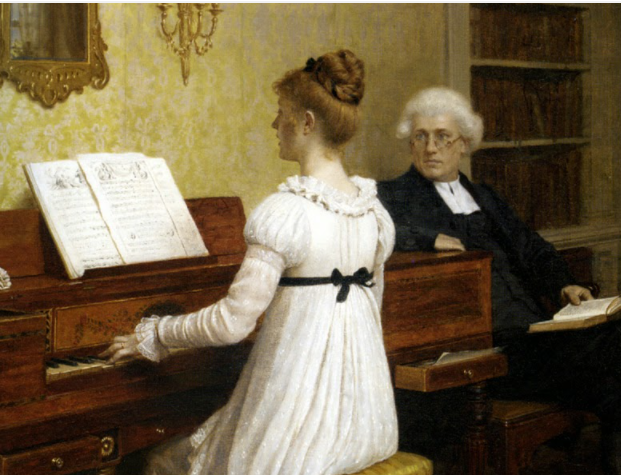
Edmund Leighton, Public domain, via Wikimedia Commons

Instead of wondering that we die we have reason to wonder that we live so long "that a harp of a thousand strings should keep in tune so long";* that the water is not sooner spilt or we who are crushed sooner than the moth, retain that life so long which is sustained by so feeble a thread.
*Quotation from Isaac Watts

Communion with God our security and bliss Psalm 69:18
Though the minister may, like John the Baptist, be a burning and shining light, let his compositions be ever so striking and eloquent, pathetic and evangelical and his manner of address ever so engaging, his voice will have but little effect unless that of his Master be also heard, it will be but like a lovely song pleasing to the ear but make no lasting impression upon the heart.  

Character tried by the Word and Providence of God Matthew 3:10
No, it was for thee he drank that bitter cup that thou hadst mingled and endured that wrath which thou hadst provoked so that thou mayest now sing and say "Who is he that condemneth it is Christ that died".

The right of private judgement Romans 15:5
... Some reject singing with a mixed multitude and according to the rules of art whilst others suppose it to be a desirable part of the worship which they owe to God and therefore by no means to be omitted in their public devotions. Many other instances might be mentioned of the same nature in which we should avoid all the animosity of party spirit ....

29/10/2021

Marine References in the Sermons

A Calm, Dominic Serres, 1789

Beddome grew up in the bustling city of Bristol and so it is no surprise that he makes maritime references in his sermons sometimes. In no particular order, these are examples. His brother Joseph was a merchant involved in the Atlantic trade.

The Nature and Importance of Prayer 1 Corinthians 14:15
Or this may be understood of the assistance of the Divine Spirit whose agency and influence is absolutely necessary to the acceptable performance of this and every other duty he must prompt us to it and quicken us in it This heavenly wind must fill the sails and it is as necessary that the Spirit should make intercession in us as that Christ should make intercession for us.

On the stability of the gracious character Hebrews 13:9
Faith is to the soul what the anchor is to the ship or the foundation to the building. The Christian in himself is like a reed shaken by every wind but firmly united to Christ he is like the sturdy oak which braves the hurricane and defies the fury of the storms.

Self-examination Psalm 139:23
As we may be easily mistaken in the ideas we entertain of our state so such mistakes are very dangerous. Those who labour under them are in a very unhappy condition in this world for however they may seek after inward rest and satisfaction they will never attain these blessings and amidst all their confident hopes and expectations they have their doubts and fears which often prove very distressing. Such persons hover between heaven and earth and like sailors in a storm are sometimes mounting at other times sinking but at all times fluctuating and uncertain.

Importance of Scripture knowledge Luke 1:4
This will prevent our being imposed upon by the arts and intrigues of crafty and designing men; we shall stand unmoved like rocks in the midst of the foaming waves resisting all their force and impetuosity; the juggling tricks, the corrupt glosses and interpretations of those that lie in wait to deceive will have but little influence upon one who can distinguish between truth and error and is well settled in the principles of his holy religion. ...

Sin offensive both to God and men 1 Thessalonians 2:15
Those who make it their business to serve and please the Creator are most likely to promote the true interests of their fellow creatures. Hateful and hating one another is the character of wicked men but the Christian temper is all made up of love. Who is weak, says the apostle, and I am not weak; who is offended and I burn not? Carnal men seek their own things distinct from nay often in opposition to those of others. If they swim they do not care who sinks but the language of the benevolent saint is I will seek thy good O Jerusalem.

The right of private judgement Romans 14:5
The first moment we set our foot upon the heavenly shore we shall know inconceivably more than we can possibly attain to here by the most vigorous exertion of our mental powers and all the aid we can receive from others, (though neither the one or the other is to be neglected) for then all obstructions will be removed, our faculties greatly enlarged, the objects of knowledge brought nearer to view and God himself, our immediate instructor.

On the fear of God Psalm 25:14
Jonah's mariners are terribly afraid whilst their lives are endangered but when the storm is abated, their fears subside. But it is otherwise with the truly good man.

Christ the subject of prayer Psalm 72:15
This subject suggests a source of comfort to those that belong to Christ. Not only Christ himself prays for them but they are interested in the prayers of all the godly like a merchant who has an interest in many ships richly freighted and one or other of them is daily arriving.

On Isaiah 54:11
The church of God is also described as being "tossed with tempests" like a ship driven from her anchors, carried to and fro by the boisterous waves and ready every moment to be swallowed up. Neither sun nor moon nor stars appearing for many days, all hope is taken away; now mounting up to the heaven, as the Psalmist expresses it, and then going down again to the depths, the mariners are at their wits ends. - A storm at sea also well represents the terrors of an awakened conscience and the agonies of a mind in deep distress; when awful providences are joined with inward darkness so that one trouble excites and sharpens another.

On Proverbs 30:8
The same wind that carries a ship forward, may sink a smaller vessel; and the same degree of worldly substance that is helpful to one, and even necessary to support his character and dignity, may less and injurious to another.

09/09/2020

The Intro to Richard Hall's Book

 INTRODUCTION

The following pages consist of Extracts from sundry old and valuable Authors, taken by the person that now occasions their publication, in his private reading, who penned them down at sundry times for his own use, and with no other design: but having been recommended by a Christian friend to print them, and as he trusts he received benefit from them himself, he is desirous others might, under a divine blessing, do so likewise, and in hopes thereof he has complied.

It may be said, what need of such extracts when the books themselves are many of them to be had? In answer: the several authors quoted may never come into the hands of many, or others may not have the opportunity to read them so as to pick out the pithy and striking sentences therein contained: therefore, to view in so small a compass the excellent sentiments, sound divinty, and sweet experience of so many great writers now in glory, the collector hopes, cannot be unacceptable to pious souls; and especially as we live in a day of so great declension, when the love of many, and even professors of religion, wax cold, 'their hearts still and backward to divine and spiritual things, a too great cleaving to the things of time, and they find a need of the useof all means to revive the soul and raise it upwards.

The Reader is desired to excuse the order that might have been observed in selecting particular subjects, and ranging them by themselves, and every other imperfection, as the person who made this collection,does not propose himself as an author, nor did he design putting his name hereto but as an anonymous book does not make so good appearance, even when the author proposes not the least advantage of profit to himself, which is the case of this publication, and therefore hopes subscribing his name will not be thought ostentatious.

If this book is blessed to any poor soul for refreshment, establishment, and consolation, and is a means to draw the heart more out to GOD and his Dear Son, the collector of these extracts will have his sincere wish, who begs an interest in the prayers of the pious Reader, and is their humble servant,

RICHARD HALL

23/11/2019

Quotation motive to good deeds

What we do must not be to gratify our inclination, promote our own interest, or please either the good or the great, but in obedience to the will of God. To be acceptable it must likewise be universal and persevering; not from mercenary, but grateful motives; not for life, but from life; not that God may love, but because he hath loved us.
(Benjamin Beddome, “Sermon V, John iii. 7,” in Twenty Short Discourses, Adapted to Village Worship, or, The Devotions of the Family/Published from the Manuscripts of B. Beddome London: Samuel Burton, 1824, 29.)

25/08/2008

Quotation God's Love

The Saxon Hus writes here and quotes Beddome
I thoroughly enjoy the writings of the British Baptist pastor Benjamin Beddome. Here is a brief excerpt from his sermon on John 16:27 entitled “On the Love of God”. I hope you enjoy his thoughts.
Our love to Christ, therefore, cannot be the cause of God’s love to us, but is a stream flowing from it; his grace in regeneration produces it; his grace in sanctification preserves and increases it. Love, as well as faith, is the gift, the free gift, of God … If God had loved us no more than he does the devils, we should have remained the same enemies to Christ as the devils are. …God’s love to us is infinitely superior to our love to Christ. The latter is mingled with coldness and indifference. Such is the imperfection of it, that the Christian often questions its reality; but God’s love is like his nature, boundless; as incapable of addition as it is of diminution.

Quotation Knowing Truth

I noticed this quote from Beddome here.
Prof Jim Renihan introduces it:
Is preaching important? Should ministers labour over the Word of God so that they proclaim it faithfully to their people? Benjamin Beddome, the well-loved pastor of the Baptist Church in Bourton-on-the-Water England for 55 years in the latter half of the 18th Century, preached a sermon from Luke 1:4 with this title: The Importance of Scripture Knowledge. In familiar style, the sermon had three main points, indicated as ‘observations’ on the doctrine of the text. The first observation is ‘that there are some things in which all real converts have been instructed ... by the Spirit of God’; the second ‘that the certain knowledge of these things may yet be wanting, and is to be obtained’; and the third ‘that this certainty of knowledge is very desirable.’ He then gives a sample of part of the third observation:
Certainty of knowledge tends to the improvement of our graces, the increase of our comfort, and our growing fruitfulness. The more knowledge the more holiness. ‘Sanctify them by thy truth,’ says Christ; ‘thy word is truth.’ The more knowledge, the more liberty, both with God and for God. ‘The truth shall make you free.’ The more knowledge, the more inward peace; the more understanding is enlightened in the truths of the gospel, the more firmly doth the soul rest itself upon God and Christ. ‘I know’ says the Apostle, ‘in whom I have believed.’ I can safely commit my eternal all into his hands, for I know that he is every way equal to his undertaking, and will faithfully discharge every trust reposed in him: in a word, the more extensive our knowledge is, the more universal will our obedience be. If the head be like the summer’s sun, full of light, the heart will not be like the winter’s earth, void of fruit; and, indeed, it is this that distinguishes between the knowledge of the hypocrite and the true believer; the one is barren and unfruitful, the other is animating and enlivening, assimilating and transforming: thus, when the Apostle prays for the Colossians, that they might be filled with all the knowledge of God’s will in all wisdom and spiritual understanding; he adds, that ye might ‘walk worthy of God unto all pleasing.’Renihan says to preachers
Beddome is exactly right. Our people will grow in grace as they grow in knowledge. They may not be the most exciting things, but preaching and teaching are the best things. Brothers, devote yourself to them.
See a summary of the sermon on this blog here.

19/06/2008

Hester quotes and Conclusion

Hester concludes by saying:
The following sentences are taken from the second volume of his sermons:
"Despondency clips the wings of desire, and cuts the sinews of exertion; but hope is a spur to activity, and an antidote against fainting."
"Diligence without dependence is folly and madness; dependence without diligence is presumption and arrogance."
"Guilt drives wicked men from God, but good men nearer to Him."
"We are not the less willing because we are made so in the day of His power. That which is an act of power with regard to the Holy Spirit, is a voluntary act with regard to the human will."
"The atonement of Christ was necessary for our pardon, and a continual application of it is necessary to our purity."
"Submission without conviction will neither bring honour to the preacher, nor profit to the hearer."
"Grace turns the serpent into a rod; but sin turns the rod into a serpent. The former turns poison into a remedy; but the latter turns the remedy into poison."
"Sinners on earth are always punished less, and in hell never more, than their iniquities deserve."
"The forbearance and long-suffering of God towards sinners is truly astonishing. He was longer destroying Jericho than in creating the world."
The following striking sayings are from a sermon on the text Therefore it is of faith that it might be by grace
"Faith gives no title to eternal life, but receives one; it constitutes no justifying righteousness, but it apprehends and applies that righteousness on account of which we are justified."
"Salvation is through faith, but not for it as if it were given in reward of believing."
"Faith has nothing to glory in, it is only the empty hand or the imploring eye"
"True faith places the crown on the head of him who ought to wear it. It does not fall in love with itself, but with the Saviour. It renounces all merits and worthiness, and seeks it in Him alone. It puts on the robe, but it did not weave it: it shows the debt paid, but did not discharge it."

We have quoted enough to show that Benjamin Beddome was no ordinary man. His sermons will richly repay perusal. It is impossible to rise from a careful reading of them without feeling a fresh glow of religious life in the heart. You feel that the preacher was thoroughly in earnest, and felt and believed what he said. Every sentence bears on it the stamp of genuineness. The conscience is appealed to, the judgement informed, affections aroused. The Gospel is not a lifeless system of stale doctrines, but a divine reality. adapted to meet all the wants of corrupt human nature. In dwelling on the lineaments of this beautiful character, we cannot but wish, that there may still be found in our churches, men who shall combine the masculine sense, the poetic beauty, the glowing piety, the fervid zeal, and the terse brevity, which were so eminently illustrated in the sermons and songs of Benjamin Beddome.

Hester on Beddome's preaching


In a further discussion of Beddome's sermons Hester refers to
... A colloquial criticism Robert Hall offered on these sermons, (where) he says

"They are very evangelical, and there is a good choice of subjects: there is a bone and sinew and marrow in them that shows a great mind. I like them, Sir, because they are so full of thought; they furnish matter for the mind to dwell upon. It is true they are very short; but it must be remembered they are posthumous, and were never intended for publication: they are little more than skeletons. I like them the better for their compactness. It shows the taste of the age, Sir: — they would have been more approved had they been long and verbose and showy. They supply materials for thinking, Sir: — some persons, however, don't like to think, Sir. — In short, Sir, I do not know any sermons of the kind equal to them in the English language. I believe they are destined to be much more extensively read and appreciated."

Hester goes on
These sermons comprehend a great variety of topics, and every subject taken in hand is treated with great judiciousness and care. There is nothing to shock the most fastidious taste. There is great evenness in the flow of Mr Beddome's thoughts; there are few outbursts of emotion. Now and then his language rises into impressive eloquence. Some of his sentences are remarkable for comprehensive brevity, antithetic beauty and aphoristic weight.

The following sentences are taken from the sermon on the text It is the Spirit that quickeneth

"Absolute sovereignty belongs only to God: and indeed it is fit that it should belong to no other, for in Him alone infinite wisdom is joined with irresistible power."
God's grace can save "our souls without any preaching; but all the preaching in the world cannot save our souls without God's grace."
"The spirit of man, that candle of the Lord, often gives but a faint and glimmering light; but the Spirit of God snuffs it that it may burn brighter. It is He that sets conscience to work at first, making it fly in the face of the sinner, saying, as Nathan to David, 'Thou art the man;' and to Him we owe all that facility and care, faithfulness and integrity, with which it acts in after life. He is the Lord of conscience, and all its motions, like those of wheels, are under His direction."
"Good things in the heart lie as embers under the ashes, and have need to be stirred up; and to do this is the peculiar office of the Spirit."

More Hester on Beddome

Hester goes on to say:
Benjamin Beddome was a poet, a teacher and a preacher. His beautiful hymns are familiar to all. There is a singular sweetness and a delightful melody in his songs. Most of his hymns seem to have been composed in connection with his sermons, and sung after the sermon was delivered. This method of gathering up the contents of the sermon in a poetical form has been adopted with considerable effect by some modern preachers. Some who visited Devonshire Square in Mr Hinton's days, were highly delighted with the manner in which he sometimes embodied the leading ideas of the sermon in the closing hymn.
Mr Beddome published a "Catechism of Divinity." This work was based on his own catechetical teaching, a work of which he was very fond, and in which he excelled. Mr Beddome took great interest in the young, and often dwelt on the importance of parental instruction. One of his most striking sermons is on the text, Train up a child in the way he should go, etc. Prov 22:7. This sermon contains many judicious counsels to parents and instructors of youth:
"Having laid the foundation of their future improvement," he says, "in the first principles of religion, we must proceed to train them up in all the relative and social duties, both towards God and man, encouraging them to pray for what they want, especially to call upon the Lord in the day of trouble, and to praise Him for all their mercies and deliverances.'
"Many parents," he says, "betray their children into the awful sin of lying, by abrupt and severe interrogations, which afford sufficient intimation to the offender that if the evil be discovered it is to be visited with punishment; and to avoid this a habit of prevarication is fatally established." "Wicked parents are their children's corruptors, and therefore are not fit to be their correctors."
"By avoiding everything capricious, and maintaining a steady and well-regulated authority, some parents can do more with a word or look than others can do with the hardest blows."
"Religious instruction may begin too late, but it can scarcely begin too soon ; it is out of the mouth of babes and sucklings that God ordaineth praise."
"Give all your instructions with gentleness and tenderness. Consider the different capacities of children, and lead them on as they are able to bear it, as Jacob did his flock, and as Christ did His disciples."
"Do not overburden them with religious duties and services, as some have done, till being surfeited with piety, they have afterwards rejected it with scorn. A yoke that is rigorously imposed will gall the neck of him that wears it, and like Ephraim he will wait his opportunity to cast it off. When a parent gives his children the austerities of religion, instead of meekness, gentleness, and kindness, he offers him a stone instead of bread. Religious instruction should as much as possible be given in the form of similitudes, or by any other means that may render it inviting and alluring; and care must be taken not to urge it too frequently or unreasonably, lest their souls should loath the heavenly manna."
Beddome's sermons were published after his death in eight small volumes. (An octavo volume containing 47 sermons, with a memoir of Beddome, was published 1835). They have always been held in high estimation. They are short, but remarkable for their neatness, accuracy and elegance of expression. A high authority has said they "are among the most popular village sermons ever printed." Robert Hall, a great authority on preachers and preaching, in his preface to Beddome's hymns, says "As a preacher he was universally admired for the piety and unction of his sentiments, the felicity of his arrangements, and the purity, force and simplicity of his language, all of which were recommended by a delivery perfectly natural and graceful. His printed discourses, taken from the manuscripts he left behind him at his decease, are fair specimens of his usual performances in the pulpit."

02/05/2007

Quotation 3

This one is on Scripture.
The Scripture is a divine testimony, given by inspiration of God. It is a testimony concerning God - His perfections and operations, the way in which He is to be worshipped, and the method of salvation which his infinite wisdom has devised. Though it is not silent on the mysteries of Nature and of Providence, yet its principal object is to make known the counsels of divine grace. It is a testimony from God to man: it teaches what could not otherwise have been known, and places in a much clearer light what might possibly have been discovered by other means.

Quotation 2

This unfootnoted saying of Beddome's is also in Spurgeon's sermon notes.
"The forbearance and longsuffering of God toward sinners is truly astonishing. He was longer in destroying Jericho than in creating the world."

10/04/2007

Quotation

In 'My sermon notes' Spurgeon quotes Beddome
'God's grace can save souls without any preaching; but all the preaching in the world cannot save souls without God’s grace.'
It is from a sermon on John 6:63

23/02/2007

Two Pithy Sayings

It is the Puritans who are often remembered in Evangelical circles for their wisdom encapsulated in pithy sayings. But there is gold in the generation of men who succeeded them in the days of awakening and revival in the 18th century. Here are two gems from Benjamin Beddome (1717-1795), minister for fifty-five years or so of the Baptist work in Bourton-on-the-Water, now sometimes called the Venice of the Cotswolds:
“If the head be like the summer’s sun, full of light, the heart will not be like the winter’s earth, void of fruit” - very Edwardsean this statement!” [From a sermon on Luke 1:4]
“Love is the sacred fire within, and prayer the rising flame.” [From the hymn "prayer is the breath of God in man"]