Showing posts with label Bunhill Fields. Show all posts

27/01/2025

Deaths of Ministers in 1795

Romaine, Stennett, Kippis

On October 18, 1795, in the year of Beddome's death, a sermon was preached by John Evans (1767-1827) at Worship Street, Shoredi
tch, being a sincere tribute of respect to the memory of the Rev Samuel Stennett, DD, The Rev Andrew Kippis DD FRSAS and The Rev Rice Harris DD. To Which Are Prefixed, A Few Particulars Of Their Lives And Writings. It was by John Evans AM and was published by request. The printer was Charles Whittingham (1767–1840) and it was sold by Benjamin Crosby, Stationers Court; Thomas Knott, Lombard Street; John Marsom, High Holborn and Joseph Cottle (1770-1853) in Bristol.
Evans, a Welshman born at Usk in Monmouthshire, studied in Bristol, where a relative, Dr Caleb Evans, was theological tutor and also in Aberdeen and Edinburgh. He came to England in June 1791 and accepted an invitation to be their pastor from the morning congregation of General Baptists in Worship Street. In 1794 he opened a school, first at Hoxton Square and subsequently in Islington. He published many works on various subjects.
His sermon is on Psalm 12:1 Help, Lord; for the godly man ceaseth; for the faithful fail from among the children of men. In the preface, where he gives some biographical information about Stennett, Kippis and Harris, he makes this remark, “... The recent mortality amongst ministers has been great. Within these few months have been numbered with the dead, Romaine, Toller, Gentleman, Flexman, Stennett, Kippis, Harris, Beddome and Clark. These were ministers of talents and respectability in their several connections, and, excepting Mr Romaine, were all of the dissenting interest.
It seems that all nine of these men died between March 15 and the date of the sermon, October 18, 1795. The order was Toller (March 15) Flexman (June 14) Gentleman (buried July 12) Romaine (July 26) Clark(e) (July 29) Stennett (August 24) Beddome (September 3) and finally Kippis and Harris (October 9 and 10).
In order of age, Flexman was the oldest at 86 (b 1708) and Gentleman the youngest at 48 (b 1746). Romaine was 80 (b 1714) Beddome, 77 (b 1717) Kippis, 69 (b 1725), Stennett, 71 (b 1727) Toller and Clark(e), both 62 (b 1732) and Harris, 60 (b 1730). Further
  • William Romaine was an evangelical London preacher in the Church of England and a friend of George Whitefield (1714-1770). He was converted in 1748 after having been in the ministry some years. A Hebrew expert, he was the author of many works, including his trilogy The Life, The Walk, The Triumph of Faith.
  • Thomas Toller was educated at Plaisterers’ Hall in London before becoming the Independent minister of Monkwell Street Chapel, London. Several of his sons were also ministers. He is buried in Bunhill Fields.
  • Robert Gentleman, a dissenting minister and tutor, was born in Shrewsbury and grew up under the ministry of Job Orton (1717-1783). He studied at Daventry under Caleb Ashworth (1722-1775) and ministered first in Shrewsbury, where he kept a boarding-school. In 1779 he became divinity tutor at the Carmarthen Academy. There were discipline problems there and in 1784 he resigned, the academy moving to Swansea. Gentleman later became minister in Kidderminster. He seems to have veered towards Arianism.
  • Roger Flexman, a non-subscribing Presbyterian minister, was a chronological and historical scholar and an indexer and bibliographer. Perhaps he should not be on this list as he became an Arian. He is also buried in Bunhill Fields.
  • Samuel Stennett DD was a Seventh Day and regular Baptist minister and a hymn writer. From an illustrious line, he succeeded his father at Little Wild Street, London in 1758. Another now lying in Bunhill Fields.
  • Andrew Kippis DD FRS was a nonconformist clergyman and biographer. He studied under Doddridge and became a voluminous writer. One of his books was about the voyages of James Cook (1728-1779). From 1753 he was a Presbyterian minister in London. Again he was probably unsound theologically and a Unitarian. Yet another now in Bunhill Fields.
  • Rice Harris DD, a Welshman, was an Independent or Congregationalist minister in London. A fifth interred in Bunhill Fields.
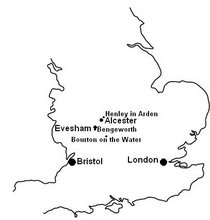
  • Benjamin Beddome MA was for 52 years a Particular Baptist pastor in Bourton-on-the-water.
  • William Nash Clark(e) was converted through Whitefield but became a Baptist minister firstly in Unicorn Yard, London and then down in Exeter. He was also a tutor for the PB fund.

Should others be added to the list? There are perhaps a few others. Again buried in Bunhill Fields, there is the Baptist William Dowars VDM (1720-1795) who died on July 1, 1795. For 38 years he was the minister of the church in Little Alie Street, Goodman's Fields. He began his ministry at Mangotsfield, near Bristol, where he laboured several years until the early death of James Fall (1727-1756), who he followed at Little Alie Street. He was succeeded by William Shenston. There is also an Independent minister called Edward Hitchin (1750-1795) who ministered in Bristol and who died January 27.
Finally, another Particular Baptist, Thomas Skinner (1752-1795) who died of a fever early in February. He ministered in Tuthill Stairs near Newcastle. Born in Northamptonshire, he grew up in Exeter where he was converted. He was educated for the ministry in Bristol and then become the first pastor of a church in Clipstone, Northamptonshire, where he baptised 60 people between 1779 and 1783. He then went to Towcester where he baptised 30 more before the move to the Newcastle area at the end of 1792. Also note James Purves (1777-1795) the Scottish universalist who ministered in Edinburgh and who died on February 1.

06/03/2020

John Reynolds


In a book on Bunhill Fields John Andrew Jones notes that among the dead there is John Reynolds, of whom he says

To the memory of the Rev John Reynolds, M.A., who, after having been many years pastor of a Protestant Dissenting Church, near Cripplegate, with hope of a glorious resurrection slept in Jesus, Feb. 6th, 1792, in the 63rd year of his age.
“An angel's arm can’t snatch me from the grave; 
Legions of angels can’t confine me there.” 

John Reynolds was born January 5th, 1730, in the parish of Farmington, near North Leach, Gloucestershire. His father, Thomas Reynolds, was a farmer at Little Rissington, in that county. His first impressions of divine things was when he was only twelve years of age, under the ministry of Mr Benjamin Beddome, of Bourton-on-the-Water. At 18 years old, he went to the Baptist Academy at Bristol, under the tuition of Mr. Bernard Foskett. He first laboured as an occasional preacher, chiefly at Bromsgrove, Bratton, Cirencester and Cheltenham but more constantly at Oxford, where he continued nearly four years. The Baptist Church at Curriers' Hall, Cripplegate, being deprived by death of their pastor, Mr. John Brine, invited Mr. Reynolds to pay them a visit, which he did in April, 1776. He was ordained as pastor of this church, in October the same year. Dr. Gill gave him his charge from 2 Tim. i. 13 Hold fast the form of sound words, &c. It was printed, and, a solemn charge it is. Mr Benjamin Wallin preached to the church from 1 Cor. xii. 25, That there should be no schism [or division] in the body. This sermon was also printed, and is truly excellent.
Mr Reynolds' success among his people, was far from being equal to his wishes, but probably greater than his own modest opinion would suffer him to judge. He had a peculiar solicitude for the conversion of souls; and was distinguished for prudence. No man, amongst his brethren, was more frequently consulted in cases of difficulty than himself; and he was deservedly esteemed by Christians of different denominations. In 1770, he received from the college of Rhode Island, the degree of Master of Arts.
For some months previous to his death, Mr Reynolds, felt a general languor overspread his frame, which often detained him from the house of God. But, in the midst of his debility, he went and preached his farewell sermon to his flock from Psalm xxiii. 4 Yea, though I walk through the valley of the shadow of death, I will fear no evil and he meant, if he had been spared to go out again, to have considered the remainder of the text, for thou art with me, thy rod and thy staff they comfort me. Through his illness he was serene and happy. 1 Cor. xiii. 10, was a pleasing scripture to him, But when that which is PERFECT is come, then that which is IN PART shall be done away.
Mr. Giles, pastor of the church at Eythorne, in Kent, coming to see him, on Thursday evening, in the last week of his life, and mentioning to him Mr Rogers's saying, “I have been the Lord's working servant, and I am now his waiting servant;” Mr. Reynolds replied, “I trust with an honest heart 1 can say the same.” On Mr. G. remarking that, “Death was a solemn subject to the people of God in health; but, he supposed it must appear much more so in the prospect of one's own dissolution.” Mr Reynolds replied emphatically, “It is really so;” and added, “I have sometimes been entertained with elegant compositions of divinity, and with such sermons as have displayed a good taste, and full of argumentation and genius.” Here he paused and panted for breath, and then said, “But none of these things will do Now ; nothing short of the good old plain truths of the Bible. The unchangeable love of God, and the vicarious sacrifice of Christ, are the foundation of my faith and hope.” And then, with a peculiar accent he added, “Here is terra firma;” and repeated, with much exertion, “I say Mr Giles here is terra firma for a dying man.”
Mr. Reynolds departed this life Feb. 6, 1792, aged 62 years and one month; and was buried in Bunhill Fields, near to his predecessors, Mr Skepp and Mr Brine. Mr Abraham Booth delivered the address at his grave, and preached the funeral sermon to his bereaved church from John xiv. 2: In my Father's house are many mansions: if it were not so I would have told you. I go to prepare a place for you. And if I go and prepare a place for you, I will come again, and receive you unto myself; that where I am, there ye may be also. - W. and I.