Showing posts with label Bourton Church. Show all posts

02/06/2025

Church Book Entry February 15 1778

Mr Beddome took Occasion last Sabbath to speak of the wretched and shameful Profanation of the Sabbath by the Children in the Village of Bourton and wish'd that someone would speak to the Curate and other Officers to join their Endeavours for the suppression of that Evil - the curate was advis'd of it and this day preached upon the 4th Commandment. The Clerk also read a paper (I suppose drawn up by the said Curate) the Purport of which was that those who were hereafter guilty of that offence should be prosecuted by the Church wardens and a similar Paper was stuck up at the Church meeting house doors and upon a Tree in the middle of the Town.

(Quoted in Stephen Pickles new book on Beddome - more of that anon)

22/09/2020

Ministers in Bourton August 14 1765

Thomas Brooks lists some 30 ministers in Bourton on Wednesday, August 14, 1765, for the Association meeting. He calls it a red letter-day in the memory of the “Saints and faithful brethren” at Bourton.

[Thomas] Tommerson, [or Thomason] of [Bollington] Cheshire
[James] Sleep, of [Princes] Risborough [near Chesham] [1742-1811] {23}
[Benjamin] Wallin, of London [1711-1782] {54}
[John] Stanger, of Towcester [nr Moulton, Northants, 1766 Bessels Gn, Seven Oaks] [1743-1823] {22}
[Thomas] Davis, of Fairford [c 1724-1784] {c 39}
[Daniel] Thomas [d 1769] of Henley-in-Arden
[John or James] Knight, of Warwick [succeeded Ryland, from Moreton, Devon and previously at Cork]
[James] Turner, of Birmingham [1726-1780] {39}
[John] Ash, of Pershore [1724-1779] {39}
[Philip] Jones, of Upton [on Severn] [c 1700-1771] {c 65}
[Samuel] George, of Wantage [c 1735-c 1768] {c 30}
[Abram] Darby, of Witney [d 1782]
[Nathaniel] Overbury, of Tetbury [1700-1766] {65}
[Benjamin] Francis, of Horsley [1734-1799] {31}
[Thomas] Ferriby, of [Chipping] Sodbury [Gloucestershire born, baptised Horsley] [1733-1808] {32}
[John] Macgowan, of Bridgenorth [1726-1780] {39}
[Lawrence] Butterworth, of Bengeworth [1740-1828] {25}
[Thomas] Skinner, of Alcester [d 1782]
[Isaac] Woodman, of Sutton [in the Elms, near Leicester, later Harvey Lane] [d 1777]
[Nathaniel] Carpenter, of Middleton Cheney [near Banbury]
[William] Hitchman, of Hil[le]sley [near Wotton under edge] [c 1728-1802] {c 37}
[John?] Davis, of [Chipping] Campden
Caleb Evans, of Bristol [1737-1791] {28}
[James] Butterworth, of Bromsgrove [d after 1794]
[Joshua] Thomas, of Leominster [1719-1797] {46}
[John] Heydon, of Tewksbury [1714-1782] {51}
[Benjamin] Whitmore, of Hooknorton [1728-1804] {37}
besides these three
[Benjamin] Beddome [1717-1795] {48}
[John] Reynolds [1730-1792] {35}
[Richard] Strange, of Bourton [who was at Stratton] [d 1768]

Brooks concludes "This was no mean gathering for a country village, in an age when railways were unknown. And there was a large congregation of hearers, as well as a great company of preachers. Good Mr. Beddome says, that in addition to vehicles of all other kinds, “there were eleven or twelve post-chaises at our Association," clearly indicating that some had come from places not very near to Bourton.

28/03/2020

Church Membership Statistics 1743-1795

These statistics are based on what Thomas Brooks reveals in Pictures of the past with some approximation at the end. Congregations were much larger than membership.

24/02/2020

Letitia Wilkins (Field)

There is a memorial to Letitia Field 1778-1844 in the Bourton on the Water church. Letitia was born and raised and died in Bourton it seems though there is some Hackney connection in the mix. Her parents were John Field (1719-196) and Ann Tidman Cromwell (1727-1797). She married Beddome's assistant Rev William Wilkins (c 1752-1812) from Cirencester in 1800. She was Wilkins' second wife His first wife was Elizabeth (possibly Alice) North, who he married November 30, 1779. She was a Presbyterian from Overthorpe near Banbury, Oxfordshire. She died May 8 1798 in Bourton.
The memorial reads
In the adjoining burial ground
are deposited
the mortal remains of
Letitia Wilkins
Widow of the Revd William Wilkins
Formerly resident in this place,
who departed this life on the
8th day of March 1844,
aged 74 years.

To the memory of an affectionate,
pious and beloved mother,
This tablet is inscribed by her
three sorrowing children

... Oh who can tell
her glorious welcome, or our sad farewell.

20/08/2019

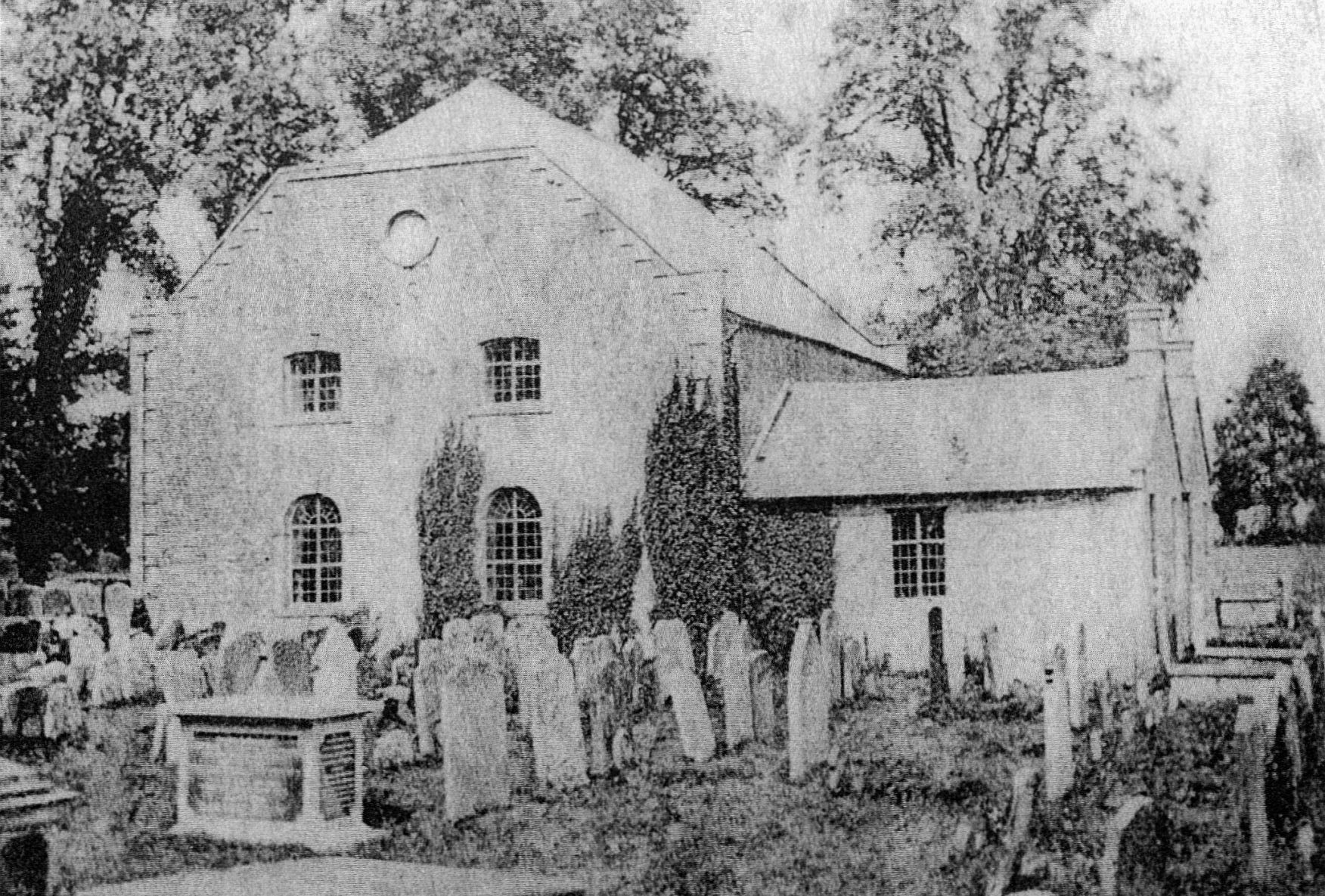
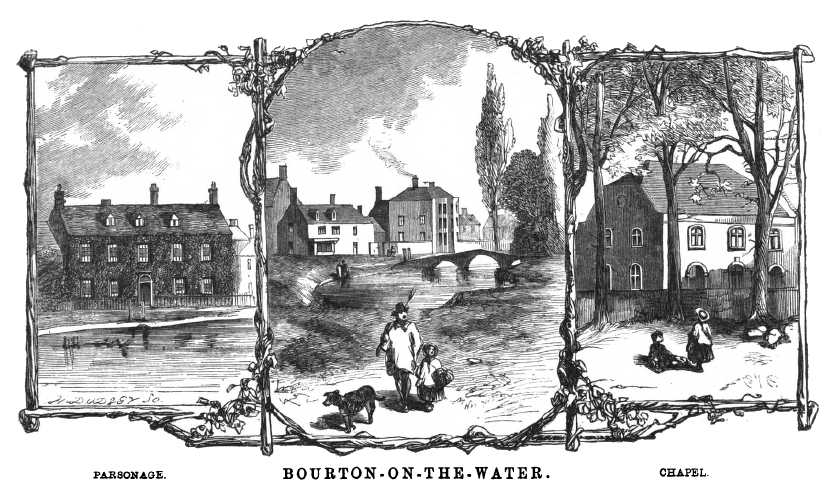
Old Bourton Chapel

Image result for beddome bourton chapel
The old chapel Bourton

Bourton Postcard

Click to enlarge
Not sure where this postcard is from but it shows Beddome's manse and the old chapel

05/12/2011

Richard Mosely 1746-1819

The Baptist Magazine of the time, reporting on the death of Richard Mosely, minister at Grittleton, six miles from Chippenham, Wiltshire, from 1776, mentions that his  "parents were members of the church at Bourton-on-the-Water, under the care of the venerable Benjamin Beddome". Mosely was born in Stow, Gloucestershire, June 12, 1746 and was baptized in 1762, joining the Baptist Church at Upton. Called to the ministry in 1774, he was ordained by his tutor Caleb Evans along with John Tommas and Benjamin Francis. He died August 12, 1819. The obituary drawing on a letter from a Mr Martin says he was "a very pious and laborious minister". (This Martin is perhaps the one mentioned in connection with Sheepshead as a source of Beddome hymn material).

30/06/2011

Covenant signatories 1720

In his book about the Bourton on the Water congregation Pictures of the past Thomas Brooks draws attention to a covenant drawn up and signed by the church in 1720. The covenant can be seen on pages 18-20 of Brooks. He says that
The names of 24 men and 26 women are annexed to this interesting document. The church contained therefore 50 members on that day. Considerable additions were made to that number. The triumphs of the gospel and the spread of their distinctive principles may be judged by the fact, that within three years from the formation of the church 47 members were added by baptism.
He does not give the names but they are listed in an article on the Bourton Church Covenant in the Transactions of the Congregational Historical Society, which arises from a discovery of the document among a bundle kept at the Congregational Library.
The list is in four sections and is as follows:

Column 1, section 1
The mark of ^ Willm Arkull
Thomas Blizard
James Roberts X
Andrew Paxford
Rebekah Paxford
Powis Collett
Thos Bishop
Samuel Fox
John Farmar
Thomas Edgarton
James @ Strang his mark
John Collett
Joseph Straing

Column 1, section 2
Anne Collett
Ruth Collett
Ann Strainge
Mary Beart
Elizabath Pinock
Mary ( Richins 
Mary [illegible] 
Mary Rafe
Thomas Collett
John Raynolds
Estar Haynes 
John Walker 
John Mabbs(?)
Mary Walker
Catherine Bishop
Sarah Farmar
) Elizabeth Blisard
Joyce Collett
John Charlwood
Aubery X Moris 
John Strainge
John Straing
Mary Roberts
William Roberts
Henry Humphris
Sarah Harris
Lawrance Dyer
Sarah Straing
Column 2, section 1
Richard Straing
John Rubee
Jonathan Turner
Howard Fox
Mary Hunt (?)
Mary Collett
Eliz. Hinman (?)
Denis + Ruby (?)
Jan Limbard (?)
Mary Hayward
Ann X Egerton
Sarah Rawbone
Hanah Cook
Eliz. C. Renolds

Column 2, section 2
Hannah Paxford
Ann Cooke
Elizabeth Farmar
Elizabeth Rowe
Mary Hathaway
William Fox
Jane Collett
Elizabeth Churlob
Ann Collett
Ann Coombs (?)
Thomas Ellis 
Sarah Morris 
John Fhluck (?)
Robert Fluck
Elizabeth Wane
Mary Humphris
[illegible] Love Collett
Ann Gibbs
Ann Farmar
Samuell Fox
William Nickol
Sarah Kite
Martha Bosner (?)
Sarah Preston
Sarah Ffox
Elizabeth Raynolds
 
Many of the names are similar or the same as is clear when set out alphabetically like this:
The mark of ^ Willm Arkull, Mary Beart
Catherine Bishop, Thos Bishop
) Elizabeth Blisard, Thomas Blizard
Martha Bosner (?); John Charlwood
Anne Collett, Ann Collett [illegible], Jane Collett, John Collett, Joyce Collett, Mary Collett, Love Collett, Powis Collett,Ruth Collett, Thomas Collett
Ann Cooke, Hanah Cook
Elizabeth Churlob; Ann Coombs (?); Lawrance Dyer
Ann X Egerton, Thomas Edgarton
Thomas Ellis
John Fhluck (?), Robert Fluck
Ann Farmar, John Farmar,Elizabeth Farmar, Sarah Farmar
Howard Fox, Samuel Fox, Samuell Fox (sic), Sarah Ffox, William Fox
Ann Gibbs; Mary Hathaway; Estar Haynes; Mary Hayward; Sarah Harris; Eliz. Hinman (?)
Henry Humphris, Mary Humphris
Mary Hunt (?); Sarah Kite; Jan Limbard (?); John Mabbs(?)
Aubery X Moris, Sarah Morris
William Nickol
Andrew Paxford, Hanah Paxford, Rebekah Paxford,
Elizabath Pinock; Sarah Preston; Mary Rafe; Sarah Rawbone
Eliz. C. Renolds, Elizabeth Raynolds, John Raynolds
Mary ( Richins
James Roberts X, Mary Roberts, William Roberts
Elizabeth Rowe
Denis + Ruby (?), John Rubee
Ann Strainge, James @ Strang his mark, John Strainge, John Straing (sic), Joseph Straing, Richard Straing, Sarah Straing
Jonathan Turner
John Walker, Mary Walker
Elizabeth Wane
Mary [illegible]

No doubt a good number of these were around when Beddome came to Bourton from 1740.

21/05/2011

Protestantism in Bourton

This is from the entry in the English county history series, A History of the County of Gloucester: Volume 6 'Parishes: Bourton-on-the-Water' (1965), pp. 33-49. URL: http://www.british-history.ac.uk/report.aspx?compid=66425

Protestant Nonconformity.
Bourton has long had a strong tradition of religious nonconformity, which can be traced as far as the late 16th century when the puritan divine, Richard Stock, was domestic chaplain to the lessee of the manor. Anthony Palmer, ejected from Bourton rectory in 1661, removed to London, but another Congregationalist, John Dunce, who may have been Rector of Condicote during the Interregnum, was preaching at Bourton in 1667 and was given a licence for a meeting there in 1672. Figures for 1676 suggest that Bourton had a higher proportion and a far higher number of Protestant dissenters than anywhere else in Stow deanery.
The main strength of dissent in Bourton has been with the Baptists. The Baptist community there, said to have been founded in 1650, was represented by three men at the Baptist meeting of 1655 at Warwick. In 1660 two Bourton men were preaching as Baptists in Bury field (perhaps exploiting the ramparts of Salmonsbury); one of them was Thomas Collett, possibly the man who owned Nethercote manor, was a dissenting preacher in 1715, and was buried beside the Baptist chapel in 1720, and whose house was licensed for meetings in 1689. A barn licensed later the same year may have either replaced it or provided for another group of Baptists. Collett's group were Paedobaptists: in 1700 they opened a graveyard in Salmonsbury and in 1701 their newly built chapel was licensed. The group, however, seems not to have survived separately for very long, and to have been absorbed by another group of Baptists led by Joshua Head who was preaching in Bourton in 1690 and died in 1719. The absorption may have taken place after Head's death, when 48 Baptists signed certain articles of agreement, or perhaps in 1735: the licensing of two houses as meetings in that year may be the result of re-alignments among the Baptists, and in the same year a diocesan survey recorded that a congregation largely composed of Anabaptists heard sermons on alternate Sundays from an Anabaptist called Flower and a Presbyterian grazier called Collett, perhaps another owner of Nethercote: the distinction between Anabaptist and Presbyterian may be a mistake for that between Baptist and Paedobaptist. That the Baptist community in Bourton was in some confusion is attested in 1724 by the simultaneous licensing for dissenting worship of the houses of John Collett, Andrew Paxford, and Thomas Kyte, all in Bourton; the denomination is stated for none of them, but the first two have names with strong Baptist associations.
By 1740, when Benjamin Beddome, the hymnologist, began his 45 years as Baptist minister of Bourton, the Baptists appear to have been united, meeting in the chapel built in 1701. In 1748 a manse was built, and the chapel was rebuilt. A new chapel was opened in 1765 on the occasion of the meeting in Bourton of an association of 15 Baptist churches. The numbers of Baptists in the Bourton congregation rose from c100 in 1735 to nearly 200 in the 1750's; it included people from many neighbouring parishes, Naunton and Stow-on-the-Wold among them, and the severance of those places under their own ministers accounts for the apparent drop in numbers at Bourton before 1795. Beddome's death in that year was followed by dissension among the Baptists of Bourton, and it was not until 1801 that they were again united under a single permanent minister. By then the numbers had dropped to 47, and from this time the community was one of Particular Baptists. In the 1850's the membership was nearly 100, and was said to include a high proportion of the wealthier inhabitants. Congregations of over 400 were claimed.
The 18th century chapel, the site of which was visible in 1962 in the graveyard off Station Road, was replaced in 1876 by the church, built of stone with a Welsh slate roof, at the High Street end of Station Road. In 1962 the church, which was in membership with the Baptist Union, had branches at Aston Blank and Clapton, and membership totalled over a hundred.
The old manse was sold in 1928, and a new one built in Moore Road. The proceeds, £653, of the sale in 1950 of land belonging to the chapel was invested in stock, and another £300 was given for the maintenance of the church under the will of C V Wilkins (d 1951).
Rooms in private houses were registered for worship in 1829, 1831, and 1845 (the last two, apparently, for the same group). A Zion chapel in Lansdown, registered in 1843, may have been Methodist, but no return for it was made in 1851. By 1872 it was used as a school, and continued as such until 1902. The chapel was apparently the building converted into a private house by 1962 and bearing an inscription stone from which all but the date 1842 had been erased. A Primitive Methodist chapel in Clapton Row was built in 1868; in 1904 it became a Christadelphian meeting, and was still so used in 1962.

29/07/2010

Hayden 06

On page 88 Hayden also quotes the Bourton church book of April 20, 1781, referring to Turner of Abingdon at the double lecture in Abingdon speaking of revival among Baptists in South Carolina. Some 851 had been baptised.
Hayden goes on to write about the double lecture established among the churches (Abingdon, Fairford, Wantage, Cirencester, Co(a)te and Bourton) 1774-1788. In the six summer months there would be a double lecture (an older and a younger minister preaching) at each of the churches in turn. He gives a typical list for 1774

Fairford: [James] Biggs [Wantage] and [Daniel] Turner [Abingdon] [April]
Wantage: Caleb Evans [Bristol] and Joseph Stennett [London] [May]
Co(a)te: Beddome and Biggs [June]
Cirencester: [Samuel or Thomas] Dunscombe [Cheltenham or Coate] and Turner [July]
Bourton: Biggs and Turner [August]
Abingdon: [Thomas] Davis [Fairford] and Beddome [September]
He gives other details and says that Beddome was usually preaching twice a year at these meetings.

28/07/2010

Hayden 04

Hayden has a section on Beddome (pages 80-92).
He suggests that he was involved in medical studies with Foskett (always writing prescriptions for people) first before switching to theology. Hayden calls him "witty and vivacious". He then gives the story, as found elsewhere on this blog, of Beddome's conversion, baptism, call and settling at Bourton. He gives the date for the building of the manse as early as 1741. He also mentions how early on the Stow church (23 members) officially disbanded and Beddome agreed to supply once a month with the Lord's Supper once a quarter.
He then spends some pages on the London call.
On page 87 he says that Beddome discovered Jonathan Edwards early on and may have been the one who introduced Ryland to him. The distinguishing marks of 1741 was in his Library by April 1742.
Referring to the church books, he mentions the strong Association involvement and visits from other ministers. As examples he mentions
July 12, 1752 Collection for Bro Whitewood of Reading
May 11, 1760 Collection for Bro Hall and Arnsby people
November 9, 1766 For fire in Montreal, Canada
June 3, 1770 For Joshua Andrews of Abergavenny (prompted by Joshua Thomas Leominster)
He also mentions fast days
June 18, 1756 French War
August 13, 1756 War and harvest
April 22, 1757 French War
November 13, 1776 American War
The last a recurring theme.

12/07/2010

POTP 10

Chapter 4 Continued

The new chapel appears to have been opened in August, 1765. In that year the Association met at Bourton, and as the new chapel would not be ready at Whitsuntide it was agreed to defer the meeting to Wednesday, August 14th. In the letter to the Association on that occasion, the church says,

"'Tis with pleasure we think of seeing your faces once more in the flesh, and though the unfinished state of our place of worship, and the difficulty of providing suitable accommodation for you in a country village, are some damps to our joy, yet, hoping that your great Lord and Master will make up in spiritual delights what is wanting in outward convenience, we bid you heartily welcome."

Wednesday, August 14th, 1765, became a red letter-day in the memory of the "Saints and faithful brethren" at Bourton. And the interest attaching to it, spread far and wide. There were but 14 churches in the Association, but there was twice that number of ministers present. There were the Rev Messrs Tommerson, of Cheshire; [James] Sleep, of Eisborough; [Benjamin] Wallin, of London; [William] Stanger, of Towcester; [Thomas] Davis, of Fairford; Thomas, of Henley-in-Arden; [John] Knight, of Warwick; [James] Turner, of Birmingham; [John] Ash, of Pershore; Jones, of Upton; [Samuel] George, of Wantage; Darby, of Witney; [Nathaniel] Overbury, of Tedbury; [Benjamin] Francis, of Horsley; [Thomas] Ferriby, of Sodbury; [John] Macgowan, of Bridgenorth; [Lawrence] Butterworth, of Bengeworth; [Thomas] Skinner, of Alcester; [Isaac] Woodman, of Sutton; [Nathaniel] Carpenter, of Middleton Cheney; [William] Hitchman, of Hilsley; [John?] Davis, of Campden; Caleb Evans, of Bristol; [James] Butterworth, of Bromsgrove; [Joshua] Thomas, of Leominster; [John] Heydon, of Tewksbury; [Benjamin] Whitmore, of Hooknorton; besides Beddome, Reynolds, and Strange, of Bourton. This was no mean gathering for a country village, in an age when railways were unknown. And there was a large congregation of hearers, as well as a great company of preachers. Good Mr Beddome says, that in addition to vehicles of all other kinds, "there were eleven or twelve post-chaises at our Association," clearly indicating that some had come from places not very near to Bourton.
The period of 30 years, from 1765 to 1795, is not destitute of interest, but, unhappily, the interest of those years is mostly of the mournful kind. The state of things in the country was gloomy and depressing. The price of bread was frightfully high, the result of war and deficient harvests. The poor were familiar with privation and suffering, the bare recital of which makes both our ears to tingle.
The very cattle seem to have been visited with unusual disease. Year after year days were set apart for solemn prayer and fasting.
The fasting, indeed, was no new or novel thing to some who engaged in these services. Many such things wore with them, and must have been still more, but for the alms given on these occasions. At Bourton chapel, there was invariably a collection for the poor on the solemn fast-day, and the proceeds were distributed principally in money, but some were supplied only with a shilling loaf. Auspicious day, that brought a shilling loaf at nightfall!
But there were "greater things than these," trials more fiery, sorrows more huge. "The ways of Zion mourned." Not that the congregation was "minished and brought low," but the church declined. Few, very few, were added during these years. During the period of 31 years, viz, from 1765 to 1795, both inclusive, there were 16 years in which not a single soul was added to the church by baptism. It was so in the years 1765, 1766, 1768, 1769, 1770, 1771, 1772, 1775, 1777, 1783,1786, 1790, 1791, 1793, 1794, and 1795. It will be seen that there was one period of five years without a single baptism, viz, from 1768, to 1772.
The letters to the Association during this period were most mournful; year after year hope was expressed, until "hope deferred made the heart sick." In 1786 the Association met at Alcester, and Mr Beddome, for the church, wrote as follows

"Beloved In Our Lord Jesus Christ,
"Our harps still hang upon the willows, for though God once smiled on us, and we sensibly experienced his quickening and comforting presence, he now frowns, and we mournfully complain with the Prophet, 'Verily thou art a God that hidest thyself.' In the years 1763 and 1764 we had thirty members added to our community, and thirteen in the year 1766, but since that we have been upon the decline. So that from 170 we are diminished to about 100 members, none being added, but two removed during the past year. We have once and again mentioned our flattering prospects; but the prisoners, though, we trust, prisoners of hope, don't manifest an inclination to go forth and shew themselves. Notwithstanding this, which is indeed matter of lamentation (and we hope you will sympathize with us, - and spread our case before the Lord), yet we have reason to be thankful that our auditory keeps up surprisingly.''

During the whole period of 31 years, 53 persons were added to the church by baptism, six were received by letter from other churches, 105 were removed by death, 12 were dismissed to other churches, and two were excluded for immorality.
The result was, that in the year 1795 the church consisted of 123 members: just 60 less than in the year 1764.

POTP 09

Chapter 4 begins with some statistics. In 1743, when Beddome arrived in Bourton there were 100 members. In 1751 there were 180 (as reported to the Association, meeting at Tewksbury). Brooks goes on

"The measure of prosperity vouchsafed to the church during the 14 years following was very variable, as indicated by the letters to the Association. Three years elapsed during which not a single soul was added to the church, viz, 1752, 1753, and 1754. During this period 15 were lost by death, and three by dismission, reducing their number to 162. Very trying to pastor and people was this period, but "The Lord can clear the darkest skies," and with 1755 came the time of refreshing, 22 persons were added by baptism. Among these were Mrs Beddome, Mrs Patience Kimber, of Burford, Mr Kyte, of the Upper Mill, Mrs Mary Kyte, and Elizabeth Wood, of the Folly Farm."
So by 1759 membership was 160, less by two than in 1753.
"The period of depression which had now set in, continued until 1764, when 28 were added by baptism. Many had been lost by death, and the church now contained 183 members, just three more than in the year 1751, being a clear increase of three members in 13 years.
During all this time, the congregations had been large and increasing. Seed-time and harvest are observable in the church as well as in the world. We must not condemn a man because he is not always reaping, "He that goeth forth and weepeth, bearing precious seed, shall doubtless come again with rejoicing, bringing his sheaves with him."
In the year 1763 the church enlarged the burying ground, by the purchase of a piece of land for the sum of £5, and to increase the available space within the chapel, they "turned the gallery stairs without doors." Mr John Collet gave the stones for walling in the new ground, and others gave the drawing. The cost of the whole, in money, was about £38. Of this sum, William Snook, Esq, contributed £10 and Mr Beddome £5.
We have seen our fathers building a new chapel in 1701, erecting a house for their minister in 1741, "enlarging and repairing" the chapel in 1748, and strengthening the same in 1750. We must now notice a work which exceeds in magnitude either of the preceding. The following extract from the church-book, will set it clearly before us—
"Oct 10, 1764. We entered upon a subscription for enlarging and rebuilding our meeting house, in which Mr Snook was the principal actor, and of which he was the most generous promoter. The old meeting-house, though altered and enlarged, was neither convenient nor sufficiently capacious, yet most were contented. However, through the indefatigable application of Mr Snook, the new building was erected."

The dimensions of the new chapel were 45 by 35 feet. Materials from the old chapel were used as far as possible. Exclusive of these, the cost of the new building was £473 14s. 10d. Towards this £69 was received as "Benefactions from abroad." These were almost exclusively from London. Dr Stennett procured and sent 20 guineas; George Baskerville, Esq, contributed 10 guineas, and sent 10 more from a friend. Of the £404 raised by the church and congregation, Snook gave £128 7s., ie £100 plus the pulpit, sounding-board, etc, which cost £28 7s. Beddome contributed £30. The rest was raised by smaller subscriptions, ranging from £20 to 5s.

"It must not be overlooked, however, that much work was given, as well as money. And but for this the cost of the building would have appeared to be much greater. "Mr Snook employed his team and servants almost continually. Mr Boswell sent his team 24 days; Dr Paxford 24 days; Mr Truby five days; Thomas Cresser one day; John Strange six days; Mr Eadburn two days; Mr Hurbert six days; Robert Taylor two days; Mr Bosbery one day; William Wood two days; John Hurbert, labourer, gave a week's work, and John Phillips gave the same with self and horse."

POTP 08

In the third chapter of his church history Thomas Brooks describes how in November, 1750, an attempt was made to induce Beddome to leave Bourton. His former pastor, Samuel Wilson, had died and the church at Goodman's Fields in London wanted Beddome to succeed him. Brooks reproduces many of the letters that passed between the churches in this matter. These are the letters used by Ken Dix in his study for the Sstrict Baptit Historical Society a few years ago and that are copied out in one of the church books.
1. The first letter is the original approach from the London church to Beddome. It was signed by five deacons and 30 members at a church meeting, November 11,1750. Brooks also gives the attached remonstrance or plea.
2. Next follows Beddome's letter saying that he would put the matter to the Bourton church.
3. The church took a month, according to Brooks, to prayerfully consider the matter before unanimously answering in the negative. The answer was drawn up by deacons John Reynolds, John Reynolds Jun and Richard Boswell (Beddome's father-in-law). That letter is also reproduced. It was signed by 37 male members at the church meeting, December 16, 1750.
4. Not content with this, the London church then sent a second letter (again reproduced) this time to the church at Bourton, arguing their case, in light of a resolution at their church meeting of February 3, 1750/1. It was signed by the deacons on behalf of the church.
5. This second application called forth a reply from Bourton, drawn up by the deacons again. This one was read, approved and signed, on the Lord's Day, February 24. Brook says that at the same time the pastor read his answer to the said letter, also in the negative, for which the Bourton church was thankful. Both are given in extenso.
Brooks comments that

“comparatively few ministers are ever called to pass through an ordeal as trying as the one disclosed in the above correspondence, and it may be safely affirmed, that none ever came out with more credit to themselves. By this circumstance, Mr Beddome's uprightness, disinterestedness, and simplicity, are placed above suspicion. We are not surprised to hear that his people were provoked to love and good works. "Shame and confusion" would have belonged to them, had they failed to love him heartily. They strove, however, with fresh zeal to promote his comfort. And first of all, they determined to get out of debt. This debt was contracted partly by the building of the minister's house in 1741, partly by the enlargement of the chapel in 1748, and partly by "strengthening" the chapel in 1750.”

Brooks then quotes Beddome on this:

“In 1750 an unfortunate circumstance happened, which increased the church's debt, for after we had repaired and enlarged the Meeting-house, the main beams of the galleries being poplar, and plastered in whilst they were too green, they rotted away as also many of the joists. So that there was a great danger of the galleries falling, nay, and of the roof too, which then bore upon the galleries. Upon this new beams and joists were provided, the galleries put a foot back, and their seats raised, and two upright pillars put to support the roof independently of the galleries. The charge of which was £25 6s 8d”'

He also quotes from Beddome's own record in the church book regarding subsequent events with regard to the call to London.

“Dec, 15th 1751 Our pastor acquainted us that he had lately received a letter from some of the members of Mr Wilson's church in London, giving him an account, that by reason of difference among the members of said church, about Messrs Reynolds and Thomas, some being for one and some for the other; they were likely to be greatly distressed if not broken in pieces, and that both parties would unite in him if he could now consent to leave his people. That this being the only probable method of preventing a breach, they were forced again to have recourse to him. He also acquainted us that last Wednesday, upon desire, he gave Mr Ball and Mr Hattersly, the meeting at Burford, who renewed their solicitations, pressing his coming to London, not only from all the arguments before used, but from others taken from the present urgent necessity of their affairs. Our pastor, therefore, desired us to pray over and consider the matter till Wednesday, the 25th instant, when he would call a Church-meeting, and receive our answer, by which at present he intended to be guided.
Dec 25th Returned for answer to said pastor, that we could not see the state of the London church to be so distressed as represented, and that if it was, we could not consent to cast ourselves into the same or greater distress in order to help them.”

07/07/2010

POTP 07

This is the final part of Chapter 2 of Brooks Pictures from the past

When Mr Beddome became pastor of the Church at Bourton he took up his residence at Lower Slaughter, in the house of Mr Head (this cannot be the nonconformist Joshua Head as he died in 1719 but this may well be a relation), where he continued till September, 1749; but then, as he intended marrying, he removed to Bourton. A dwelling had been provided by his people some years before. "In 1741, the Church resolved to build a dwelling house for the use of their minister, there being no convenient one either to be let or sold in Bourton for that purpose." Every item in the cost is carefully recorded, down to "odd things, bread, cheese, beer, etc." The sum total was something more than £350. This sum, with the exception of about £40 from a few of Mr Beddome's personal friends, was raised by the church and congregation. Mr Beddome has recorded every subscription (taking great care to preserve the identity of each donor), from "Mr John Reynolds sen, £45 0 0" to "Molly Hanks, the Mantua maker 2s 6d" and "Nanny Strange, Joseph's daughter, 2s."
While Beddome was thus preparing to be married and settled at Bourton, his father was seeking, with great perseverance, to lure him to Bristol. Such was the estimate formed of the value of his labours, that he was warmly solicited to become co-pastor of the Pithay church, Bristol. On this subject his father addressed many letters to him, one of which will show how earnestly he pleaded with his son.

“October 28,1748, My Dear Benjamin,
I wish from my heart, the Lord would incline you to come to this city. Here you would have a comfortable income, and a better people than you take them to be. They very much desire you. and are willing to make extraordinary efforts for your comfortable support. But my principal reasons, why I so much desire your removal are these: (1) It would save a large number of people from sinking (2) My children would be all together (3) It would be a great comfort to your poor mother to sit under your ministry (4) You would have less labour, an honest, good-hearted man to be your partner, much good conversation for your improvement, and an abundant harvest of souls, as well as anywhere else.”

But none of these things moved him. Seven years before this he had recorded his wish

My dwelling-place let Bourton be,
There let me live, and live to thee

And he was "in one mind" and none could turn him.
In the "wish" named above, he had also said first

Let the companion of my youth
Be one of innocence and truth;
Let modest charms adorn her face,
And give her thy superior grace.
By heavenly art first make her thine,
Then make her willing to be mine.

These conditions appear to have been met in some measure, by Miss Elizabeth Boswell, to whom he was "joined in matrimony," December 21, 1749.
She was the daughter of Mr Richard Boswell, of Bourton, who was a deacon of the Church, and a most valuable man. Had this engagement anything to do with his determination to abide at Bourton? Did Miss Boswell strongly object to quitting the "Golden Valley" for the smoky city? When Mr Beddome gave her that letter from his father, to read, and, with tears in his eyes, pointed out the reason No 3, involving the comfort of his "poor mother," did she smiling sweetly, say "For this cause shall a man leave his father and his mother?" We cannot tell. It is not in evidence; but we cannot help thinking that the Church at Bourton was fortunate in having " specially retained " on their side Miss Boswell, instructed by her father. It was not a light thing, in a secluded village, to have secured for so many years the services of Benjamin Beddome.
And here we must not omit the fact, that prior to this event the chapel became too strait for the congregation, and being "very much decayed in several places, they resolved to pull down a great part of it, and enlarge and repair it." This was done at a cost of £118 15s 6d in the year 1748, costing more than the original chapel in 1701. It is pleasing also to perceive that this church, favoured in the possession of an "able minister," was producing others who were destined to be the pastors of other churches. In 1750, the Rev John Ryland, after repeated trials of his gifts, was dismissed to the Baptist church at Warwick, to become its pastor; and the Rev Richard Haines, to the Church at Bradford, Wiltshire, for the same office there. In addition to these, Mr John Reynolds, jun, "having been under the care of Mr Foskett of Bristol," for the increase of his learning, "almost two years, was permitted by the Church to exercise his gift occasionally, till they saw fit to give him a more full and solemn call."

POTP 06

This is the next bit of Chapter 2

Here it may be well to record the fact, that, shortly before the “fixing of their pastor, Benjamin Beddome” the church at Stowe had become one with the church at Bourton. The transaction is thus recorded

“Copy of a paper signed by the members of Stowe church, March 19, 1742/3
“Whereas we, whose names are underwritten, (being formerly members of the Church of Christ meeting at Stowe, commonly known by the name of Baptists,) having by a church act dissolved ourselves, and looking upon ourselves no longer as a distinct church, have also made application to the Church of Christ meeting at Bourton for communion and fellowship with the said church. We do hereby confirm that our application, and profess, that we no longer look upon ourselves as a distinct body ; but as members of the said church at Bourton, in conjunction with which we desire to be fed with the sincere milk of the word, and attend upon those ordinances which were instituted as well for the glory of the Redeemer, as the comfort of our souls.”

This document is signed by 23 persons, male and female, and is followed by articles of agreement between Bourton and Stowe churches.

“I. No longer to look upon themselves as two distinct and separate bodies, but as one Church ; and as members of that one church, reciprocally to watch over one another, pass church acts, exercise church discipline, &c.
II. That the minister resident or preaching at Bourton, shall preach at Stowe in the afternoon one Lord's day in the month absolutely, and oftener, if providence order it so that the meeting at Bourton may be supplied at the same time.
III. That as long as there may be any persons living about Stowe, who cannot comfortably sit down at Bourton and there partake of the ordinance of the Lord's supper,' and are desirous to have that ordinance administered at Stowe; it shall be so administered by the pastor of the church at Bourton, at the most expedient seasons, three or four times a year.
IV. That whenever there may be twenty or thirty members, living nearer Stowe than Bourton, having a prospect of being supplied with an orderly minister of the same perswasion, and desirous of re-embodying themselves ; a liberty shall be granted them to renew and keep up a separate church state, as before this union.
V. That if any persons formerly belonging to Stowe church, shall refuse to comply with this act of that church ; and upon proper application, shall persist in their refusal, they shall be looked upon as withdrawing from the communion of the church, and their names expunged out of the list of members, unless they desire their dismission to any other church, which shall be granted them."
We are not surprised to find that this did not give perfect satisfaction. The Stowe people were certainly put upon very low diet. The result was that “after some time Stowe people complaining that one day in the month was not sufficient, and also proposing to raise something independent of Bourton, for the support of the ministry, if another opportunity might be granted them, it was agreed that they should be supplied twice a month. The minister not lessening his labours at Bourton on one of those days.”

We must not forget that the "flock" of which Benjamin Beddome had taken "the oversight" was spread over a spacious field. The Church contained about 100 members. They resided at Bourton, Lower Slaughter, Upper Slaughter, Naunton, Barton. Hawling, Saperton, Clapton, Farmington, Great Rissington, Little Rissington, Burford, Longborough, Dunnington, Swell, Stow, Broadwell, Icomb, Chipping Norton, and Hook Norton. The Church at Bourton was therefore composed of persons residing in 20 parishes – a fact often overlooked in the present day. We rejoice that it is not so now, our neighbours "have no such lengths to go, nor travel far abroad" because this mother-church sees her children rising all around.

POTP 05

Brooks continues in Chapter 2

During the period we have now reviewed, Mr Beddome had repeatedly visited Bourton-on-the-Water. His first visit was paid in the Spring of 1740, and many persons were added to the church during the three years following. During this time his ministerial labours seem to have been divided between Bourton and Warwick. In July, 1743, the church at Bourton invited him to become their pastor. He had now to choose between Bourton and Warwick. Upon this subject his father writes

“As to the continuance of your journeys between Bourton and Warwick, you are the best judge. If your strength will permit, and the people's desire remains strong, and there is a prospect of serving the interests of religion at both places, to my judgement, it may be best to continue some time longer; and if you pray fervently, and commit your way to the Lord, you will see the leadings of his providence. 'The meek will he teach his way.' Take notice of the feelings you are subject to, and the assistance you obtain at each place, and consider where the gospel is most needed and most likely to be received, for that place will yield most satisfaction to a gracious mind. We are not so much to consult our own ease and pleasure, as to honour Him who made us, and promote His interests.”

Having received many very pressing invitations from the church at Bourton to become their pastor, he at length acceded to their request, and was ordained September 23, 1743. On that occasion, Mr Foskett, of Bristol, gave the charge to the pastor, (from 1 Tim iv 12 "Let no man despise thy youth; but be thou an example of the believers, in word, in conversation, in charity, in spirit, in faith, in purity,") and offered the ordination prayer. Dr Joseph Stennett preached to the people, from Heb xiii 17; and other parts of the service were taken by Messrs Haydon, Cook, and Fuller, of Abingdon. His venerable father was not present on this interesting occasion, owing to his incapacity for travelling, but sent the following letter, expressing the feelings and desires of his heart

“I should have been glad to have attended your ordination, but cannot. I never expect to travel so far on horseback more. I hope what you are about to take upon you, will be a stimulus to you, to walk more closely with God than ever, and make you more sincerely and simply concerned for the good of the souls of men. I desire, with my whole heart, that an unction of the Holy Spirit may be poured out upon you at the laying on of the hands of the Presbytery; and that your faith therein may be strong.”

Our fathers were careful to state clearly, on such occasions, the engagement between the pastor and the church. In this case, a document was drawn up, adopted by the church, and signed by 18 of its members, in behalf of the whole, on the 16th day of September, 1743. The following is a copy.

“We, the church of Christ meeting at Bourton-on-the-Water, Having solemnly called, and set apart, our beloved brother, Benjamin Beddome, to the office of teaching elder to us, do hereby declare, that we don't intend to bring him under any such special obligation to us; but that if the providence of God calls him elsewhere, or he upon valuable considerations, doth desire his release from us, we will give up our right in him, as if he had never stood in any such relation to us. In witness whereof we have put our hands, etc.”

Well, it was something to know that they had not bored his ear through with an awl, and bound him to serve them for ever. It would be possible to get away.

POTP 04

This is the next part in Chapter 2
 
His father appears to have been a wise and faithful counsellor. The following is an extract from a letter written by him to his son about this time.

"I am pleased to hear you have given yourself to a Church of Christ; but more, in that I hope you first gave yourself up to the Lord to be his servant, and at his disposal. And now, I would have you remember, that when Christ was baptized he was soon tempted of the devil; and I believe many of his followers, in that, have been made conformable to their Head. So also may you, therefore, of all the evils you may find working in your heart, especially beware of spiritual pride and carnal security."

According to the custom of the Baptist churches, he was requested to preach before the church, and did so, January 9 and February 28, 1740. The result was, that the Church called him to the work of the ministry. His father seems to have thought this rather premature, and wrote to his son as follows

"May 21, 1740. Dear Benjamin,
"I am sorry Mr Wilson is in such a hurry to call you to the ministry. It would have been time enough just before you came away; but supposing it must be so, I think you should not preach in public above once or twice, at most, at your own place, and nowhere else, except Mr Stennett, or his people, ask you, and if the latter do it, you may serve them as oft as their necessities require. The Lord, I hope, will help .you to make a solemn dedication of yourself to him, and enter on the work of the Lord with holy awe and trembling. I hope to get sundry friends in this place to beg assistance for you, and a blessing, on Thursday next.”

Thus did he continually. How much may these paternal counsels and fervent prayers have contributed to the eminence and usefulness which marked the career of his beloved Benjamin! Nor were these faithful admonitions and wise counsels confined to what might be regarded as the weightier matters. He deemed nothing unimportant that stood related to the ministry, and might therefore either help or hinder its success.
It appears that Benjamin Beddome, like too many young preachers, fell into a hurried mode of delivery. The result was, that his voice, like a horse with the bit between his teeth, became unmanageable, while the effort of the preacher became painful to the hearer. His father became aware of it, as also of the fact that another evil habit was in process of formation, viz, that of making his sermons too long ; and came down upon him with great force, in two loving letters. We take from them the following extracts

"Bristol, May 17, 1742.
My Dear Benjamin, I wish from my heart I could prevail with you not to strain your voice so much in the delivery of your sermons; and if you would make them shorter, and less crowded with matter, it would be more acceptable and edifying to your hearers, and more safe and easy for yourself. Strive, then, to comply with this advice, which is given in great affection, and, I think, with judgment. If you deliver the great truths of the gospel with calmness, and with a soft, mellow voice, they will drop as the gentle rain or dew. For the good of souls, then, and for your own good, be persuaded to strive after this."

"August 6, 1742.
My Dear Benjamin, I cannot but advise, and carefully press you, to strive with all your might to soften your voice, and shorten your sermons; for it would be better both for you and your hearers. I say this, not merely from myself, but from many of the most judicious I know. I lately heard a great man say, that if you could deliver the matter you produce in the same manner as Mr Evans, you would be more popular and useful than ever you are likely to be if you retain your harsh mode of speaking. Mr Grant, not four days ago, said the same things in other words; and I well know, that those of your people, who have the best sense, (ie common sense) have said to several, that if you would strain yourself less, and shorten your sermons, it would be better for all. What all say, give ear to. Of one discourse I beg you will make two, and so take care of your health and comfort. Let two hours be the longest time you spend in the pulpit at any place. This I leave as my special charge; and as I write with all the love and tenderness of a father, I hope you will consider these things."

Benjamin Beddome had probably read before he left home Psalm 141:5, Let the righteous smite me; it shall be a kindness; and let him reprove me; it shall be an excellent oil, etc and thinking this an opportunity for exhibiting his acquiescence in the sentiment, he largely profited by the kindness of his father; he held his voice with a tighter rein, and applied the scissors to his sermons.

POTP 03

Brooks' Pictures of the past Chapter 2 begins

We have spoken of the church, we regret that we cannot speak as certainly of the ministry of the same period. The only name that has come down to us is that of Mr Flower, and the only reference to him is connected with a list of subscriptions promised for his support. It reads as follows

“Whereas we hope the worthy Mr Flower purposes to settle with us as pastor, we whose names are underwritten do voluntarily and willingly subscribe to pay yearly for the support of his ministry, viz”

We know, from statements made subsequently, that the church was destitute of a pastor for many years; and, in 1750, they testify that many of them could then remember the death of two or three pastors who were very eminent and valuable men. Thus much, and this is all, we know of the ministry of that age. But there was mercy in store for this people. They tell us that “notwithstanding their many cries to Almighty God, he was pleased to withhold direct answers of prayer, till at length he graciously raised up, eminently qualified, and unexpectedly sent, our dearly beloved and Rev pastor, Mr Beddome, to our assistance, and inclined him, after our many solicitations and calls, to became our pastor”
This eminent man (the Rev Benjamin Beddome) was born at Henley-in-Arden, Warwickshire, January 23, 1717/18. His father, the Rev John Beddome, had purchased in that place a large house, which he fitted up partly for his own residence, and partly as a place of worship. When Benjamin Beddome was about seven years of age, his father removed to Bristol, where he became co-pastor with Mr Beazely, of the Pithay church, in that city.
The son, after receiving a suitable education, was apprenticed to a Surgeon-apothecary in that city. Some 20 years of his life had passed away, when his heart was opened to attend to the things belonging to his peace. He thus records the "event".

“Mr Ware, of Chesham, preached at the Pithay, Bristol, August 7, 1737, with which sermon I was, for the first, deeply impressed. Text, (Luke xv 7) 'Likewise joy shall be in heaven over one sinner that repenteth, more than over ninety and nine just persons that need no repentance.'”

He heard the character of the penitent described, and it at once became his own. So intense were his feelings, that he selected the most retired part of the chapel to conceal his tears. He found much relief, we are told, in reading the Scriptures and in prayer; and soon the tears of penitence were dried up by the “Sun of Righteousness”.
His own heart changed, he soon began to feel for the spiritual condition of others; and became desirous of devoting himself to the work of the ministry. With a view to this, at the close of his apprenticeship, he became a student in the Baptist College, Bristol, then superintended by the Rev Bernard Foskett, who was formerly co-pastor with his father at Henley-in-Arden. Having pursued his studies for some time at Bristol, he removed to London, for the purpose of completing his education under the tuition of Mr John Eames, at the Independent Academy, in Tenter Alley, Moorfields. Strange to say, he had not at that time became a member of any Christian church. Soon after his removal to London, however, he joined the Baptist church in Little Prescot Street, Goodman's Fields, under the care of the Rev Samuel Wilson, by whom he was baptized in September or October, 1739.

01/07/2010

POTP 02

Later in the book we have an interesting quotation from a letter sent from Bourton to the Association meeting in Oxford.

Since your former meeting, the Lord has added 17 to our number (the 14 mentioned last year as proposed, and three besides), most of these, however, had been some years before brought to God, but were prevented coming forward by the very unhappy condition of the church.
One (Thomas Kitchen) spoke of a sermon preached 20 years before by Mr Beddome, as the means of his conversion. He had never so much desired baptism as since he witnessed the baptism of 14 persons by Mr Coles, October 3, 1802. On that occasion he "wished himself among them." He, with two others, was baptised, April 3, and the most striking incident in connection with this service, was the contrast in the ages of two of the candidates. Thomas Kitchen was 75, and Elizabeth Wood 16 years of age. "We sang," says Mr Coles, "the following verse

To thee, the hoary head
Its silver honours pays;
To thee, the blooming youth
Devotes his brightest days;
And every age their tribute bring,
And bow to thee, all-conquering king!
(by Elizabeth Scott it was No 358 in Ash and Evans's Baptist Collection of Hymns, 1769, in 4 stanzas of 6 lines and by 'S')