From the Baptist Register
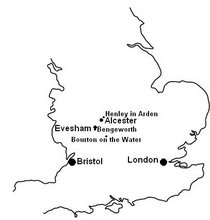
The Rev. Mr. Bernard Foskett, son of Mr. William Foskett, of North Crawley, in Bucks, a gentleman of good repute, easy fortune, and blessed with a numerous offspring, was born March 10, 1684-5, near Wooburn, in Bedfordshire, where he had an estate. And as he early discovered a taste for learning, he was put under the care of a very able master, with whom he soon made progress. He became experimentally acquainted with religion, in the early part of his life, and at seventeen years of age joined the Baptist church, then under the pastoral care of Mr. Pigott, in Little Wild-street, London, over which our excellent friend, the Rev. Dr. Samuel Stennett, I hope yet presides. About this time an intimacy had commenced between Mr. Foskett, and Mr. John Beddome, (the father of our venerable friend, the Rev. Benjamin Beddome, of Bourton on the water) some years after a respectable minister of the church in the Pithay. The friendship of Mr. John Beddome and Mr. Foskett was like that of Jonathan and David, and lasted through life. Mr. John Beddome was called to the work of the ministry by Mr. Keach's church, of which Dr. Gill was afterwards pastor, and was sent to Henley Arden, near Alcestor, in 1697, to assist the aged Mr. John Willis, pastor of that church, who died about 1705. A few years after the death of Mr. Willis, viz. in 1711, Mr. Foskett, who had been regularly called to the work of the ministry, and exercised his preaching talents several years, quitted the the flattering prospects of his profession in London, preferring the character of an able minister to that of a skillful physician, and removed to Henley Arden, a place to which his peculiar friendship for Mr. Beddome led him to give the preference. At Henley, at Bengeworth, and at Aulcester, these two worthies continued their joint labours, till the year 1719, when Mr. Foskett received a pressing invitation from Broadmead, to assist Mr. Kitterell, their pastor, and to become the tutor of the academy in the room of Mr. Jope, just removed into the west. This invitation he thought it his duty to accept, and in 1720, entered on his double charge with great seriousness and firmness. One who for upwards of twenty-four years served with him in the gospel of Christ, has favoured us with a biographical sketch of him, which demands a place in this essay.
His natural abilities were sound and good; and his acquired furniture, of which he never affected making a great shew, was very considerable. He had a clear understanding, a penetrating judgment, and a retentive memory. His application to study was constant and severe: but though he was of a retiring and contemplative disposition, yet he was not so far detached from the world, as to be wholly unpractised in the duties of social life. In the management of his temporal concerns he was inflexibly just and honest; in his counsels, prudent and faithful; in his friendships, sincere and steady; and though he was not a man of strong passions, yet in the relations of a brother and a son, he was tender and affectionate, dutiful and obedient. His conduct as a Christian, through a course of near sixty years, was most exemplary and ornamental. She that it may be truly said of him, he had few equals, hardly any superiors. Religion he considered not as a matter of mere speculation, but as an affair most sacred and important. How serious and regular he was in his private devotions, in his attendance on family and public worship, and every other religious exercise, they who best knew him will be readist to declare. Nor was his religion confined to the closet, the family, or the house of God, but happily diffused its sacred influence through his whole life. Few they were, if any, of the Christian virtues, that did not shine with a bright and distinguishing lustre in his temper and behaviour; to delineate them all would carry me too far: I must not, however, omit to mention what he was always careful to conceal, his disinterested and extensive benevolence; for in this, as in many other respects, in imitation of his divine master, he went about doing good. The necessitous and deserving without distinction partook of his bounty; but the pious poor he ever considered as the special objects of his regard. And while he often judiciously prescribed to the indigent sick, he generously supplied them with the means of obtaining what was necessary to their relief. And as the Gospel ever held the highest place in his esteem, his charities were chiefly directed in such a manner as tended most effectively to promote its interestes; so that the poor ministers of Christ shared very largely in his compassionate regards, and were multitudes of them refreshed by his liberality. Not did he confine his benevolence to those of his own sentiments only, but cheerfully extended it to many who differed from him. In a word, as his charities were thus generous and extensive, so the prudence, humanity, and privacy, with which they were conducted, secured to him the most cordial respect from those who shared of them, as well as merited the imitation of those who could not avoid knowing them. And as he was thus charitable whilst living, so in this respect as well as many others, being dead he still speaketh.
In the character of a minister, he approved himself judicious, prudent, faithful and laborious. His religious principles, which were those commonly called Calvinistical, he ever maintained with a steady Christian zeal. But though he was strenuous for what he apprenhended to be the truth, yet he was fond of no extreme. While he strongly asserted the honours of free grace, he earnestly contended for the necessity of good works; preaching duty as well as privilege, and recommending holiness as the only way to happiness. And with what judgment, seriousness, and affection he insisted on these important and interesting subjects, some yet alive remember; as also the extraordinary weight which these his intructions received from his own very regular and pious example. he was inded a pattern to the flock, in word, in conversation, in charity, in spiit, in faith, in purity. Not was he without the pleasure of seeing his labours crowned with great and happy success; of which the very flourishing state of his community, at the time of his deth, will be considered a sufficient evidence.
To all which I must add, that in the office of a tutor he failed not to persue the same ends, which animated his profession as a Christian, and his public albours as a Minister. He was always studious to promoite the real advantages of those under his care, endeavouring to lead their minds into a general knowledge of the most beneficial and important branches of literature. And though he judged a superficial education best suited to the years and capacities of some; yet he encouraged and assisted others in the persuit of a more finished one, conforming himself in the whole to the professed design of the founder of this institution.
In the regular adunwearied disharge of all these several duties of his profession he spent near forty years; during which time he suffered little or no interruption of his work from the disorders incident to human nature. But at length, by a paralytic seizure, he received the notice of his approaching dissolution. In these circulstances he continued near a fortnight, still enjoying the perfect and undisturbed use of his reasoning powers, and still discovering the same serene, pious, and heavenly spirit which ran through his whole life. Within a day or two of his decease, he addressed himself to his dear friend and colleague, the Rev. Hugh Evans, with a preculiar solemnity, and an uncommon pathos, in these words: "I have done with man and the inhabitants of the world, and I have nothing now to rely on, but the merits of my dear Redeemer, who of God is made, I trust, unto me, wisdom, righteousness, sanctification, and redemption: this is all my salvation and all my desire!" Sustained with these blessed hopes of the everlasting Gospel, he cheerfully submitted to the stroke of death, and quiety fell asleep in Jesus, September 17, 1758, in the 74th year of his age.
His funeral sermon was preached, but not printed, by the Rev. Hugh Evans, from 1 Cor, 27. I keep under my body, and bring it unto subjection; lest that by any means, when I have preached to others, I myself should be a cast-away. Thus the course of one holy apostolic man was finished.
If the list of Mr. Foskett's students now before me is complete, they were in number sixty-four, not including a pupil of the independent denomination, who afterwards lived and died a useful minister at Maidstone in Kent. Concerning the first of these sixty-four, this memorandum is preserved. "November the 5th, 1720, Mr. Thomas Rogers was proposed as a student to Mr. Foskett, recommended by the church in Pithay, and the ten pounds left by Mr. Terrill was granted to him." Mr. Rogers was from Pontypool, in Monmouthshire,and soon came to the close of his life. And as the first of Mr. Foskett's students, so the last of them was from Wales, namely Mr. Samuel George, who was pastor of the church at Wantage, Berks, and left an excellent character behind him. It is somewhat remarkable that the number of the English and of the Welsh students should have been exactly the same. For there were thrity-two of them Englishmen, and thirty-two belonging to the Principality. But I hope it will appear much more interesting to report, in the words of our ever dear High Evans; "that most of those who were under Mr. Foskett's care approved themselves truly serious, and with great reputation filled many of our churches." Here let us pause - and most heartily praise the great Head of the church, for his mercy and grace. I am sure they are willing to do it, who still survive of that respectable catalogue.
Blessed be God, there are a few of these good men yet in the wilderness. I know not whether there are more than six or seven; but as you will conceive a favourable opinion of the rest from them as a specimen, I withe pleasure recite their names.
BENJAMIN BEDDOME, A.M. at Bourton.
JOHN OULTON, A.M. at Rawden, York.
EDMUND WATKINS, at Usk.
JOHN EVANS, now at Northampton.
BENJAMIN FRANCIS, A.M. at Horsely.
MORGAN JONES, L.L.D. at Hammersmith, and
JOHN EVANS, of Pentre.
May the latter days of these reverend ministers abundantly increase.
By such disciples we may, in some measure, form a judgement of the matter. And if it be conceded that his method of education was limited rather than liberal; severe rather than enchanting; employing the memory rather than the genius, the reasoning rather than the softer powers of the mind; in a word, if it be granted that Mr. Foskett was not the first of tutors, it is a piece of justice to his memory, and a debt of honour to the divine grace, most cheerfully to acknowledge, that some good scholars, and several of the greatest ministers who have adorned our denomination since the Reformation, were educated by him. Here I pass the names which have just been recorded. But were I to single out from his students a scholar, it would be proper to repeat what the late Dr. Gibbons said to me some years since, when several eminent linguists had been mentioned; "I think, my young friend, that Dr. Llewelyn is the first scholar we have among the Protestant dissenters." Were I to distinguish those who were eminent as scholars and preachers too, I should select not only from the short list which adorns a preceding paragraph, but produce several others, and among them I might mention,
ROBERT DAY, A.M. at Wellington.
JOHN ASH, L.L.D. at Pershore.
JOHN RYLAND, A.M. at Northampton.
Bot there is one name I cannot omit - the name of the third student in the roll of the sixty-four; I mean that of the immortal
HUGH EVANS, A.M.
Mr Foskett finished his labours and entered on his rest; but instead of the father came up this son, who had in general the esteem and influence of a prince, wherever he was known, in all the earth.