Showing posts with label John Rippon. Show all posts

17/01/2026

Beddome's admiration for Abraham Booth

unknown engraver, Public domain, via Wikimedia Commons

Abraham Booth (born 1734) died in 1806 and his funeral sermon was preaached by James Dore (1763/4-1825). Dore's sermon was soon published with a memoir composed by John Rippon (1751-1836). In the memoir Rippon includes a footnote that says of Booth
No wonder that the gracious and eminent Mr. Beddome, of Bourton, when speaking of this eminent saint, some years since, should have exclaimed, "Oh, that Abraham Booth's God may be my God."
One would like more detail. In 1769 Booth had become pastor of Little Prescot Street Baptist Church, Goodman's Fields, with whom Beddome has been baptised thirty years before. Perhaps it was said in 1769.

16/05/2021

Rippon on Beddome Part 2


In his preaching he laid Christ at the bottom of religion as the support of it, placed him at the top of it as its glory, and made him the centre of it, to unite all its parts, and to add to the beauty and vigour to the whole. As he carefully guarded his people against Arminian principles, so he earnestly dehorted them from countenancing Antinomian practices, with every sentiment which tended to lessen their sincere regard for the law of God - maintaining, that, while it is the happiness of good men to be delivered from the law as a covenant of works, it is their duty, and therefore their honour and interest to be subject to it as a rule of walk and conversation. He was assured, that the least contempt cast on the law tarnishes the gospel - that the same word which asserts believers are dead to the law, so as neither to be distressingly afraid of it, not to place a fiducial dependence on it, does as expressly declare that they are not without law to God, but under the law to Christ. It was an axiom with him, that "If moral weakness and incapacity do not, certainly privileges cannot, lessen our obligation to duty." from this may be gathered, what indeed was a fact, that his discourses were a happy mixture of the doctrinal, experimental, and practical parts of religion.
Though his voice was low, his delivery was forcible and demanded attention. He addressed the hearts and conscience of his hearers. His inventive faculty was extraordinary, and threw an endless variety into his public services. Nature, providence and grace, and formed him for eminence in the church of Christ.
How acceptable his labours were to the churches, when he could be prevailed upon to visit them, has long been known at Abingdon, Bristol, London, and in the circle of the Midland Association.
It is not easy to ascertain the exact number of members in 1740, when Mr. Beddome went to Bourton, as the oldest church book is lost. In May 1743, when 48 persons had been added to the Society, they were in all 113 - if then 15 persons died in these years, they must have been about 80 communicants in the year 1740; but whether fewer or more at that time, such was his success, that in 1751, they were increased to 180. The largeness of such a number in any church will be the occasion of a decrease, unless considerable additions are annually made; but in May 1764, thirteen years after the other calculation, notwithstanding deaths, and other changes, the number had been kept up to 176, and at the close of the year 1766, there had been added to the church, from the time of Mr. Beddome's first coming, about 196 persons.
One considerable instrument of his success may be learnt from the letter he sent to the Association in 1754. In this, it was said, that the work of catechising was kept up at Bourton "with advantage to the children, and to many grown persons who attended thereon." In conducting this service the people were astonished at the words which proceeded out of his lips. But his Catechism will be the best representation of his method: This is indeed a compendium of Divinity. As a larger Catechism than Mr. Keach's had been greatly wanted among the Baptist denomination, he was induced, by the pressing solicitation of many of his friends, to compose this work in imitation of Mr. Henry's. In his preface to the first edition, printed in 1752, he laments the melancholy state of those churches and families where catechising is thrown aside - How much, many of them, have degenerated from the faith, and others from the practice of the gospel. The second edition of this invaluable work was printed in Bristol in 1776, by the last excellent Dr. Evans, who highly prized it, and introduced it among its numerous acquaintances.
As Mr. Beddome had a pleasing poetical talent, he accustomed himself, through the chief part of his life, to prepare a Hymn to be sung after his morning sermon, every Lords-Day. Several specimens of these compositions have appeared, with credit to their author, and are used in many Baptist churches, as well as in some other respectable congregations.
In 1770, the Fellows of Providence College, Rhode Island, conferred on him the degree of A.M. as a token of respect for his literary abilities; not was it the only one to which he was entitled. Being a scholar himself, and residing in a more secluded situation than many of his brethren, he gave several of his sons a classical education at home.
Four or five persons in his time were called to the work of the ministry by his church, in all of whom he had reason to rejoice.
But it is not to be supposed that he was free from trials: Sorrows were mingled with his songs in the house of his pilgrimage. Among the most pungent may be reckoned those which arose from the early deaths of his three sons, John, Benjamin, and Foskett. John was born January 7, 1750, and died enjoying a very desirable frame of mind, February 4, 1765. His brother Foskett, brought up in the medical line, was drowned as he was coming from on board a ship near Deptford, October 10, 1784, in the 26th year of his age. Benjamin was born October 10, 1753. Trained as a professional man, and availing himself of the wisdom which a combination of circumstances threw in his way; his prospects at length became highly flattering. He was master of the Latin, Greek, and Hebrew, before he went from Bourton to London, and afterwards obtained a knowledge of the French and Italian. He was admitted a member of the medical society at Edinburgh before the usual time, and took his Doctor's degree at Leyden, September 13, 1777. His Thesis has been much admired. It is entitled, Tentamen Philosophicomedicum inaugurale de hominum varietatibus et earum causis. This inaugural Philosophico-medical essay, concerning the varieties of men and their causes, fills 52 handsome pages, in octavo, comprehending a vast variety of matter, and forming, what perhaps competent judges will denominate, an accurate syllabus of the subject. If fine talents, and smiling connexions, could have detained him on earth he had not been removed; but in all the bloom of full life, not having completed the 25th year of his age, he died at Edinburgh of a putrid fever, January 4, 1778.
Mr. Beddome considered it as somewhat observable, that on the very day his son died, not suspecting the news he should receive the next morning, nor indeed knowing of his illness, he preached from Psal. xxxi. 15. My times are in thy hand, after which this remarkable hymn, which he had composed for the sermon, was sung.
My times of sorrow and of joy,
Great God, are in thy hand ;
My choicest comforts come from thee,
And go at thy command.

If thou should'st take them all away,
Yet would I not repine;
Before they were possessed by me
They were entirely thine.

Nor would I drop a murmuring word
Tho' the whole world were gone,
But seek enduring happiness
In thee, and thee alone.

What is the world with all its store?
Tis but a bitter sweet,
When I attempt to pluck the rose,
A pricking thorn I meet.

Here perfect bliss can ne'er be found,
The honey's mixed with gall;
Midst changing scenes and dying friends
Be thou my all in all
Rippon's Selections, Hymn 176
Mr. Beddome had also before Lord's-day, the 4th of January, made preparations for the ensuing Sabbath, January 11th, which was the day before he received the melancholy account of his son's death, from Ezk. x. 12. The wheels were full of eyes round about. Both of these sermons were studied without any particular view. When Mr. Beddome records these notable things, he says, "But alas! how much easier is it to preach than practice. I will complain to God, but not of God. This is undoubtedly the most affecting loss I have ever sustained in my family. Father of mercies let me see the smiles of thy face, whilst I feel the smart of thy rod. Job xiv. 13. Thou destroyest the hope of man."
Early, bright, transient, chaste as morning dew,
He sparkled, was exhal'd, and went to heaven.
Mr. Beddome having for some time felt his infirmities increasing, the church, in 1777, began to look out for a person to assist him in the ministry, and obtained the Rev. William Wilkins of Cirencester, who had been for some time a student at Bristol, and finished his education in Scotland. In their letter to the Association, held at Warwick, 1778, the church says, "The assistant we have procured for our pastor is every way acceptable both to him and us, and we hope the Lord has blessed his labours." But, though fast advancing in years, Mr. Beddome persevered in his pastoral duties.
The Association at Evesham in 1789 was the last he ever attended, or preached at - His first sermon addressed to this body was at Leominster in 1743. He preached to them 17 times in 46 years; this, on an average, was as frequently as he could have been chosen to the service - for it has long been a rule in the Midland Assembly, that no person shall be chosen to preach at the Association oftener than once in three years - But, perhaps, on examination it will appear, in the instance of Mr. Beddome, that this has not been always strictly adhered to from the year 1740, and it seems there was no such limitation at that time.
From his last visit to the Association in 1789, to the end of his days, he set apart for charitable designs, and gave away, all that he received from the people for his services. He was in London to see his children and friends in 1792, and preached with the same acceptance as ever. Though he had a multitude of sermons which had never been preached, he kept on composing, and was lively in his ministry to the very last - and it has been said that his discourses of late years have, after all, been his best; but towards the last he generally destroyed them, on the Monday after he preached them. For a considerable time he was carried to and from meeting, and preached sitting.
In the near prospect of death he was calm and resigned. It had been his earnest wish not to be long laid aide from his beloved work of preaching the gospel, and his prayer was remarkably answered, as he was ill but one Lord's-day; yea, he was composing a hymn about six hours before he died. These are some of the unfinished lines of it:
God of my life, and of my choice,
Shall I no longer hear thy voice?
O let that source of joy divine,
With rapture fill this heart of mine!

Thou openedst Jonah's prison doors,
Be pleas'd, O Lord, to open ours;
Then will we to the world proclaim
The various honors of thy name.

He had left a desire on paper, that no funeral discourse should be preached for him; but as this was not found till after his internment, his affectionate friend, the Rev. Benjamin Francis, performed the funeral solemnities. His text on this solemn occasion was Phil. i. 21. To me to live in Christ, and to die is gain. From which he he considered, first, the excellent life, and the gainful death of Paul. And then secondly, applied the words to the deceased; not as at any time the vaunting language of his lips; but as the humble and ardent desire of his devotional heart. At the close of the sermon, the corpse, which had been in the place of worship all the time of the service, was interred in the yard, near the meeting-house door; after which, Mr. Francis, who remained in the pulpit, recommended to the very numerous audience a due improvement of the labours of this great man of God, and insisted on the importance of being prepared for death.
Mr. Beddome had arrived at the good old age of 79 years, 55 of which he ministered at Bourton. he departed this life Septmeber 3, 1795. We believe he has not printed anything beside his Catechism, mentioned above, and the Midland Association Letter in 1765. He has, however, left behind numerous sketches of sermons. From these manuscripts a selection might be made which would probably redound as much to his credit, as to the advantage of the religious public. But whether we are to be favoured by this desirable publication or not, must be left to his worthy sons, whose wisdom, discretion and public spirit, leave us not entirely without hope.

Rippon on Beddome Part 1

http://www.hymntime.com/tch/htm/h/o/w/howfirm.htm,
Public domain, via Wikimedia Commons

These extracts are taken from
The Baptist Annual Register for 1794, 1795, 1796-1797, including Sketches of the State of Religion among Different Denominations of Good Men at Home and Abroad (vol 2) by John Rippon, DD

Rev. Benjamin Beddome,A.M.Bourton-on-the-water, Gloucestershire.
His walk so steady, and his hope so high,
He neither blushed to live, nor fear'd to die.

The Rev. Benjamin Beddome of Bourton-on-the-water, lately deceased, and the Rev. John Beddome of Bristol, his father, are names which have given celebrity to the Beddome family, through the chief part of this century, and derive respectability from a long line of descent in the ages which are past.
The maiden name of Mr. Benjamin's mother was Rachel Brandon. She was a daughter of Mr. Benjamin Brandon, a silversmith, who lived near the Royal Exchange, London.
The Brandon family was supposed to spring, in Harry the VIII's time, from an illegimate son of Brandon, Duke of Suffolk, whose arms the family bore. Mrs. Brandon, the mother, or Mr. Brandon, the father of Benjamin Brandon, and great grandfather of Mr. Benjamin Beddome, had a married sister of the name of Spilsworth, esteemed a very gracious and prudent woman, whose husband was a timber merchant, and left £2,100 to Rachel, the sister of Benjamin Brandon. Rachel's first husband was a salesman, named Hudson, at whose death she was possessed of six thousand pounds. She afterwards married Mr. Joseph Cope, a lapidary, who cut Pitt's Diamond, purchased by the King of France, for which he had a great sum, and the chips. Mrs. Cope was left a widow, and by a suit in Chancery which was intended to affect her jointure, she was put to the expense of £1,500, though the verdict was finally in her favour. She died without issue, at Hanham, near Bristol, March 2, 1731; and being fond of her niece, Miss Rachel Brandon, whom she had brought up at a boarding school at Nantwich, in Cheshire, she left most of her substance to this young lady, who afterwards became the wife of the Rev. John Beddome of Bristol.
This honoured man, sixty or seventy years ago, in the circle of his friends, used to speak of two ancestors, it is thought of the name of Barnet, in the civil wars. The father was a colonel in King Charles' army, the son on the opposite side. One day, the father, either on hoseback or on foot, met his son at the head of his company, and transported with anger, caned him; upon which some of the soldiers were going to fire, but the son commanded them to forebear, informing them it was his father, who had a right to treat him so, if he pleased.
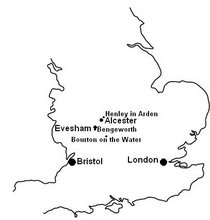
Mr. John Beddome, of Bristol, was born in London; he was called to the work of the ministry by the church in Horsley Down, Southwark, then under the pastoral care of the Rev. Benjamin Keach, and afterwards of Dr. Gill. His dismission to the church at Alcester, in Warwickshire, is dated Sept. 19, 1697. On his removal to that country, he purchased a large house at Henly-in-Arden, which had formerly been an Inn, and fitted up one part of it for his residence, and the other part for a place of worship. Here he continued, enjoying the assistance of the Rev. Mr. Bernard Foskett as co-pastor from 1711, til 1719, when Mr. Foskett removed to Broad Mead church, at Bristol. To the Pithay church in that city the providence of God called Rev. John Beddome in 1724, where he succeeded the renowned puritan, Andrew Gifford, and Emmanuel his son, who did not long survive his father.
Mr. Benjamin Beddome was born at Henley, January 23, old style, 1717, and was about seven years of age, when the family removed to Bristol. In due time, having received an education suitable to the profession, he was apprenticed to a surgeon and apothecary. The wit and vivacity which, in a measure, continued with him to the end of his days, accompanied his juvenile steps into the public walks of life. We have no vestiges at all of his early piety; on the contrary, the bent of his mind affected and afflicted his parents several years - but at last divine mercy reached his heart. The date of it we learn from an obscure page which only contains these words, in his own hand writing; "Mr. Ware, of Chesham, uncle, I believe to Coulson Scottow, Esq. preached at the Pithay, Bristol, August 7, 1737, with which sermon I was, for the first time, deeply impressed. Text, Luke xv. 7" Likewise joy shall be in heaven over one sinner than repenteth more than over ninety and nine persons who need no repentance. And a repenting sinner he now was. At his first awakening, he used to be greatly affected under the word. For though the winning ministry of his father had not effectually gained his attention before; at this time he felt it in a most impressive manner. That he might conceal his abundant tears in hearing, he would sit behind in the gallery, where he was not likely to be seen; alleging, when asked by his parents, why he chose such a place, That his profession sometimes obliged him to come in late, or to go out early, neither of which had a becoming appearance in a minster's son.
To this penitential frame of mind he indulged, and the language of one of his Hymns appears to have been the dictate of his heart;
Lord, let me weep for nought but sin,
And after none but thee;
And then I would, O that I might,
A constant weeper be!
In this condition, his resource was constant prayer, and, at his leisure hours, reading the scriptures;
He turned the sacred volume o'er,
And searched with care from page to page;
Of threatenings found an ample store,
But nought that could his grief asswage.
Assured, however, of the riches of the divine word, he persevered to read it, and perseverance was crowned with success. He was ready to exclaim,
'Tis done; and with transporting joy,
I read the heaven inspired lines;
There Mercy spreads its brightest beams;
And truth, with dazzling lustre, shines

Here's heavenly food for hungry souls,
And mines of gold to enrich the poor!
Here's healing balm for every wound:
A salve for every festering sore.

At the expiration of his apprenticeship, he became a student under the care of his father's bosom friend, the Rev. Mr. Foskett of Bristol; after which he removed to London, and finished his studies in the Independent Academy. He appears to have been baptized by the famous Mr. Samuel Wilson, a predecessor of Mr. Booth, either at the later end of September, or at the very beginning of October 1739, for, at a church meeting of the Goodman's-fields society, held Sep. 27, 1739, this minute was made; "Agreed to receive Benjamin Beddome of Bristol, upon his being baptized." His gift was tried before the same society, Jan. 9, and Feb. 25, 1739, 40, but their records do not mention the time when they solemnly called him to the work of the ministry.
Upon the death of Thomas Flower, senior, pastor of the church at Bourton, whose son, of the same name, was afterwards settled at Unicorn-Yard, London, Mr. Beddome left the academy in London,, and was invited to supply the Burton friends. He went to them in July 1740, and having given full proof of his abilities, and received many solicitations and calls to become their pastor, he accepted the office, and was ordained September 23, 1743. Mr. Foskett gave the charge from 1 Tim. iv 12. Let no man despise thy youth, and Dr. Joseph Stennett preached to the people from Heb. xiii. 17. Obey them that have the rule over you &c. The ordination prayer was offered up by Mr. Foskett, with the laying on of the hands of the presbyters.
At Mr. Beddome's settlement, he resided at Lower Slaughter, where he continued till September 25, 1749, when, preparing for marriage, he removed to Bourton, a place of which he seems to have been fond, as may be inferred from lines, over which he has written, "Composed about the year 1742,"

The Wish

Lord, in my soul implant thy fear,
Let faith, and hope, and love be there;
Preserve me from prevailing vice,
When satan tempts, or lusts entice!
Of friendships's sweets may I partake,
Nor be forsaken, nor forsake!
Let mod'rate plenty crown my board,
And God for all be still adored!
Let the companion of my youth
Be one of innocence and truth;
Let modest charms adorn her face,
And give her they superior grace;
By heavenly art first make her thine,
Then make her willing to be mine!
My dwelling place let Bourton be,
There let me live, and live to thee!

On December 21, 1749, New-style, he was married to Miss Elizabeth Boswell, one of the daughters of Mr. Richard Boswell, of Bourton, who was an honourable member and Deacon of the baptist church in that place. The nuptials were celebrated at Hamnet.
Mrs Beddome was then but in the 18th year of her age, for she was born in February 13, N.S. 1732. His connexion with this amiable woman was not more gratifying to himself, than his relation to the people was satisfactory to them. They were pleased and profited. But a threatening illness, of six weeks continuance, brought him to the margin of the grave. Prayer was made by the church continually unto God for him; and the gift for which they wrestled was granted; he considered his restoration as an answer to their importunate intercessions.
On recovery he wrote a pathetic hymn; but some time after reviewing it, and considering that this providence placed him nearer the grave than he was before, he inserted these lines on the same page where he had before written his effusion of gratitude for restoration:
If I must die, O, let me die
Trusting In Jesu's blood!
That blood which hath atonement made,
And reconciles to God.

If I must die, then let me die
In peace with all mankind,
And change these fleeting joys below,
For pleasures more refined.

If I must die, as die I must,
Let some kind seraph come,
And bear me on his friendly wing,
To my celestial home!

Of Canaan's land from Pisgah's top
May I but have a view!
Though Jordan should o'erflow its banks,
I'll boldly venture through.

The danger in which so valuable a life had been, endeared the pastor to his flock more than before; and their earnest prayers and solicitations for his recovery increasingly endeared his flock to their pastor. He had not, however, been long restored to his people and his pulpit, before another unexpected providence excited their fears. The Rev. Mr. Samuel Wilson, pastor of the largest Particular Baptist church then in London, finished his course. His church in Goodman's-fields employed the condescension of entreaty, and the force of argument - and so determined were they to secure their object that for awhile they would take no denial. Thus circumstanced, Mr Beddome threw himself into the hands of his people, desirous of acting according to their wishes. They sent an absolute refusal to London; and he concluded the whole business in these words:
"If my people would have consented to my removal (though I would have had much to sacrifice on account of the great affection I bear them, yet) I should have made no scruple in accepting your call; but as they absolutely refuse it, the will of the Lord be done. I am determined I will not violently rend myself from them; for I would rather honour God in a station much inferior to that in which he has placed me, than intrude myself into a higher without his direction."
The affection which the people of Bourton bore to their minister, for his personal worth and pastoral excellences, was far from being lessened by the regard which the bereaved church in London discovered for him. A fear of losing him also "more firmly united the people together, and stirred them up to pay off a debt of near a hundred pounds, under which they had long and heavily groaned. "The labours of this good man among his charge were unremitting and evangelical. He fed them with the finest of the wheat. No man in all his connexions wrote more sermons, nor composed them with greater care - and this was true of him to the last weeks of his life. In most of his discourses the application of a student, and the ability of a divine were visible. He frequently differed from the generality of preachers by somewhat striking either in his text or his method. If the passage were peculiar or abstruse, simplicity of interpretation, and familiarity in discussion, characterized the sermon: or if his text were of the most familiar class, He distributed it with novelty, discussed it with genius, and seldom delivered a hackneyed discourse. Indeed sermonizing was so much his forte, that at length when knowledge had received maturity from years, and composition was familiarised by habit, he has been known, with a wonderful facility of the moment, to sketch his picture at the foot of the pulpit stairs, to colour it as he was ascending, and without turning his eyes from the canvas, in the same hour, to give it all the finish of a master. One instance of this will long be remembered, which happened at a minister's meeting at Fairford, in Gloucestershire. After public service began, his natural timidity, it seems, overcame his recollection - His text and his discourse, for he did not preach by notes, had left him; and in the way from the pew to the pulpit, he leaned his head over the shoulder of the Rev. Mr. Davis, pastor of the place, and said, Brother Davis, what must I preach from? Mr. Davis, thinking he could not be at a loss, answered, Ask no foolish questions. This afforded him considerable relief. He turned immediately to Titus iii.9. Avoid foolish questions. and preached a remarkably methodical, correct, and useful discourse on it. Nor was he more remarkable for illustrating the divine word in general, than for the apposite quotation of its particular parts. being a good textuary, and admitting that scripture is the best interpreter of scripture, his proofs were given with an accuracy of selection, and received under the effect of an admirable conviction. When he placed a passage of Scripture by a particular of his discourse, intelligent auditors said, as David concerning the sword of Goliath, "There is none like it," or equally suitable through all the sacred volume.

28/08/2019

10 Eighteenth Century Baptist Hymn Writers


1. Anne Steele
2. Benjamin Beddome
3. Benjamin Francis
4. Benjamin Wallin
5. Daniel Turner
6. John Fawcett
7. John Rippon
8. John Ryland Jr
9. Robert Robinson
10. Samuel Medley

12/07/2014

Rippon's Selection

These are the hymns by Beddome in Rippon's Selection. There appear to be more than other sources suggest.
  1. Wait, O my soul, thy Maker's will 11
  2. Great God my Maker and my King 18
  3. Great God of providence! 35
  4. Astonished and distressed 40
  5. What is the world? A wildering maze 43
  6. God in the gospel of his Son 54
  7. My rising soul with strong desires 97
  8. Great God 'tis from thy sovereign grace 111
  9. When by the Tempter's Wiles Betrayed 122
  10. Ye worlds of light that roll so near 160
  11. Jesus, my love, my chief delight 171
  12. Come, Holy Spirit, come 211
  13. Faith! 'tis a precious grace 217
  14. Lord, incline my wandering heart 226
  15. Let party names no more 255
  16. O blest society 258
  17. Dear Lord, though bitter is the cup 264
  18. The Mighty God will not despise 273
  19. Why, O My Soul, Why Weepest Thou? 274
  20. My times of sorrow and of joy 276
  21. If secret fraud should dwell 283
  22. If God is mine, then present things 287
  23. Ye trembling souls, dismiss your fears 288
  24. If duty calls, and suffering too 293
  25. While carnal men with all their might 293
  26. Is there in heaven or earth who can 294
  27. Strait the Gate, the Way is Narrow 294
  28. The wandering star and fleeting wind 310
  29. Great god! oppressed wit guilt and fear 330
  30. Prayer Is the Breath of God in Man 353
  31. Unto thine altar, Lord 356
  32. How free and boundless is the grace 362
  33. Ye messengers of Christ 420
  34. Go forth ye saints, behold your king! 421
  35. Father of mercies bow thine ear 426
  36. Shout, for the blessed Jesus reigns! 429
  37. How great, how solemn is the work 453
  38. Jesus! When faith with fixed eyes 477
  39. So fair a face bedew'd with tears 484
  40. On Britain, long a favoured isle 530
  41. Death! 'tis an awful word 580
  42. To the eternal three (Doxology) 592

28/06/2011

Hymn Singing in Bourton

As far as we know, in Beddome's day hymn singing was unaccompanied and would have used Beddome's own hymns plus available books. Lining out would have been the norm, led first by Jasper Bailey (c 1740-1782) and later by William Palmer (1726-1807), with William Snooke (1730-1799) standing in on occasion. The hymn book compiled by Ash and Evans appeared in 1769 and Rippon's selection in 1787. Before that the book in general use was Isaac Watts psalm versions, first published in 1719.

In Wikipedia the entry on "lining out" says:
The practice of lined-out psalmody was first documented in England by the Westminster Assembly, which prescribed it in 1644, though only for those congregations with an insufficient number of literate members or printed psalters. It became however the norm in English Dissenting churches of all levels, and American ones as well, even after psalters and then hymn books became more readily available.
Lining out became prevalent in the seventeenth century both in Great Britain and America, gradually developing a distinctive style characterised by a slow, drawn-out heterophonic and often profusely ornamented melody, while a clerk or precentor (song leader) chanted the text line by line before it was sung by the congregation. Though attacked by musical reformers as uncouth, it has survived to the present among some communities and contexts, including the Gaelic psalmody on Lewis, the Old Regular Baptists of the southern Appalachians (USA) and for informal worship in many African American congregations.
The tide turned against lining out in England and New England in the first quarter of the eighteenth century, with greater literacy, improved availability of texts such as New Version of the Psalms of David (1696) by Nahum Tate and Nicholas Brady, and more widely available and better-printed tune collections. Influential clerics in England and America disliked the ragged nature of the singing that resulted as the congregation struggled to remember both the tune and the words from the lining out.
Lining out was in most places replaced by "regular singing," in which either the congregation knew a small number of tunes like Old Hundredth that could be fitted to many different texts in standard metres such as Common Metre, or a tunebook was used along with a word book. There began to be "singing societies" of young men who met one evening a week to rehearse. As time went on, a section of the church was allocated for these trained voices to sit together as a choir, and churches voted to end the lining out system.
Lining out persisted much longer in some churches in the American South, either through theological conservatism or through the recurrence of the conditions of lack of books and literacy, and in some places is still practiced today. In African American churches this practice became known as "Dr Watts Hymn Singing," a historical irony given Watts' disapproval of the practice.

18/06/2011

Beddome's verse improved

I am enjoying the book on Rippon by Ken R Manly Redeeming love proclaim (Volume 12 in the SBHT series). On page 94 he points out how in his Selection Rippon improves a hymn by Beddome by the simple expedient of lengthening some of the lines. The hymn appears in the Beddome collection with a 7s metre. It is 206. Rippon turns it into a long metre hymn (264).

206 (Beddome)

LORD, though bitter is the cup,
Thy kind hand deals out to me,
Cheerful I would drink it up,
Nought can hurt which comes from thee.

2 Dash it with unchanging love,
Let no drops of wrath be there;
Saints now ever blessed above,
Oft were most afflicted here.

3 From thy blessed incarnate Son,
True obedience I would learn;
When thy will on earth is done,
I shall then no longer mourn.

264 (Rippon)
DEAR Lord! though bitter is the cup
Thy gracious hand deals out to me,
I cheerfully would drink it up;
That cannot hurt which comes from thee.

2 Dash it with thy unchanging love,
Let not a drop of wrath be there!—
The saints, for ever bless'd above,
Were often most afflicted here.

3 From Jesus, thy incarnate Son,
I'll learn obedience to thy will;
And humbly kiss the chastening rod,
When its severest strokes I feel.

28/07/2010

Hayden 02

Hayden quotes from Rippon (pages 71, 72) who says on John Ryland (to quote Rippon himself)
Many years pastor of the Baptist Church at Northampton, was well known, and highly esteemed, by his acquaintance, both in London, which he often visited, and in most parts of the kingdom. He was born Oct 14, 1723. When a youth he was proverbially gay, and spent his early days in folly and sin: but in the spring of 1741, the Lord met with him in mercy, at a time of general awakening in the Baptist congregation at Bourton on the Water, then under the pastoral care of the Rev Benjamin Beddome, MA. when about 40 persons were brought under serious impressions at the same time Mr Beddome baptised him, Oct 14, 1741, (Hayden has Oct 2) received him into the church, and, observing an uncommon sprightliness in his genius and animated piety, gradually led him forward to the work of the ministry, with the fostering hand of a wise and kind parent; laying laying a plan, without his knowledge, for his going through a course of academical studies in the Baptist seminary at Bristol, then under the presidency of the Reverend Bernard Foskett.
When the intention was fully made known to Mr Ryland, he felt an unusual degree of concern and retlessness; as his private diary of that and of subsequent life sufficiently evinces.
Hayden quotes Ryland's diary
"At 6 went with Mr Benja Beddome towards Mr Thompson's and he told me what I had never before heard that I should go to Bourton for Mr Beddome and the church to prove me and if they thought me capable and worthy of the Ministerial work - to call me out - and then for Mr Foskett - (after I returned) to correct and instruct me in the composure of sermons"
Bourton called Ryland in the Spring of 1746.

30/10/2008

Richard Hall 03

Sadly, there was division after Gill's death and his young successor John Rippon (1751-1836) was not liked by all. Hall's son later wrote “In consequence of a division in the Church on the death of their Minister my father's mind appears to have been very unhappy and for a time he was unsettled. Much animosity and contention existed in consequence of the majority of the Church choosing Mr. Rippon, (afterwards Doctor), who was ordained to the pastoral Office November 11th, 1773. My father was one of the minority who signed the protest against this step, and with that minority chose Mr. Button to be their pastor, for whom it appears that they built a new Place, but owing to some shyness between the members he discontinued his attendance and in 1776 was set aside by the Church”. (Exactly what this last sentence means is unclear. Button served faithfully at the new place in Dean Street for many, many years).
Hall, says MR, always viewed this as most ungenerous conduct on the church's part. He never forgave Rippon (who remained as pastor for 63 years all told). Cathcart's Baptist Encyclopedia (1881) says "When about twenty-one he became the successor of the great Dr. Gill, in London. Mr. Rippon had neither the talents nor the learning of his predecessor, but he was bold, witty, and ready in speech; his "preaching was lively, affectionate, and impressive; his administration of church affairs was marked by great prudence, and he soon became very popular."
MR suggests a more personal slant. He says that Rippon took a fancy to Hall’s daughter Martha – then just 16. Hall, MR suggests, was having no Devonshire hot-head messing with her affections! Spurned by the family, Rippon turned his attentions elsewhere and soon found an alternative bride.
Later family diaries recount: “On 20th August, 1776 my father was much pleased by the baptism of his beloved wife at Leominster by Mr. [ie Joshua] Thomas and on the 6th November, 1777 that pleasure was enhanced by his daughter (Martha) giving in her experience to the same Church and being baptized by the same minister on the 20th of the same month.” Such pleasure was short-lived because two years later daughter Martha went back to Rippon’s church! Hall was horrified and his relationship with his daughter deteriorated. He seems to have regarded her as something of a “wild child”. Matters improved in time but at some stage after 1785 (when she married) contact dwindled to the extent that they barely spoke or corresponded. For the last 10 years of his life they never met or wrote to each other. Hall was to die without resolving their differences.
Hall remained unmoved and carried his grudge against Rippon to the grave. The dislike was reciprocated – at Richard’s funeral Dr Rippon wrote a short eulogy, not, as was normal, praising the deceased for his fine qualities, but stating: “Mr Hall was certainly not distinguished among his religious connections for the felicity of his disposition but we are given to understand that he has left behind him the testimony of an affectionate husband a kind father and a sincere friend.”
Hall made his distaste for Rippon clear to all and sundry. A letter from a friend who was the Baptist Minister in Bedford dated February 16, 1773 reads: “… you complain in your letter you are like a sheep without a shepherd. May the great Head of the Church afford you support, relief, direction and consolation. But I always think it must dismay a humble minister to think of succeeding the great Dr Gill of precious memory.”
Hall refers to his sadness at matters being “very quarrelsome”. He was still attending Rippon’s services – and indeed having him round for tea – but matters were coming to a head and on August 16 he records “was at Church meeting. Very disagreeable disputes and contentions”. Later in the year (October 11) he records “Was at Church Meeting – things very confused. A protest against the proceedings delivered in – signed by 19 persons. Very fine day. Like Summer. Cool”. There is a reference to Rippon's ordination (November 11 – “to my great concern”).
In summer, 1774 Hall appears to have made a visit to Bourton, which he did from time to time. In 1775 he was there again and we read interestingly "1775 - Sept 8th – after 10 o’clock at Night when at Bourton a Shock of Earthquake was felt. Mr Beddome felt the bed rise up three times. Felt at Oxford, Bath, Salisbury etc."
Then on January 16, 1799 Snooke died. Richard later wrote “After a short illness of about five days of a paralytic stroke departed my worthy friend and brother-in-law William Snooke Esq. aged 49. My dear wife and self went to Bourton on hearing of his illness but he died the day before we got here. We stayed the interment which was on the 17th.”
It must have been a huge blow to Richard says MR – William was all the things Richard was not – rumbustuous, charming, always laughing at his own mistakes. Richard, always pious and invoking the Lord, must have envied William his simple Faith, his generosity – and of course his enormous wealth!