Showing posts with label Books. Show all posts

26/06/2025

Two new books on Beddome


Readers of this blog will be pleased to know that two new books on Beddome have recently appeared or are about to appear. Firsty, a second volume and final volume by Stephen Pickles completes the record of his extensive research into Beddome's life and testimony. The first part of the book I have read and it uncontroversially ransacks Beddome's works to piece together a theology, something I have longed to do myself. The second part of the book gets into Huntington, Fuller, etc, and the more controversial matters among Particular Baptists. I have not yet read that part but hope to do so in the near future.
Meanwhile, Yuta Seki has put his PhD on Beddome into popular form. “Long May Thy Servant Feed Thy Sheep” looks at Beddome's pastoral theology, making use of letters, sermons and other materials. I am not sure when this volume will appear but I have seen it and it looks excellent. “Long May Thy Servant Feed Thy Sheep” is a quote from a Beddome hymn.

16/11/2018

Stokes's Chronological events

In William Stokes' History of the Midland Association of Baptist Churches he has a list of chronological events. Here is the list up to the year of Beddome's death.

CHRONOLOGICAL EVENTS.
The following Remarks, &c. were intended for a column in the foregoing Chronological Table, but the want of space prevented that arrangement. The author was advised not to suppress them,—-he 
therefore gives them in the somewhat dissociated form below. 

1762 Middleton Cheney joined—John Pyne, pastor at Shrewsbury. 
1763 Cannon-street chapel, Birmingham, enlarged for the first time. 
1764 Mr. L. Butterworth came to Bengworth—Covenant adopted at Bromsgrove. 
1765 Dudley joined. - [John] MacGowan, [1726-1780] author of the “Dialogue of Devils," one  of the preachers this year. He was supplying at Bridgenorth.
1766 Eighteen associated churches—Association held at Hook Norton for the first time. 
1767 James Kettilby died, aged 71, preacher at Bewdley 50 years.
1768 Decrease 5.—-L. Butterworth ordained at Bengworth after four years' probation. 
1769 Mr. Poynting's Sermon printed by the Association, the first thus honoured
1770 Leicester left.— P. Jones died, 30 years pastor Upton on Severn
1771 Mr. J. Willis settled at Upton. Death of Dr. Gill, aged 73
1772 Sutton-in-the-Elms left to join the Northampton Association.
1773 Church members at Bewdley, l2.—-Mr. John Sandys pastor at Shrewsbury. 
1774 Members at Cannon-street, Birmingham, 112.—Second time of holding the Association at Bengworth. 
1775 Brettel Lane joined -— Association held at Dudley for the first time.
1776 Cannon-street, Birmingham, 140 members—Association held at Tewkesbury for the tenth time. 
1777 Cirencester joined—Association at Birmingham, the fourth time.
1778 Robert Hall entered at Bristol College, 15 years of age.
1779 Mr. J Stennet, minister at Warwick.—Association held at Cirencester for the first time. 
1780 Decrease 7. Died this year, aged 54, Mr. Turner, pastor of Cannon-street, Birmingham, for 25 years. 
1781 Mr. Stephens pastor at Upton. - Baptists in Birmingham as one to 385 of the whole population. 
1782 Middleth Cheney left — Agreed to have an Association Book, to be kept by L. Butterworth. 
1783 Darkhouse church formed — Mr. P. Reece settled at Warwick.
1784 .Darkhouse joined the Association — Preaching by Baptists commenced at Willenhall. 
1785 Church formed at Needless Alley, (now Bond-street) Birmingham.
1786 Needless Alley, with 50 members, joined the Association — Thomas Edmonds called to the ministry, at Cannon-St, Birmingham. 
1787 Cannon~Street members 235. — First Baptist meeting-house opened at Willenhall. 
1788 Byeford admitted — T. Smith, and Joshua Bissell, ordained joint pastors of the Darkhouse, Coseley. 
1789 B. Beddome’s last appearance at the Association.— Mr. [Henry] Taylor, pastor at Cannon-Street, Birmingham, resigned, and was succeeded by Samuel Pearce.
1790 S. Pearce ordained at Cannon-Street, Birmingham, August 18. - The6 Association resolved, that “No church to be admitted or retained, but such as agree with the doctrines of the Association."
1791 Robert Hall, of Arnsby, died March 13, aged 63.- Sermon on the oppressive, etc, tendency of the Test, etc, Acts, by Samuel Pearce, February 21.
1792 Willenhall admitted.— Baptist Mission formed at Kettering, Oct. 2. First Public collection ever made for the Baptist Mission, was made at Birmingham, £70 collected.
1793 The Coppice received — Day of fasting and prayer appointed on account of the alarming state of the nation — March 20, J. Thomas and W. Carey ordained missionaries to the East Indies.
1794 Shifnal received — Derby spoken of as an “infant interest."
1795 Beddome, for 55 years pastor at Bourton, died September 3 aged 79. - A day of fasting and prayer appointed.-—A meeting of the Committee of the Baptist Mission in Birmingham, when 
Messrs. [Jacob] Grigg and [John] Rodway were designated Missionaries to Africa, September 16. 
1796 Wolverhampton received. - J[ohn] Palmer ordained at Shrewsbury.- J[ohn] Wilson ordained at Warwick.

22/05/2017

Useful learning - new book

A new book has just been published under the title Useful Learning: Neglected Means of Grace in the Reception of the Evangelical Revival among English Particular Baptists. The book is by Anthony R Cross and has a foreword by Ian Randall.
It contains a section on Benjamin Beddome. The blurb says
Explorations of the English Baptist reception of the Evangelical Revival often - and rightfully - focus on the work of the Spirit, prayer, Bible study, preaching, and mission, while other key means are often overlooked. Useful Learning examines the period from c. 1689 to c. 1825, and combines history in the form of the stories of Baptist pastors, their churches, and various societies, and theology as found in sermons, pamphlets, personal confessions of faith, constitutions, covenants, and theological treatises. In the process, it identifies four equally important means of grace.
The first was the theological renewal that saw moderate Calvinism answer "The Modern Question" develop into evangelical Calvinism, and revive the denomination.
Second were close groups of ministers whose friendship, mutual support, and close theological collaboration culminated in the formation of the Baptist Missionary Society, and local itinerant mission work across much of Britain.
Third was their commitment to reviving stagnating Associations, or founding new ones, convinced of the vital importance of the corporate Christian life and witness for the support and strengthening of the local churches, and furthering the spread of the gospel to all people.
Finally was the conviction of the churches and their pastors that those with gifts for preaching and ministry should be theologically educated. At first local ministers taught students in their homes, and then at the Bristol Academy. In the early nineteenth century, a further three Baptist academies were founded at Horton, Abergavenny, and Stepney, and these were soon followed by colleges in America, India, and Jamaica.
Cross is Emeritus Director of the Centre for Baptist History and Heritage and a Research Fellow at Regent’s Park College

08/07/2014

A manuscript book by Richard Hall

It seems that Richard Hall wanted to add to his first book with more of the same. The Angus Library has a ms book of quotations, some from the 1771 book, some not. A note dated 1794 reveals that Hall had a sequel in mind that does not appear to have been published.

22/09/2011

Printers of the Catechism

The first edition of Beddome's Catechism in 1752 was published by John Ward in London. John Ward (c 1679–1758) was the son of a Baptist minister, also John Ward, and was an English teacher, a supporter of learned societies, and a biographer, remembered for his work on the Gresham College professors, of which he was one. He has an entry in the ODNB and Wikipedia has this here. Also see this article here and this one too. This is probably the wrong Ward, however. The Ward we want is the son of Aaron Ward, mentioned in a later blog.
By 1776 Ward was dead and for the second corrected edition Beddome turned to a Methodist in Bristol, William Pine (1739-1803) printer first of the Bristol Chronicle (from 1760) and then the original printer of the Bristol Gazette (from 1767). A Methodist he had a large business in Wine Street, Bristol. He was associated at one point with the Quaker Joseph Fry (1728-1787) of chocolate fame when Fry turned his attention in 1764 to type-founding, following the success of John Baskerville. Their new type may be traced in several works issued between 1764 and 1770. In 1774 Pine printed at Bristol a Bible in a pearl type, asserted to be ‘the smallest a bible was ever printed with.’ To all these editions notes were added to escape the penalty of infringing the patent. In 1776 Pine published Beddome's catechism but in 1777 the firm became J Fry and sons, reprinting octavo and folio Bibles and Pine subsequently withdrew entirely. Pine was John Wesley's printer until by 1775 Wesley found him too much of a Calvinist and pro-American independence. He married three times and had children. His second wife (from 1790) was Elizabeth Owen. His third wife outlived him.

Catechism Book on sale (2nd ed)


A notice on the Internet now removed was as follows:

A Scriptural Exposition of the Baptist Catechism By Way of Question and Answer.

Second Edition, Corrected. 8vo. [153 x 91 x 12 mm]. 192pp. Contemporary binding of canvas over pasteboard, the spine lettered on two later black labels. (Upper joint split, but cords holding, worn at the edges). Stock no. ebc3224.
Bristol: by W. Pine, 1776.

£500

The first edition of 1752 is known only from a single copy, at Regent's Park Oxford. This second edition is recorded at nine locations, but there is only one in the USA, at Andover Newton Theological School.

Benjamin Beddome (1717-1795) was pastor at the Baptist Church in Bourton on the Water, Gloucestershire, from 1740 until his death. He wrote over 800 hymns, which were published as Hymns Adopted to Public Worship or Family Devotion in 1818. In 1770 he was awarded an MA by Providence College in Rhode Island in recognition of his literary gifts.

With a neat ink inscription inside the front cover: "G.P. Hinton the 28th May 1804. The Gift of his very Dear Friend the Rev. Dr Ryland. Note this Book is very useful to Ministers & Students to the Ministry for here they may look for Answers in Scripture Language to whatever questions they are answered on whatever subject they may be upon".
(Hinton appears to have been a Unitarian who was once a minister of a west country church but then went into the legal profession in Bristol.)

26/08/2011

Poole's Annotations

In 1839 in Lumley's Bibliographical Advertiser the following two volume set was on sale (No 1500)

POOL'S ANNOTATIONS, 2 vols, folio, half calf, 21. 10s

A note says
Beni. Beddome's copy, with very numerous MS. notes and references, which, judging from the rarity and excellence of the works referred to, are exceedingly valuable.

This would be

Annotations upon the Holy Bible. Vols. I and II: wherein the sacred text is inserted, and various readings annex'd, together with the parallel Scriptures: the more difficult terms in each verse are explained, seeming contradictions reconciled, questions and doubts resolved, and the whole text opened, by the late reverend and learned divine Mr. Matthew Poole.

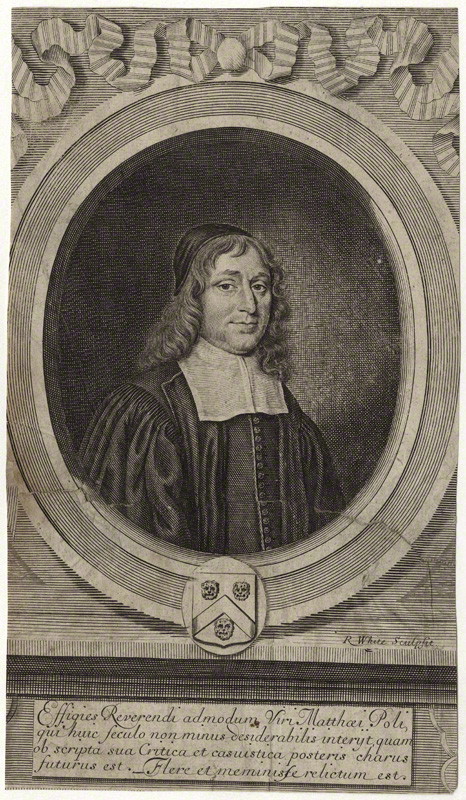
Matthew Poole (1624–1679) was an English Nonconformist theologian born at York and educated at Emmanuel College, Cambridge. From 1649 till the passing of the Act of Uniformity 1662 he held the rectory of St Michael le Querne, London. Frightened by the Popish plot - for Titus Oates, on account of Poole's tract on the Nullity of the Romish Faith, had represented him as marked for assassination (1678) - Poole left England and passed his last years in Amsterdam, where he died in 1679. A complete biography of Poole was published by Thomas Harley in February 2009.
The work with which his name is principally associated is the Synopsis criticorum biblicorum (5 vols fol, 1669-1676), in which he summarises the views of 150 biblical critics. This book was written in Latin and is currently being translated into English by the Matthew Poole Project. Poole also wrote English Annotations on the Holy Bible, a work which was completed by several of his Nonconformist brethren, and first published in 2 vols fol. in 1683. The work was continued by others (last edition, three volumes, 1840). The Banner of Truth published a 1700 version in 3 volumes some years ago.

29/06/2010

Acknowledgement and hymns

Among the items found in Bristol are a note that reads as follows

Dec 26 1758
Acknowledge the receipt of two
Book (viz:) of Benjamin Beddome
Anti: his of Rome}
Family Instructor}
Mary Bright
Mary was Beddome's sister. Mr Bright was her second husband.
On the reverse of this paper are five hymns not known from elsewhere
Earth's vanities farewell
How greatly honourable Israel was
Nor dark nor clear nor Night nor Day
How excellent thy drawings are
I'm tired of living here below
The book references appear to be to Antiquities of Rome by Basil Kennett first published in 1690 and Daniel Defoe's enormously popular Family Instructor first published in 1715.

19/05/2008

Beddome's Catechism

A review of the modern reprint of the catechism appears here at Discerning Reader. It says
 
Benjamin Beddome (1717-1795), an English Baptist minister and hymnist, wrote A Scriptural Exposition of the Baptist Catechism in order assist families and Bible teachers in laying out the textual foundation of the Baptist catechism. Whereas catechisms normally have the Bible references listed, Beddome prints out a phrase or clause from the referred text.
More than that though, he fleshes out the catechism question itself. The extra questions that explain the original catechism question are not few in number. The best way to explain this is to print out one of the questions and corresponding Beddome questions and textual assistance:

Question 1. Who is the first and chiefest Being?
Answer. God is the first and chiefest Being.
Is God the first of all beings? Yes. ‘I am the first,’ Isaiah 44:6.
Is he the first cause of all beings? Yes. Of whom are all things, 1 Corinthians 8:6.
Are all other causes subordinate to the first cause? Yes. O Assyrian, the rod of mine anger and the staff in their hands is mine indignation, Isaiah 10:5
Is God the first in creation? Yes. He spake and it was done, Psalm 33:9.
Is he the first in providence? Yes. For in him we live, and move, and have our being, Acts 17:8.
Is he the first in government? Yes. Thy throne is established of old, Psalm 93:2.
Is he the first in the world of grace? Yes. All things are of God, who hath reconciled us to himself.
2 Corinthians 5:18.
Is he first in the displays of his love? Yes. We love him because he first loved us. 1 John 4:19.
Can we be beforehand with God? No. Who hath first given unto him, and it shall be recompensed unto him again. Romans 11:35.

Now, just to be clear, the above “further questions” that I took the time to type out here represent only nine of about twenty-five of the questions that Beddome came up with to explain the very first question of the catechism.
Therefore, you can see what you are getting in this book – a full supplemental aid to understanding the catechism. Additionally, there is a nine-page biography of Beddome written by SBTS professor Michael Haykin, an introduction to the text by James Renihan, and a textual index that may have been prepared for this particular edition.
So far, my only complaint is that some of the Scripture texts Beddome uses in his explanation leave me scratching my head wondering how they relate to the actual point being made.
This book has already found use at home with my sons, but I can also see it being put into use in a church class studying doctrine. And as always, I appreciate the dark ink and bright paper that characterizes the Solid Ground Christian Book reprints.

22/02/2007

Biographical Sources

Biographical details concerning Beddome can be gleaned from Michael Haykin's essay; Thomas Brooks, Pictures of the past: the history of the Baptist Church Bourton–on-the-water (London, Judd and Glass, 1861) [see here]; John Rippon (1751-1836), The Baptist Annual Register 1794-1797, 2:314-326; Joseph Ivimey (1773-1834), A History of the English Baptists Volume IV, (London, Isaac Taylor Hinton/Holdsworth and Ball, 1830, pp 461-469); the memoir, pp ix-xxviii, in Sermons printed from the manuscripts of the late Benjamin Beddome (London, William Ball, 1835).There are also details in Ken Dix, Thy will be done A study in the life of Benjamin Beddome, Strict Baptist Historical Society Bulletin No 9, 1972; Derrick Holmes, The Early Years (1655-1740) of Bourton-on the-Water Dissenters who later constituted the Baptist Church, with special reference to the ministry of the Rev Benjamin Beddome AM 1740-1795, (Unpublished Cert Ed Dissertation, St Paul’s College, Cheltenham, 1969); J R Watson, The English Hymn A critical and historical study, (Oxford, Clarendon Press, 1999).