Showing posts with label Isaac Mann. Show all posts

17/08/2020

Henry Keen(e)

Among the letters in the NLW collected by Isaac Mann is one from Beddome to Henry Keene. Henry Keene is described as follows here

Henry Keene (1726?-97), a coal merchant in Blackman Street, Southwark, and later in St. Mary Over-stairs, joined Maze Pond on 3 July 1748, becoming a deacon on 20 May 1765. Keene’s first wife, Mary, died on 16 March 1767. His second wife, Mary Winch, joined Maze Pond on 3 November 1765, remaining a member until her death in 1813. Keene was first appointed a Deputy to the Protestant Dissenters Fund in 1757, serving into the 1780s. Keene and Thomas Flight became Messengers to the Particular Baptist Fund in 1768, serving almost continuously until their deaths (see Benjamin Beddome to Henry Keene, 14 September 1772, Mann Collection). ... Keene was a generous subscriber to the Sunday School Society in 1789 (Plan 31). In 1795 he served, along with James Dore, on a London Committee for the Baptist Missionary Society that recommended the creation of what would later become the Baptist mission in Sierra Leone (see Abraham Booth to Andrew Fuller, 30 March 1795, Mann Collection). He was also active in the movement for political reform and religious toleration in the 1780s and early 1790s. Like Flower and Robert Robinson of Cambridge, Keene was a member of the Society for Constitutional Information (“Lists of the Members” 6). He also served on the Committee of Protestant Dissenters for the Repeal of the Test and Corporation Acts in the late 1780s. He was present at a meeting on 4 December 1789 when a letter was presented to the Committee by a group of leading Dissenting laymen and ministers from London requesting a public meeting be held in London for all interested Dissenters supporting the repeal efforts. Among the signers of the letter were Keene, Henry Smithers (Keene’s business partner), Joseph and John Gurney, and James Dore (Davis, Committees 40). As evidence of the radical political bent of the church at Maze Pond in the early 1790s, Keene, along with Smithers, Flight, and both Gurneys, signed a diaconal epistle in October 1790 praising the “wonderful Revolution” in France and complaining of religious persecution in England, requesting Dore to commence a series of lectures on the “principles of nonconformity, and of civil and religious Liberty” and thanking him for his “repeated exertions to advance the cause of Humanity and Universal Freedom” (“Diaconal Epistle” 216). In his will Keene left a legacy of £186.18s. to the Particular Baptist Fund (BAR 3.60). Dore preached Keene’s funeral sermon, The path of the just like the shining light (1797), which was printed for and sold by Martha Gurney. To Dore, Keene was “a just man [who] would not sacrifice his conscience, prostitute a divine ordinance, and betray the rights of the Head of the church, by qualifying for the office of justice of the peace, though many years in the king’s commission: but, had it not been for the baneful operation of the Test Act, which prevented him from administering justice in the quality of a magistrate, a man of his enlightened mind, strict principles, and public spirit, might have been a blessing to the district” (26).

21/05/2011

Calendar of Letters 03

Letter 41
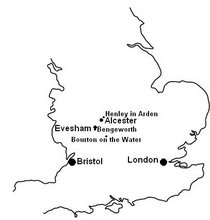
On (Sunday) May 31, 1789, the church at Bourton-on-the-Water wrote to the Association meeting at Evesham.
It begins with "Greetings". It says that the Bourton Church "enjoys a measure of peace ... though Oneness of Heart is too much wanting." It complains that "the Spirit of Error is creeping into some of the churches, and that where the great doctrines of the Gospel are not totally rejected their importance is not properly attended to" and asks the Association to face this in their Circular·Letter.
The letter is signed by Beddome (who was ill), with James Ashwin, Edward Reynolds, Thomas Cressor, William Palmer, Richard Dalby, Joshua Parry, William Collett and Samuel Fox.

Calendar of Letters 02

Letter 35
On (Tuesday) December 12, 1786, John Reynolds (1730-1792), London, wrote a letter to Bourton conveying the views of Dr (Samuel) Stennett on the distribution of money left for the poor by Mrs Seward. A side note shows the letter to have been passed on to Mr Reynolds' Church.
[John Reynolds, now aged 56, had followed Brine at Cripplegate. He was, of course, baptized at Bourton by Beddome, and in 1770 had received an honorary AM from Rhode Island. Mrs Seward, of course, is the great Baptist benefactor and friend of George Whitefield.]

Calendar of Letters 01

A Calendar of Letters 1742-1831 apparently exists in the National Library of Wales in Aberystwyth. It was owned by Isaac Mann (1785-1831). He  was a member of a church at Bridlington, under Robert Harness from Hull and when the Northern Education Society was established, he was the first student admitted, in April 1805, to the Academy at Horton. After short pastorates at Steep Lane, Burslem, Shipley, he returned to Horton as classical tutor in 1816, and became joint secretary to the Society in 1822. Four years later he went south to Maze Pond, London, retaining a close connection with the Society till his death. Most of the letters he collected had to do with one or other of these places.
The transmission of the collection is obscure for 50 years but in 1885 the letters were owned by W Thomas Lewis of Aberdare who sorted them into two groups, relating to Ministers and to Missionaries, arranging each group alphabetically, evidently valuing them as Autographs, and not concerned with the facts. One of his kindred was ennobled as Lord Merthyr and he, during the war, sold them for the benefit of the Red Cross. They were bought by the National Library of Wales (NLW MS 1207). The Rev F G Hastings, then pastor of Alfred Place Baptist Church, Aberystwyth calendared the 201 documents by order of date. Apart from one of 1711 they range from 1742 to 1831. The Baptist Quarterly (vi and vii) printed his remarks along with notes by W T Whitley in the 1930s.
Some few of the letters have a Beddome reference. This is the first:


Letter 17
On (Monday) September 14, 1772 (sic, it was actually Saturday, November 14, 1772) Beddome wrote a letter to Henry Keen of Southwark. The letter was intended to "cheer, refresh, and quicken" commending "My grace is sufficient for thee." It mentions that "Mr Clark, of Oxford, formerly your neighbour, preached at the Meeting House built by Madame Gin for Mr Rudd," but "apprehend not the most settled in his sentiments or direct in his conduct" and "appears to have acted weak." It mentions "Mr Wall" from whom "I have not heard for a long time." After his signature Beddome quotes three verses of a hymn "When sorrows rise and sins prevail." He says "They are a short hymn which I composed (I do every Sabbath)."
[Sayer Rudd was expelled from Baptist circles for Unitarian views and in 1736 Mrs Elizabeth Ginn built him a meeting-house in Snow's Fields, Southwark. However, he joined the Church of England in 1742. That a "Mr. Clark of Oxford" preached here was not known to Walter Wilson when he wrote the story of dissenting meeting-houses in and near London.]