Ivimey quotes Rippon's Baptist Register on Beddome (the latter part):
The labours of this good man among his charge were unremitted and evangelical. He fed them with the finest of the wheat. No man in all his connexions wrote more sermons, nor composed them with greater care - and this was true of him to the last weeks of his life. In most of his discourses the application of a student, and the ability of a divine were visible. He frequently differed from the generality of preachers by somewhat striking either in his text or in his method. If the passage were peculiar or abstruse, simplicity of interpretation, and familiarity in discussion, characterized the sermon: or if his text were of the most familiar class, he distributed it with novelty, discussed it with genius, and seldom delivered a hackneyed discourse. Indeed sermonizing was so much his forte, that at length when knowledge had received maturity from years, and composition was familiarized by habit, he has been known, with a wonderful facility of the moment, to sketch his picture at the foot of the pulpit stairs, to colour it as he was ascending, and, without turning his eyes from the canvas, in the same hour, to give it all the finish of a master.
One instance of this will long be remembered, which happened at a ministers' meeting at Fairford, in Gloucestershire. After public service began, his natural timidity, it seems, overcame his recollection. His text and his discourse, for he did not preach by notes, had left him; and in the way from the pew to the pulpit, he leaned his head over the shoulder of the Rev Mr Davis, pastor of the place, and said, 'Brother Davis, what must I preach from?' Mr Davis, thinking he could not be at a loss, answered, 'Ask no foolish questions.' This afforded him considerable relief. He turned immediately to Titus iii 9 "Avoid foolish questions" and he preached a remarkably methodical, correct, and useful discourse on it.
Nor was he more remarkable for illustrating the divine word in general, than for his apposite quotation of its particular parts. Being a good textuary, and admitting that scripture is the best interpreter of scripture, his proofs were given with an accuracy of selection, and received under the effect of an admiring conviction. When he placed a passage of scripture by a particular of his discourse, intelligent auditors said, as David concerning the sword of Goliath, "There is none like it," or equally suitable, through all the sacred volume.
In his preaching he laid Christ at the bottom of religion as the support of it, placed him at the top of it as its glory, and made him the centre of it, to unite all its parts, and to add beauty and vigour to the whole. As he carefully guarded his people against Arminian principles, so he earnestly dehorted them from countenancing Antinomian practices, with every sentiment which tended to lessen their sincere regard for the law of God - maintaining, that, while it is the happiness of good men to be delivered from the law as a covenant of works; it is their duty, and therefore their honour and interest, to be subject to it as a rule of walk and conversation. He was -assured, that the least contempt cast on the law tarnishes the gospel—that those who think lightly of sin cannot exalt the Saviour - that "the same word which asserts believers are dead to the law, so as neither to be distressingly afraid of it, nor to place a fiducial dependence on it, does as expressly declare that they are not without law to God, but under the law to Christ. It was an axiom with him, that "If moral weakness and incapacity do not, certainly moral privileges cannot, lessen our obligations to duty." From this may be gathered, what indeed was a fact, that his discourses were an happy mixture of the doctrinal, experimental, and practical parts of religion.
Though his voice was low, his delivery was forcible and demanded attention. He addressed the hearts and consciences of his hearers. His inventive faculty was extraordinary, and threw an endless variety into his public services. Nature, providence, and grace, had formed him for eminence m the church of Christ.
How acceptable his labours were to the churches, when he could be prevailed on to visit them, has long been known at Abingdon, Bristol, London, and in the circle of the Midland Association.
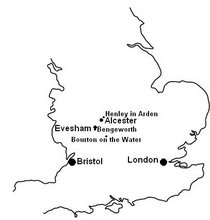
It is not easy to ascertain the exact number of members in 1740, when Mr. Beddome went to Bourton, as the oldest church book is lost. In May, 1743, when 48 persons had been added to the Society, they were in all 113 - if then 15 persons died in these three years, there must have been about 80 communicants in the year 1740; but whether fewer or more at that time, such was his success, that in 1751 they were increased to 180. The largeness of such a number in any church will be the occasion of a decrease, unless considerable additions are annually made; but in May, 1764, 13 years after the other calculation, notwithstanding deaths, and other changes, the number had kept up to 176, and at the close of the year 1766, there had been added to the church, from the time of Mr. Beddome's first coming, about 196 persons.
One considerable instrument of his success may be learnt from the letter he sent to the Association in 1764. In this it was said, that the work of catechising was kept up at Bourton 'with advantage to the children, and to many grown persons who attended thereon.' In conducting this service the people were astonished at the words which proceeded out of his lips. But his Catechism will be the best representation of his method. This is indeed a compendium of Divinity. As a larger catechism than Mr Keach's had been greatly wanted among the Baptist denomination, he was induced, by the pressing solicitations of many of his friends, to compose this work in imitation of Mr Henry's. In his preface to the first edition, printed in 1752, he laments the melancholy state of those churches and families where catechising is thrown aside - how much many of them have degenerated from the faith, and others from the practice, of the gospel. The second edition of this invaluable work was printed at Bristol in 1776, by the late excellent Dr Evans, who highly prized it, and introduced it among his numerous acquaintance.
As Mr Beddome had a pleasing poetical talent, he accustomed himself, through the chief part of his life, to prepare a hymn to be sung after his morning sermon, every Lord's day. Several specimens of these compositions have appeared, with credit to their author, and are used in many of the Baptist churches, as well as in some other respectable congregations.
In 1770 the Fellows of Providence College, Rhode Island, conferred on him the degree of A. M. as a token of respect for his literary abilities; nor was it the only one to which he was entitled. Being' a scholar himself, and residing in a more secluded situation than many of his brethren, he gave several of his sons a classical education at home.
In his time the Rev John Ryland, sen Richard Haynes, John Reynolds, Nathanael Rawlings, and Alexander Payne, were called to the ministry by his church, in all of whom he had reason to rejoice.
(To be continued)