Showing posts with label Sermons. Show all posts

26/01/2025

Beddome Sermons Subscribers Part 2


Others
The MPs are the brothers Charles Barclay (1780-1855) and David Barclay (1784-1861) whose wife is also listed. Both MPs, like the publisher, had a Quaker background. Charles of Bury Hill, Surrey, was a brewer and landowner and Tory MP for West Surrey (1835–1837, previously of Southwark 1815–1818 and Dundalk 1826–1830). David was Whig MP for Penryn, Cornwall, 1828-1830 when he resigned. After two unsuccessful attempts to take the Sunderland seat, he eventually won it in 1835, only to lose it in 1837. He was re-elected as MP for Sunderland in 1841 and held it until he resigned in 1847.
The Beddome family is well represented in the list, unsurprisingly. Ten sons, daughters-in-law and grandsons bear the Beddome name but others may be missed, such as Olinthus Gregory LLD FRAS (1774-1841) the mathematician, whose second marriage was to Beddome's granddaughter Anne Beddome (b 1789). Another grand daughter, Elizabeth Charlesworth, has already been mentioned.
The medical doctors are Samuel Ashwell (1798-1857) a leading London gynaecologist and Bourton based Nathaniel Stenson (1776-1862). The other Bourton resident is Mrs Elizabeth Ashwin (1775-1855) probably the daughter of deacon James Ashwin (1710-1801). Also listed are John Reynolds (1776-1854) of Lower Slaughter and his two daughters or granddaughters at Sondes Place, Dorking, where Charles Barclay's wife and a Mrs Crawford, another subscriber, are all also said to be living and Richard Cooper (1757-1848) of Little Rissington, converted from Anglicanism in Beddome's time and a member at Bourton.
Other identifiable individuals include William Bury (1785-1839) of Fox-hill Bank, Blackburn; clothier and art collector E A Butler (c 1802-1886); William Romaine Callender (d 1872) and his wife, Hannah (nee Pope) of Manchester (who also paid for two further copies for a friend); the Manchester Quakers, Isaac Crewdson (1760-1844) Wilson Crewdson (1790-1871) and David Dockray (1778-1853); the businessman George Hillhouse (c 1778-1844) of Combe-house, Bristol; the clothiers, William and Nathaniel Marling, who owned mills in the Stroud area; the widows of Francis Paynter (1762-1835) of Denmark Hill, the successful Cornish builder and of the Independent minister Robert Winter (1762-1833) from London. Others with a Stroud connection include Henry Whyatt (1783-1847); the local historian Paul Hawkins Fisher (1779-1873) and Lindsey Winterbotham (1799-1871) a banker and landowner, then of Tewkesbury but later of Stroud.
The only non-personal subscriber is The Nailsworth Reading Society. This is a Quaker group started in 1818 and still very active at this time. Individuals from Nailsworth, near Stroud, include the clothier Baptist deacons, Samuel Enoch Francis (d 1858), the son of the pastor there, Benjamin Francis (1734-1799) and Edward Barnard (1796-1867). Mary Bliss of Pensile House, the widow of Baptist deacon, Edward Bliss. Her sister Ann Bliss is also listed and Thomas Overbury. Another two London men called Bliss also appear.
The name Mrs W Brock, Norwich, is interesting as William Brock (1807-1875) had settled in the Baptist church there, St Mary's, in 1833. In 1834 he married Mary Bliss of Nailsworth, whose family was just mentioned.
The Baptist minister George Cole has been mentioned. He was in Leamington as was Josephus Beddome (1808-1854), Beddome's youngest son. So also were the subscribers, John Walter Sherer (1776-1846), Mrs Way and the Misses Phelp and Pimlott.
The naval officer James Masters (1787-1863) was living then on the Isle of Wight.
Thirty subscribers are from Manchester and thirteen from London. Only a few subscribers are from outside England. William Petrie (1821-1908), the inventor of the arc lamp, was then a medical student in the Cape of Good Hope (Beddome's grandson Josephus married a Sophia Petrie); there is also Mrs Poole and Miss E Wallis in Waterford, Ireland and the Quaker bookseller and stationer, Richard Moore Tims of Grafton Street, Dublin; in Haverfors West, Miss Maelor and, in Edinburgh, Mrs John Anderson and the Misses Saville.
Beddome's support by this time was coming from family and old friends, one or two from among the great and the good and others whose connection it is difficult at this remote time to work out.

Beddome Sermons Subscribers Part 1


In 1835, about forty years after his death, a volume of sermons by Benjamin Beddome was published with a memoir. The book was published by means of subscription and the 175 or so subscribers are listed in the book. Most signed up for one copy but some signed for two, three, four, six or even in two cases, eight copies. This meant that when Quaker publisher William Ball (1801-1878) of Aldine Chambers, Paternoster Row, London sent his copy off to Richard Clay (1789-1877) for printing in Bread Street Hill he could be sure that approaching 300 copies were already sold.
Understandably, most of those found on the list are by now to us mere names. Some can be traced, however - people such as the many ministers, the two MPs, various members of Beddome's family and at least two medical doctors.

Ministers
Unsurprisingly, among the ministers, Baptists are in the majority. Perhaps the best known of these is William Steadman (1764-1837) from Bradford, pastor of Westgate Baptist Church and president of the academy there. It is no surprise to see the name of Thomas Coles (1779-1840), then minister in Bourton and Benjamin Snook Hall (1787-1859), a former Bourton member who became pastor at nearby Burford.
Other Baptist ministers include Steadman's long lived son-in-law, John Aldis (1808-1907) father of the inventor of the aldis lamp, who, in a 47 year long ministry, served in Manchester, Maze Pond in London, Reading and Plymouth; George Cole (1798-1857) at Leamington at this time but previously in nearby Kenilworth and later in Evesham, Blackfriars in London, Exeter and, finally, Naunton, Gloucestershire; James Hoby (1788-1871) Birmingham; Richard Pryce (1780-1865) Cote, Oxfordshire; Edward Steane (1798-1882) Camberwell, one of the founders of the Evangelical Alliance, and William Stephens (1765-1839) West Street church, Rochdale.
The Independents or Congregationalists are John Burder MA (1785-1867) Stroud; John Addison Coombs (1788-1856) Manchester; John Herbert, Long Itchington, Warwickshire; Thomas Jackson (1770-1837) Bamford Independent Chapel, Heywood, Lancashire and Robert Stephens McCall LLD (1782-1838) Moseley Street, Manchester. Another Coombs also listed is W H Coombs, a Baptist minister in Taunton.
There are also several Anglicans - Thomas Blundell (1786–1861) All Cannings, Wiltshire, eldest son of the Baptist minister, Thomas Blundell (1752–1824); Isaac Bowman, Formby (whose brother John is also listed); Henry Gwyther (1815-1844) Yardley, Worcestershire and William Renton (1788-1857) Tilstock, Shropshire. Also, John Charlesworth (1782-1864) Flowton near Ipswich. His wife Elizabeth is also listed. She was one of Beddome's grand daughters.
There is also an H H Jones, another Manchester minister and a J Watts from London.

24/07/2023

References to other writers in Sermons 6


In Volume 6 of his published sermons (Short Discourses Vol 6) Beddome makes reference to these sources

6:1 1 Corinthians 16:13

Henry Newcombe (1627-1695)

An eminently pious minister once said that were it not for his hope in the grace and righteousness of Christ the thoughts of death would drive him distracted.

Ignatius

When the flesh of Ignatius began to be torn by the wild beasts, Now, says he, with a kind of holy exultation, now I begin to be a Christian.

Edward Young (1681-1765)
Night Thoughts

to trifle, is to live:
And is it then a trifle, too, to die?

John Milton (1606-1674)
Paradise Lost

Oh when will Death This mouldering old partition wall throw down
Give beings one in nature, one abode
Oh Death divine that givest us to the skies.

Edward Young (1681-1765)
Night Thoughts

The man immortal, rationally brave,
Dares rush on death - because he cannot die.

6:4 Revelation 2:4
John Chrysostom (d 407)


It is said of the Christians at Antioch that they so valued Chrysostom their excellent pastor that if driven to the alternative they would rather choose to be deprived of the light of the Sun than his ministrations.


6:6 Romans 5:8
Archbishop Ussher (1581-1656)
A word of Christ before we part was the usual saying of pious archbishop Usher to his friends when they had been conversing about the various branches of human literature in which he was so eminently versed.
Edward Young (1681-1765)
Night Thoughts

Behold the picture of earth's happiest man:
"He calls his wish, it comes; he sends it back,
And says he call'd another; that arrives,
Meets the same welcome; yet he still calls on;
Till One calls him, who varies not his call,
But holds him fast in chains of darkness bound,

...

To man the bleeding cross has promised all
The bleeding cross has sworn eternal grace.
Who gave his life, what grace shall he deny?

6:8 Romans 1:6
Westmnster Shorter Catechism

Effectual calling is the work of God's Spirit, whereby, convincing us of our sin and misery, enlightening our minds in the knowledge of Christ, and renewing our wills, he does persuade and enable us to embrace Jesus Christ, freely offered to us in the gospel.

20/07/2023

Medical References in Sermons 18


In Volume 5 and Sermon 13 on Acts 16:31

By faith we receive the atonement and are led to acquiesce in that way of acceptance with God as full of wisdom, suited to our helpless and sinful condition. It is not enough that Christ died for us; we must receive his death, appropriate its benefits to ourselves and make an interest in it our own personal concern. It is not the medicine prepared, but applied that effects it.

References to other writers in Sermons 5


In Volume 5 of his published sermons (Short Discourses Vol 5) Beddome makes reference to these sources

5:4 Zechariah 8:23
Theodosius I (347-398)
One of the ancient Fathers thought it a greater honour to be a member of the church than to be Roman Emperor
The reference is to an emperor then not a father.

5:6 Matthew 11:30
Ignatius of Antioch (d 108/140)

Hence, when Ignatius, one of the primitive fathers of the church was carried to the theatre to be exposed to the fury of the wild beasts, he cried out Now I begin to be a disciple

Augustine
Confessions
Grant what thou commandest and then command what thou wilt.

5:9 Acts 14:3
The Great Ejection of 1662

By raising up a constant succession of saints to propagate and defend it, the Lord is still giving testimony to the word of his grace. It was apprehended by some that the interests of religion would be fatally affected by the ejectment of such a multitude of pious and learned ministers, in a former period of history, and such indeed was the case in a communion but if the candlestick was removed from its place, it was fixed elsewhere, and the light diffused abroad.

Towards the end he refers to a number of Puritans

Isaac Ambrose (1604-1664)

Angels, do your office (See Looking unto Jesus)

Dr Andrew Rivett
Let all men have access to visit me. I ought to give an example of dying to other men, as I have taught them the way of holy living I ought to give them an example of livin.

See Nehemiah Coxe (d 1689) A believer's triumph over death exemplified in a relation of the last hours of Dr. Andrew Rivet 1682

Samuel Rosewell (1679-1722)
I am going to heaven and I long to be there. Why are his chariot wheels so long in coming? 

Thomas Halyburton (1674-1712)
It is but a few strokes more and victory, victory forevermore through the Captain of our salvation … My body is going to the clay and my soul to heaven … I that have been many years under the terrors of death can look it in the face with joy
Beddome also refers to his promise to clap before expiring

5:14 Jeremiah 25:6

James Hervey (1714-1759)

Good, when he gives, supremely good,
Nor less when he denies;
E'en crosses, from his sovereign hand,
Are blessings in disguise.

5:15 Matthew 20:6

Hugo Grotius (1583-1645)

One of the most learned ministers of former times complained in the views of eternity that he had spent his life in a sort of busy idleness.

I have fritted life away in a sort of busy idleness, To lead a life to advantage, one must be serious.

Archbishop James Ussher (1581-1656)

And the dying prayer of Archbishop Usher was that God would forgive his sins of omission.

The last words that Archbishop Usher was heard to express, were, "Lord, forgive my sins; especially my sins of omission."

5:16 Hebrews 8:12

Edward Young (Night Thoughts)

My crimes forgive - forgive my virtues too

19/07/2023

Medical References in Sermons 17


Volume 8, Sermon 6 on Galatians 6:2

Bodily infirmities and diseases are in themselves a burden, however providence may intend them for our good, and finally overrule them for our spiritual advantage. Health is a great mercy, without which many of the enjoyments of life would lose much of their sweetness; and sickness cannot but be considered in itself as a great affliction. Music cannot delight the ear, the most pleasing objects the eye, nor the richest viands the taste of a sick man. He finds but little pleasure in the company of his dearest friends; and while he is shut out from public ordinances, he is often unfitted for the devotions of the closet, how much soever he delighted in them before. Job complained that wearisome nights were appointed to him; and the apostle Paul^ wishes for his beloved Gaius, that he might prosper and be in health, even as his soul prospered. It is the lot however of some pious people to endure heavy loads of sickness and distress, and some here are who scarcely know what it is to enjoy a singl day of health. They have been afflicted from their youth up, and are laid on beds of languishing, until the graves are ready for them.
*This should be John

11/07/2023

Review of Volume 2 of Sermons 1807

 This is from The Evangelical Magazine 15

Twenty Short Discourses, adapted to Village Worship, or the Devotions of the family, Vol II. By the late Rev. B. Beddome, AM 12mo, 2s, 8vo, 3s.
THESE Sermons, published from the author's manuscript, are justly entitled to public esteem. We gave a favourable report of the first volume in our Number for December 1805; (see here) and we are gratified in the compliance of the editor with our wish to see a second volume.
The subjects arc appropriate to the purposes expressed in the title. They discover a fertility of intellect, a deep acquaintance with the human heart, a comprehensive knowledge of mankind, and an experimental savour of divine truth. The style also, in general, happily corresponds to the powers and spirit of the author. Scriptural quotations and metaphors abound, by which the subject is placed before the reader with the most inviting and interesting evidence. The sound logic, the forcible reasoning, and the impressive appeals to the heart, make these discourses no bad models for young divines.
The Sermons are not of equal merit: but there is a pure vein of evangelical divinity which runs thro' them all. Yet the experimental unction, the practical spirit, and the awakening energy that pervade them, demonstrate how far the author was concerned to preserve the doctrines of grace from the abuse of professor and profane. The discourses on "the Heavenly Stranger," are the most interesting. both for sentiment and impression. The opening of the first head contains a masterly description of human depravity and obstinacy.
We shall extract the first paragraph from the first head in the sixth sermon; which admirably expresses the benevolent spirit of gospel invitation: "If any man hear my voice. How soft, how sweet the expression, how extensive the grace! If any man - whatever his country, character, or condition may be. Tho' be may have been a monster in wickedness, a beast in fulfilling the lusts of the flesh, and a devil in fulfilling those of the mind; - though he has no merit to recommend him, no peace-offering to bring with him; - though he feels his heart as hard as a stone; nay, harder than the nether mill-stone; let him have had ever so much or ever so little terror before hand; let his convictions have been ever so weak, or ever so strong; - though he may seem to himself ever so unhumbled and unbroken; yea, though he may have stood it out against Christ these thirty, forty, fifty, or sixty years, - "yet, if he shall now hear my voice," saith the Saviour, "and open the door, I will come in to him, and will sup with him, and he with me." p. 45.
This extract shews that genuine, old-fashioned Calvinism is neither afraid nor ashamed of addressing sinners of all descriptions. And this volume contains many awakening addresses to the ungodly. In fine, it affords much that is profitable for readers of all characters and of all opinions.

08/07/2023

Beddome on Friendship Part 2


The duty of friendship
When one thinks of friendships among Baptist ministers in the eighteenth century one instinctively thinks of Fuller, Sutcliffe and Ryland, who held the ropes for Carey. Beddome does not seem to have had a ministerial friendship of that sort although in The Baptist Register Rippon refers to the younger man, who preached Beddome's funeral sermon, Benjamin Francis (1734-1799) as his "affectionate friend".
Beddome had several good friends in the congregation at Bourton including his father-in-law Richard Boswell (d 1783), William Snooke (1730-1799) and later, Snooke's brother-in-law, Richard Hall (1728-1801). Their father-in-law Benjamin Seward (1705-1753) of Bengeworth was likely another friend of Beddome's. Beddome, sometimes accompanied by his wife, would often take tea at her father's or at Snooke's or at one or other of the wealthier church members' homes.
When a student he came to know Sarah Evans. His friendship with Hugh Evans (1712-1781) and especially Sarah Evans nee Browne (1713-1751) goes back to Bristol days. It is referred to by her son Caleb in a funeral address he gave for his stepmother Ann. Beddome took Sarah's funeral and wrote an epitaph for her grave.
Henry Keene (1727-1797) was probably another friend. Keene was a coal merchant and a well respected deacon in the Mazae Pond church in London. A warm letter written in November 1772 from Beddome to Keene is preserved in the NLW, Aberystwyth, part of the Isaac Mann collection.
John Ryland's father. John Collett Ryland (1723-1792), was born in Bourton on the Water and spent his formative years in that area. Only six years younger than Beddome, the two became friends when in 1740 Ryland Senior was one of about 40 converts in a revival that marked the early period of Beddome's ministry. Beddome baptised Ryland in October, 1741 and when the latter began to show an interest in also being a minister, a strong friendship blossomed between the two. As mentor, Beddome "led him forward to the work of the ministry with the fostering hand of a wife and kind parent" (according to a funeral sermon for Ryland by John Rippon, Gentle Dismission, 37-38). As to their friendship, Beddome called Ryland Sr. his "dearest friend:" and the two kept in contact well after Ryland Sr. left Bourton and moved to Bristol and became a minister in Warwick and then Northampton (Newman, Rylandiana, 137-39. See also Lon Graham, All Who Love Our Blessed Redeemer The Catholicity of John Ryland Jr.).
Beddome was no doubt friend also to several others in the congregation who went on to become ministers themselves, notably men like John Reynolds (1730-1792) Nathanael Rawlings (1733-1809) and Richard Haines (d 1767).
In the second part of the sermon Beddome speaks about the duty of friendship highlighted in the verse he preaches He that hath friends should show himself friendly.
“Act agreeably to the connexions formed,” says Beddome, “and the confidence reposed in him.” He goes on

Though the forming of friendships is a matter not of necessity but of choice, yet, when they are formed, it is highly incumbent upon us that we should so regulate our temper and conduct as may best tend to their continuance and improvement.

He says four things about this
We should take care that our inward sentiments and feelings perfectly agree with our outward professions
Undissembled integrity becomes the man, and adorns the Christian. Extravagant professions of regard, and large promises of help and assistance, are to be avoided, as also lavish praises and commendations; for these, however gratifying they may be to a weak man, will rather be disgusting to a wise one. We should never speak more than our hearts feel, or enter into engagements which we may possibly want both an ability and inclination to perform. This is the character that David gives of men in a very degenerate age: They speak vanity every one to his neighbour, with flattering lips, and with a double heart do they speak
We should not be shy in using our friends, or backward in receiving kindnesses from them
He quotes Young again “Reserve will wound it, and distrust destroy.” He goes on
It is as much an act of friendship without hesitation to accept a favour, as readily to confer one; and the not doing so at proper and convenient seasons has begotten a jealousy and suspicion that we would not lay an obligation upon another because we are so loth to come under one ourselves but a real friend should be willing to do both. He should give and receive advice, admit frequent visits and repay them, inquire into the grievances of another and tell his own, partake of the bounty of his friend, and let require. Mutual sympathy, and a readiness to communicate to each other's wants, is necessary among friends: Have pity upon me, O my friends! says Job. Friendship is a profession of love, and love should not only be professed, but acted upon.
We should prefer the interests and welfare of their souls to that of their bodies
Thus did Christ, the friend of publicans and sinners, when he was upon earth, and thus should all his followers do; and surely those will be most indebted to us for our friendship, whose everlasting felicity is promoted by it.
He then says, firstly,
We should pray for our friends; thus did Job for his, though by their uncharitable invectives they had greatly added to the weight of his afflictions, and his prayers returned into his own bosom. Yet he obtained a blessing both for himself and them. If we can do nothing else for our friends, we can pray for them; and whatever else we have done, or can do, this should not be neglected.
And secondly
We should faithfully reprove them when they do amiss. Not to do this is represented as an evidence of hatred: Thou shalt not hate thy brother in thine heart; thou shalt in any wise rebuke thy neighbour, and not suffer sin upon him and therefore to do it is an instance of the greatest love, and a wise and good man will esteem it so. Let the righteous smite me, says David, and it shall be an excellent oil but then we must do it in a friendly manner, secretly, and not so as to expose him; with meekness and tenderness, and not so as to irritate and provoke him; and at the most convenient season, when he is most likely to bear it, and be benefited by it.
We should carefully avoid all those things which may either break the bonds of friendship, or weaken them
We should not, by divulging his secrets, abuse the confidence that our friend has placed in us. We should guard against envy if providence has exalted him above us; and of coldness and neglect if he is sunk into a state of inferiority to us. We should also shun the company of those who are given to calumny and detraction, for Solomon tells us that a whisperer separateth chief friends and, lastly, if by any notorious miscarriage, or unmerited provocations, they have forfeited our friendship, we should remember that we still owe them common charity, if prudence prohibits our former familiarity with them. Religion should restrain us from turning our love into hatred.
Conclusion

The sermon concludes with two reflections. First,
What need of grace have we to enable us to act up to this, or any other character that we sustain! The duties of friendship, you see, are not few or easy; we should therefore implore the assistance of divine grace, that we may rightly perform them. Nor should we, as has been wisely said, make choice of many intimate and bosom friends; for a multiplication of friends will involve a multiplication of duties, and, consequently, of difficulties.
Second,
Let those who are so happy as to have Christ for their friend be particularly observant of this rule with respect to him. O let us cultivate a more intimate acquaintance with him, set a proper value upon his friendship, give him the uppermost place in our hearts, make him the frequent subject of our conversation, avoid every thing that is offensive to him, frequent those places where we may meet with him, and long to be for ever with him!
We should be thankful for our friends, if we have them. The duties of friendship are clearly not few or easy and we need divine grace to rightly perform them. Let us be good friends then and especially to the Lord Jesus Christ that Friend who sticks closer than a brother.

Beddome on Friendship Part 1


Enumerating God's kindnesses in one of his hymns, the long serving minister at Bourton on the Water, Gloucestershire, Benjamin Beddome (1717-1795) includes not only "constant supplies of outward good, your nightly sleep and daily food", but also
your health and strength and faithful friends,
And happiness that never ends.
In another hymn he acknowledges that his dearest friends he owes to God's goodness.
One hymn (737) is all about friendship in the context of worship
How sweet the interview with friends
Whose hopes and aims are one
All earthly pleasures it transcends
And swift the moments run

Of sympathy and love possessed
Our sorrows we impart
And when with pure enjoyments blessed
They go from heart to heart.

Pursuing still our way to bliss
A weak and feeble band
We trust in Christ our righteousness
Who will our strength command 

Though for a season we must part
As urgent duties call
Still we remain but one in heart
And Jesus is our all

Oh may his glorious cause encrease
And we his wonders tell
Now bid us Lord depart in peace
And now dear friends farewell.
Growing up, Beddome would have been keenly aware of the intense friendship between his father John Beddome (1675-1757) and his life-long bachelor friend Bernard Foskett (1685-1758) who Beddome junior followed both into medicine and the ministry. Beddome senior and Foskett first met in London. They then ministered together in the Midlands before coming together again in Bristol, where, in due time, the two died within a year of each other and were buried alongside each other. Foskett was considered to be a part of the Beddome family and was often with them when they gathered. Benjamin named one of his sons Foskett. Sadly, this son drowned, dying prematurely as a young man. Beddome was asked to speak at Foskett's funeral but felt unable to do it. He was one of the coffin bearers.
The friendship between the older men no doubt informed Beddome when on at least one occasion he preached on the subject of friendship.
Before coming to that sermon we quote a paragraph from another sermon, this one on Zechariah 8:23 in Volume 5 of the short discourses. He says that one of the things we can learn from his text is
That seclusion from all society is neither the Christian's duty, nor his privilege. It was God himself who said, It is not good for man to be alone. Satan imagined that lie had the greatest advantage against our Lord, and that he was most likely to prevail over him, when he found him in a solitary wilderness, unsupported by the presence of a friend. To guard against a similar danger, Jesus afterwards sent out his disciples two and two; not only that out of the mouth of two witnesses every word might be established, but that they might be helpers of each other's joy in the Lord. 
The text of the sermon on friendship is Sermon 59 in a collection of 67 posthumously published sermons. It is on Proverbs 18:24 A man that hath friends must show himself friendly and has been given the title The reciprocal duties of friends.
Beddome begins it by saying
The advantages of real friendship are great and the duties resulting from it many. We have a comprehensive view of them in my text. We should exercise a common civility towards all men neither despising the poor on account of the meanness of their condition nor hating our greatest enemies for the injuries we have received from them but a man that hath friends must show himself friendly. Here we have a privilege spoken of and a duty prescribed.

The privilege of friendship
The sermon is in two parts. Beddome says firstly that a privilege is spoken of. What a privilege to have a friend, says Beddome,
To say that a man is friendless is to denote a complete state of misery. Lover and friend says David hast thou put far from me. This aggravated his troubles and added weight to all his other distresses. On the contrary next to the comforts of religion are those of friendship and society especially when those whom we look upon as our friends are …
And then he lists four qualities in a good friendship. It is

Real and disinterested
Sincerely what they profess to be not acting from selfish motives but making our interest their own. Most men seek their own and do not, as the apostle expresses it in another case, naturally care for the state of others. Here and there perhaps we may find one who will sympathize with us in all our griefs and joys and by all proper means promote our happiness and welfare. Happy is the man that hath such a friend.
Wise and prudent
Able and willing to give us advice when we are at a loss how to act and that without upbraiding our ignorance or despising us for our weakness. It is a happiness to have such friends who are discreet and experienced and at the same time open and communicative. If our friend be weak and silly his folly may plunge us into great inconveniences and let him be ever so sagacious, if he be sullen and reserved his wisdom will do us little service. David was happy in the friendship of Hushai who by his good sense and deep penetration defeated the pernicious councils of Ahithophel and extricated his royal master from a state of the greatest perplexity.
Marked by pious virtue
Pious virtue is the only solid foundation for friendship for he that is not a good man cannot be a good friend. Prayer for friends is one of the most important duties of friendship but he is not likely to pray for us who does not pray for himself. The concerns of the soul are of the most interesting nature but it is not probable that he will be mindful of the spiritual concerns of others who is regardless of his own. Those are the most valuable and desirable friends who are at the same time like Abraham the friends of God. Not the gay sensual and profane but the serious and thoughtful, circumspect and holy whose conversation will be instructive and their example improving whose hearts glow with love to God and whose conduct and behaviour exhibit all the beauties of the religious life. By their means we may be fortified against temptations kept from many an hurtful snare be convinced of sin when we have committed it and rendered more steadfast in the ways of God. As iron sharpeneth iron says Solomon so doth the countenance of a man his friend. We insensibly contract a likeness to those whom we choose for our companions: if they are modest and humble, we grow like them; if they are bold and impudent, we become so too. Give me leave to add, under this head, if a courteous and obliging temper, a natural sweetness of disposition, be added to strict virtue and real piety, it makes the ties of friendship more sweet and more durable. This seems to have been the case with respect to David and Jonathan. That man can never be a friend to others who is a foe to himself.
Faithful and persevering
The fourth and final thing he includes under his first heading, and here he must inevitably have thought of Foskett and his father, is this
Lastly. Faithful and persevering, who will smile when the world frowns, stand by us when others forsake us and adhere to us in the face of the greatest opposition. Thus all Saul's threats and reproaches could not make Jonathan renounce the covenant of friendship he had made with David, whom he loved as his own soul. Such friendships are very rare. My brethren, says Job, have dealt deceitfully as a brook, and as the stream of brooks they pass away. A failing brook is a fit emblem of a false heart. A friend that loveth at all times, who does not change when our circumstances change, but is the same whether we are in a state of affluence or want, in honour or disgrace, is one of the choicest gifts of God.
He quotes Edward Young, one of his favourite authors, from Night Thoughts
Friendship's the wine of life:
A friend is worth all the hazards we can run.
Poor is the friendless master of a world:
A world in purchase for a friend is gain.
Beddome concludes this part of his sermon
This should lead us to think of the Lord Jesus Christ, in whom all these characters meet. He is the greatest, best, and most affectionate, the most disinterested and faithful of all friends, a friend to them that have no other friend; a friend to those who have been his most bitter enemies, and who lives when other friends die; to whom we may justly apply the words following my text: There is a Friend that sticketh closer than a brother. O may each of us be able to say, This is my beloved, and this is my friend!

01/07/2023

References to other writers in Sermons in the large extra volume


Besides the eight volumes of Beddome sermons published under the title Short discourses adapted to village worship or the devotions of the family a further large volume was later published with a memoir and 67 sermons printed from the manuscripts. These contain several references to other writers, as follows.

Sermon 17 Revelation 17:14
Thomas Goodwin (1600-1680)
Wicked men may give their assent to this or the other evangelical doctrine, and have some confused notions about the work of the Spirit upon the heart of a Christian; but having no spiritual perception of these things, they are ever fluctuating and wavering, and will sooner renounce the truth than suffer for their adherence to it: nay, Dr.Goodwin, that truly evangelical writer, has a whole chapter to prove that the principles of religion are not really believed by carnal men, which seems agreeable to that of the apostle: "If our gospel be hid, it is hid to them that are lost, in whom the god of this world hath blinded the minds of them which believe not, lest the light of the glorious gospel of Christ, who is the image of God, should shine unto them."

Sermon 18 Galatians 1:16
William Romaine (1714-1795)
(Beddome calls him a reverend divine of the Established church and quotes his sermon on Mark 12:28)
By the Son here, we are certainly to understand the Lord Jesus Christ: some suppose this to be only a mediatorial or official title. "The right knowledge of God," says a reverend divine of the Established Church, "consists in believing that in Jehovah, the self-existing essence, there are three coequal and coeternal persons, between whom there is no difference or inequality but what is made by the covenant of grace. Their names, Father, Son, and Holy Spirit, are not descriptive of their nature, but of their offices. They are not to teach us in what manner they exist in Jehovah; but they are covenant names belonging to the offices which the divine persons sustain in the covenant. They are used to teach us, not how they exist, but how they act, and how they stand related to the heirs of promise."

Sermon 27
Augustine (354-430) (Confessions)
None continue the slaves of sin and Satan, but with their own consent; and if they are bound with chains, it is of their own choosing. Hence that saying of St. Augustin, "Ligatus eram non alieno ferro, sed mea ferrea voluntate:" I was bound not with a chain imposed by another, but by my own stubborn will.

Sermon 28 Luke 13:21
Huss, Jerome, Wickliffe, Luther, Calvin and the other reformers
Leaven is not only sour and disgusting, but penetrating and diffusive; and so is false doctrine. "It eats," says the apostle, " as doth a canker," or, as the word might be rendered, a gangrene; which, beginning in the extremities, soon reaches the vitals, carrying with it inevitable disorganization and destruction. Now, had not this gangrene, this leaven "hid" by Antichrist, and disguised by plausible appearances, or mingled with some important truths, at one time infected and corrupted the whole visible church, till God raised up Huss, Jerome, Wickliffe, Luther, Calvin and the other reformers? Thus the apostle Peter speaks of persons bringing in "damnable heresies," and adds, "many shall follow their pernicious ways." Thus some apply the words of my text to a general defection from the way of truth and righteousness.

Sermon 29 Jeremiah 4:18
John Chrysostom (347-407)
Of this we have an instance in the thief upon the cross: when his body was half dead, his soul was made alive to God, and he became a humble suitor to him whom he before despised; and now, instead of revilings and blasphemy, his broken accents are, Lord, remember me when thou comest into thy kingdom! His hands and his feet were nailed to the cross, but his tongue was at liberty, and this he employs for Christ, both in pleading with him and for him, and reproving those who spoke against him. Nor was it a temporal salvation that he desired, but one that is eternal; he prayed not to be delivered from the cross, but to be admitted into heaven. St Chrysostom calls this a greater miracle than the darkening of the sun, the trembling of the earth, or the rending of the veil of the temple. Surely this is also a brand plucked out of the fire. ...
Thus, when Solomon would express his abhorrence of a sin into which he had fallen, but now repented of, he speaks of it as "more bitter than death;" and it is probable he would rather have suffered the most painful death, nay, a thousand deaths, than again wound his conscience and provoke God. When Eudoxia, the empress, threatened Chrysostom with death, his bold answer was, "I fear nothing but sin."

Sermon 35 Psalm 72:15
John Owen (1616-1683) (on Hebrews 7:23-25)
“It is” says Dr. Owen, “no ways unbecoming the human nature of Christ, in its glorious exaltation, to pray to God; for this seems to be one condition of the advancement of his interest as mediator. "Ask of me and I shall give thee the heathen for thine inheritance, and the uttermost parts of the earth for thy possession."”

Sermon 40 Isaiah 11:10
Ebenezer Erskine (1680-1754)
"Faith in its justifying act" says Mr Erskine (in his sermon on Christ in the believer's arms) "is not a working but a resting grace, it lays its help where God has laid it and expects all the blessings of salvation from him in whom it hath pleased the Father that a fulness of them should dwell."

Sermon 46 1 Thessalonians 2:15
Martin Luther (1483-1546)
The seed of the serpent will still retain its enmity to the seed of the woman, and Cain, as Luther expresses it, will kill Abel to the end of the world. It is the glory of the gospel to turn the lion into a lamb; but where the light of the gospel is not come, nor the power of it felt, the savage disposition of the lion still remains.
(Also quoted in another sermon referenced elsewhere)

Sermon 59 Proverbs 18:24
Edward Young (1681-1765) Night Thoughts (the first line is from elsewhere in the poem)

Friendship's the wine of life:
A friend is worth all the hazards we can run.
Poor is the friendless master of a world:
A world in purchase for a friend is gain.

References to other writers in Sermons 4


In Volume 4 of his published sermons (Short Discourses Vol 4) Beddome makes reference to these sources

4:6 1 Thessalonians 5:17 Pray without ceasing
The Baptist Catechism (1693)

What is prayer? Prayer is an offering up our desires to God, by the assistance of the Holy Spirit, for things agreeable to his will, in the name of Christ, believing, with confession of our sins, and thankful acknowledgments of his mercies.

Early on Beddome says
We have a beautiful and comprehensive description of this sacred duty in our Catechism. Prayer say the Compilers of that excellent compendium is the offering up of our desires to God. It is the act of a needy indigent creature seeking relief from the fountain of mercy.

He then quotes the other parts of the catechism answer as he goes on.

Also at the end of the same sermon he quotes the martyr Richard Roth (d 1557)

It was the advice given by one of the martyrs to a friend in Queen Mary's time "Pray pray pray" and there are few good men but who in their last hours have reason to wish that they had prayed more.

4:7 1 Thessalonians 5:18
John Bradford (1510-1555)

I have no quarrel with the queen. If she release me I will thank her, if she imprison me I will thank her, if she burn me I will thank her.

As a holy martyr said of queen Mary "If she release me I will thank her if she imprison me I will thank her if she burn me I will thank her so should every believer say of God". Let him do what he will with me I will still be thankful.

4:12 1 Thessalonians 5:22

Benjamin Franklin (1706-1790)

God only can set bounds to it saying to a raging lust as he did to the raging sea. Hitherto thou hast gone but thou shalt go no farther. Seeming evils make for real ones as in cleaving of wood, the lesser makes way for the greater. He who sups up the broth will by and bye taste of the meat. An ounce of prevention is worth a pound of cure. 

The first saying bhas not been traced but the second was collected by Franklin in 1736

4:14 Luke 22:48
William Shakespeare (1564-1616)

There is something in this like the words of Caesar to Brutus, when aiming a dagger at his heart ...

4:15 Acts 1:25

John Milton (1608-1674) Paradise Lost (Book 1 l 61ff)

A dungeon horrible, on all sides round
As one great furnace flamed, yet from these flames
No light but rather darkness visible
Served only to discover sights of woe,
Regions of sorrow, doleful shades where peace
And rest can never dwell, hope never comes
That comes to all; but torture without end
Still urges and a fiery deluge, fed
With ever burning sulphur unconsumed.

4:19 Zechariah 3:2

John Chrysostom (*)

St. Chrysostom calls this a greater miracle than the darkening of the sun, the trembling of the earth, or the rending of the veil of the temple. Surely this is also a brand plucked out of the fire .

30/06/2023

Medical References in Sermons 16

In a sermon on 1 Thessalonians 5:20 Despise not prophesyings he says

It becomes us to guard against a sickly stomach which rejects the most wholesome food and is like the full soul which loatheth the honey comb.

References to other writers in Sermons 3


In Volume 3 of his published sermons (Short Discourses Vol 3) Beddome refers to only to two writers, as far as we can see.

3:3 Luke 19:41, 42
Edward Young (1681-1765) The Complaint

In sorrow drowned but not in sorrow lost

3:11 Zechariah 9:12 The sinner's refuge

Probably a reference to Plato

A heathen philosopher blessed God that he was born at Athens and have we not greater reason to bless him that we were born in a Christian country and descended from godly ancestors?


3:12 Acts 9:4 Martin Luther (1483-1586)

It is the general character of unconverted men to be of a persecuting spirit. "Cain," says Luther, "will kill Abel to the end of the world." He might indeed with great propriety make this observation, for few men have been more cruelly harassed or more wonderfully preserved from their enemies than he.

08/05/2023

New Edition of Beddome Sermons


Particular Baptist Heritage Books has issued what appears to be a handsomely bound re-typeset volume of 67 Beddome sermons with a memoir. The old memoir appears to have been replaced with one by Professor David Luke. The contents and first sermon can be read in e-form at the PBHB site. See here. It is intended that all 225 extant sermons will be published in due time. One slightly jarring note is a reference in the preface to a digital colour portrait of Beddome. It is not clear what that might be.
I have had chance to read the memoir and it is very good - succinct, well informed and helpful.David Luke is a member of the faculty at the Irish Baptist Institute.

18/11/2022

References to other writers in Sermons 2


In Volume 2 of his published sermons (Short Discourses Vol 2) Beddome refers to a number of writers, as follows.

2:9
Augustine (354-430)
The world troubles ... me, says one of old, and yet I love it. What (should I do) if it did not trouble me?

and

Samuel Rutherford (1600-1661)
I am not myself (myself is not myself, mine own is no longer mine own yet our aiming at this in all we do shall be accepted)

2:12
Edward Young (1683-1765) in Night Thoughts

And why not think on death? Is life the theme
Of every thought and wish of every hour?

2:14
Edward Young (1683-1765) The Congregation?

Not all those Inminaries quenched at once
Were half so sad as one benighted mind
Which gropes for happiness and meets despair

Isaac Watts (1674-1748)

Absent from Thee my guide! my light!
Without one cheering ray
Through dangers fears and gloomy nights
How desolate my way

Oh shine on this benighted heart
With beams of mercy shine
And let thy healing voice impart
A taste of joys divine

2:15
The Marian martyr John Hooper (1495-1555)
A holy man once said "Lord, I am hell but thou art heaven. I am sin but thou art goodness itself. I am nothing but corruption and vileness but thou art a fountain of purity and perfection." This is to be truly poor in spirit and of such is the kingdom of heaven.
(“Lord, I am hell, but Thou art heaven; I am swill and a sink of sin, but Thou art a gracious God and a merciful redeemer. Have mercy, therefore, upon me … according to Thine inestimable goodness.”)

Medical References in Sermons 15


In a sermon on Isaiah 65:20 The aged sinner he says

Many plunge themselves into the pleasures and pursuits of life so as not seriously to think of death or what is needful in order to it but they must die, whether they expect it or not and whether they be prepared for it or not. We may recover from many diseases and escape from many dangers but death is inevitable: the sentence is passed and life whether it be short or long is only a reprieve. Let then the worldling increase his wealth, the voluptuous his pleasures and the ambitious rise to honour and preferment, yet death will soon reduce them to a level with the common herd of mankind.

16/11/2022

Medical References in Sermons 14

In a sermon on Psalm 81:10 Motives to enlarged prayer he says

This is strongly and beautifully expressed in Psalm cxix 131 I opened my mouth and panted for I longed for thy commandments This may allude to children when hungry, to persons in a burning fever or to dry and parched land in hot and sultry weather and expresses vehement and passionate desires, vigorous and forcible motions of the soul after God, as if it were so stretched out that it was ready to break; so indeed it is expressed in another part of this psalm My soul breaketh for the longing it hath to thy judgments at all times Of all desires those after spiritual blessings should be the strongest as being the most satisfying and lasting.

and

The groanings of a sick man are often the presages of death but those of the Christian are a sign that he is alive and shall live for ever The Spirit of God not only excites praying graces but also furnishes with praying expressions, not only inclines to prayer but gives liberty in prayer and when that is enjoyed the mouth may be said not only to be opened but opened wide.

16/01/2022

References to other writers in Sermons 1


In Volume 1 of his published sermons (ie 20 Short discourses Vol 1) Beddome refers to a number of writers, as follows.

1:2
Bernard of Clairvaux (1090-1153) "He that is his own teacher, is sure to have a fool for his master".

1:3
Ebenezer Erskine (1680-1754) "The king is held in the galleries" (reference to a sermon of that name)

1:7
Martin Bucer (1491-1551) Beddome says of him that after long experience, he resolved to despise none in whom there was any thing of Christ.

1:8
Augustine of Hippo (354-430) There are some who would be made clean, but it must be hereafter. Like saint Austin, who prayed to be delivered from his easily besetting sin, but added, “Not yet, Lord!” (Confessions Book 8)

1:13
  • John Tillotson (1630-1694) Archbishop of Canterbury (Sermon 158 Of diligence on our general and particular calling)
Those who are in a low and private condition can only shine to a few but they that are advanced to a great height above others may like the heavenly bodies dispense a general light and influence and scatter happiness and blessings among all that are below them.
  • James Ussher.(1581-1656) It was Archbishop Usher's dying prayer, though he was a man that had wasted his strength, exhausted his spirits and worn out his very life in the service of God "Lord pardon my sins of omission".
1:15
George Herbert (1593-1633)
Love bade me welcome
Yet my soul drew back
Guilty of dust and sin .... (Poem 160 Love I) 

1.17
  • Thomas Manton (1620-1677) (In a sermon on 2 Thess 2:16, 17)
Reconciliation by his death is propounded as more difficult than salvation by his life. Rom v 10 For if when we were enemies we were reconciled to God by the death of his son much more being reconciled we shall be saved by his life
  • Jonathan Edwartds (1703-1758) Beddome calls him a very judicious writer and draws on his Men Naturally are God's Enemies of 1736 on Romans 5:10
  • Stephen Charnock (1628-1680) (Man's enmity to God Part V on Romans 8:7)
As the perfection of love in heaven is a part of heaven's happiness so the perfection of enmity in hell is a part of the damned's misery.

1.18
  • Edward Young (c 1683-1765) (Night Thoughts Night VII) 
Whate'er the Almighty's subsequent command,
His first command is this - Man , love thyself.
  • Robert Leighton (1611-1684) Archbishop of Glasgow (Love the fulfilling of the Law)
In a word, the great disorder and crookedness of the corrupt heart of man consists in self love; it is the very root of all sin both against God and man for no man commits any offence but it is in some way to profit or please himself.
  • Stephen Charnock (1628-1680) (On the existence of God)
Self is great antichrist and antigod in the world that sets up itself above all is called God.

17/11/2021

Beddome dead but speaking in 1825

In The Baptist Magazine for 1825 there is news from itinerant evangelist Isaac McCarthy (c 1780-1859) who worked in Ireland some 40 years (1814-1854) and spent his final years as a minister in England.

Lord's day [April] the 17th I preached in the Baptist meeting house twice. We had a cheering time at the communion and I hope that the impressions made on the minds of the people will not be "like the water spilt on the ground which cannot be gathered up again" but like the "bread cast on the waters seen for many days." My young friend from Tullamore attended and we again resumed our conversation on the subject of conversion, Christian experience and heartfelt religion; the day was passed over with much comfort and mutual profit to each party. My dear brother R-- had visited the people here several times; they express much satisfaction at hearing him and believe him to be very promising and a young man called by the Spirit of God to preach his word. He is my son in the gospel and I am not ashamed of him. In my absence and his, Miss B and my daughter meet the young people and as many more as will attend and read to them Beddome's Sermons and others which contain the same unadulterated sentiments of the gospel. By this means their own minds are kept alive to the divine word and the young persons of the neighbourhood are training up in the knowledge of the truth.

01/11/2021

Musical References in the Sermons

Sermon on Romans 8:28
The strings of a musical instrument struck in their proper order yield an agreeable harmony and the various movements in a complicated piece of machinery complete the design of the artist but if one string of the instrment be broke or one movement of the machine be out of order, neither of them will answer the appointed end ...

The happy results of repentance 2 Corinthians 2:2
When there is a casting down among the people it is a time of lifting up to godly ministers. The sighs and groans of returning penitents are delightful music in their ears. The success of Peter's sermon in the second chapter of the Acts no doubt laid a foundation for many thanksgivings to God.

A funeral sermon Hebrews 2:15
Salvation by Jesus Christ is the very sum and substance of the Christian religion and the extensiveness thereof is one of its greatest glories. Were all the fruits of Christ's death concealed in the darkest oblivion and all reserved for another state yet were the highest returns of gratitude due even for a hope of future glory. The distant prospect might afford us ground of joy and tune our harps to the praise of Him who then would be the distant portion of his people. But what superior strains of praise are due when we consider that salvation begins even here, clusters are vouchsafed from the promised land and by the first fruits we may conclude what the harvest will be.

A funeral sermon Hebrews 2:15
Our work will be the most desirable reflecting upon the wonders of redeeming love the mysteries of providence the discoveries of grace the experience of our past lives and then we shall tune our harps to praise, make heaven echo with a new song, a song always the same yet always new ...

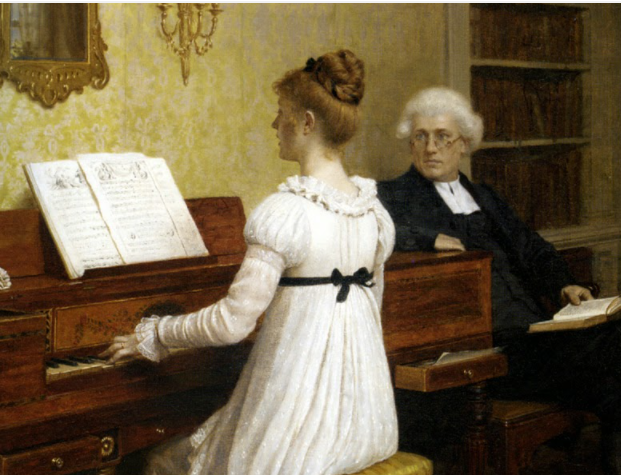
Edmund Leighton, Public domain, via Wikimedia Commons

Instead of wondering that we die we have reason to wonder that we live so long "that a harp of a thousand strings should keep in tune so long";* that the water is not sooner spilt or we who are crushed sooner than the moth, retain that life so long which is sustained by so feeble a thread.
*Quotation from Isaac Watts

Communion with God our security and bliss Psalm 69:18
Though the minister may, like John the Baptist, be a burning and shining light, let his compositions be ever so striking and eloquent, pathetic and evangelical and his manner of address ever so engaging, his voice will have but little effect unless that of his Master be also heard, it will be but like a lovely song pleasing to the ear but make no lasting impression upon the heart.  

Character tried by the Word and Providence of God Matthew 3:10
No, it was for thee he drank that bitter cup that thou hadst mingled and endured that wrath which thou hadst provoked so that thou mayest now sing and say "Who is he that condemneth it is Christ that died".

The right of private judgement Romans 15:5
... Some reject singing with a mixed multitude and according to the rules of art whilst others suppose it to be a desirable part of the worship which they owe to God and therefore by no means to be omitted in their public devotions. Many other instances might be mentioned of the same nature in which we should avoid all the animosity of party spirit ....