Showing posts with label Biography. Show all posts

27/10/2025

AI Interview


An imagined interview with Reverend Benjamin Beddome (1717–1795)

Setting: We are transported to a quiet study in Bourton-on-the-Water, a small village in the Cotswolds, during the late 1770s. The room is lined with books, and the air is scented with lamp oil. The elderly Reverend Benjamin Beddome, settled into a large armchair with a Bible in his lap, receives a visitor.

Interviewer: Reverend Beddome, thank you for welcoming me into your home. Your reputation as a pastor and hymn writer extends well beyond this serene village. What drew you from your early apprenticeship as a surgeon to a life dedicated to ministry?

Beddome: It was a path not of my choosing, but of divine design. For many years, my parents prayed for my conversion, and I showed little interest in matters of faith. Then, at the age of twenty, a sermon struck me to the heart, and I saw the truth of God’s Word. My medical apprenticeship came to an end, and it became clear to me that my true calling was to heal the soul, not just the body. I pursued my theological training in Bristol and London before being led to this quiet corner of Gloucestershire.

Interviewer: You have served the Baptist church here in Bourton for several decades now. What has kept you so committed to this congregation, even in the face of calls to London?

Beddome: (A gentle smile crosses his face.) Ah, yes, those entreaties from the city. I placed the decision in the hands of my congregation, and their refusal to let me go was a deeply humbling moment. For me, ministry is not about ambition or location, but about the bonds formed with the flock. Here, among these good people, I have found my purpose. The work is constant, the joys are immense, and the sorrows are shared.

Interviewer: You are famous for composing a hymn to accompany each of your Sunday sermons. How did this practice begin, and what purpose did it serve for you?

Beddome: I began the practice not with the thought of publication, but to deepen the spiritual reflection of my congregation. I believed that a hymn, written specifically to echo the sermon's message, could help the truth resonate more fully in the hearts of the listeners. It became a way to make the sermon's message not merely heard, but sung and felt. Many of them were quite impromptu, written at the last moment as I made my way to the pulpit.

Interviewer: Of the more than 800 hymns published after your death, some stand out for their deeply personal inspiration. Your hymn, "My times of sorrow and of joy," is said to have been written on the very day you learned of a son's passing.

Beddome: (He nods, a look of solemn remembrance in his eyes.) That is a painful memory, but a true one. I did not know of my son's death when I preached that day from Psalm 31:15, "My times are in thy hand". The words came from my heart, seeking comfort in God's providence amidst the changing scenes of this life. It was a stark reminder that we find no perfect bliss here on earth; "the honey's mixed with gall". Only in God can we find our true portion.

Interviewer: You also played an active role in the evangelical revival of your time and were a leading figure in the Midland Baptist Association. How did you balance your devotion to your local parish with this broader influence?

Beddome: My time in Bourton never isolated me. We are all members of a larger body, and the work of revival is a collective effort. I felt it my duty to encourage other young ministers, such as John Sutcliff, and to cooperate with brothers of other persuasions. My association with George Whitefield, for instance, showed that evangelical catholicity—a spirit of unity and cooperation—was more important than theological divisions. This ministry extended beyond our own chapel walls, serving to clear the stumbling blocks from the path of revival.

Interviewer: Your physical health has been declining in recent years, yet you continue to preach, even from a seated position. Why is preaching so important to you?

Beddome: (His voice, though low, is firm and earnest.) My body may fail, but the message does not. The pulpit is a place of light and fire, a place where words can give wings to the religious aspirations of the hearers. I believe that preaching is a vital means for the nurture of souls, bringing them to the very gates of heaven. While my legs may no longer carry me, my voice and my heart remain committed to this calling until my last breath.

Interviewer: You were known for your learning and your conversational wit, even in a village setting. How did you maintain that intellectual sharpness and erudition?

Beddome: A love of reading and a respect for the "best writers of antiquity" kept my mind active, even in rural isolation. Yet, true wisdom is not found only in books, but in the deep study of God's Word and the thoughtful contemplation of the human soul. I have found that a vigorous mind is a gift, and a godly wit can be a blessing, when used to glorify God and build up others.

Interviewer: Reverend Beddome, thank you for sharing your reflections.

Beddome: The pleasure has been mine. May God's blessing be upon your day.


05/12/2024

Burrage on Beddome


We have never included this piece by Henry Burrage before
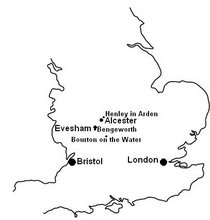
For fifty two years Benjamin Beddome was the beloved pastor of the Baptist church at Bourton on the Water in the eastern part of Gloucestershire. He was born at Henley in Arden a market town near Warwick January 23 1717. In 1724 his father Rev John Beddome removed to Bristol where he became a co pastor of the Pithay Baptist church. Here Benjamin Beddome spent his youth and in due time he was apprenticed to a surgeon and apothecary. His conversion occurred in connection with a sermon which was preached August 7 1737 by Rev Mr Ware in his father's church at Bristol from the text Luke xv 7 Likewise joy shall be in heaven over one sinner that repenteth etc. At the expiration of his apprenticeship he entered upon a course of study preparatory to the work of the Christian ministry first under Mr Bernard Foskett then tutor in the Baptist Academy Bristol and afterward at the Independent Academy in London under the learned Rev John Eames. He was baptized in London September 27 1739 by Rev Samuel Wilson and united with the Baptist church in Goodman's Fields. By this church he was called to preach. The church in Bourton was at that time pastorless and Mr Beddome was invited to supply the pulpit. His labours were acceptable and he preached both at Bourton and Warwick. At length in answer to repeated solicitations he accepted the pastorate of the church at Bourton and he was ordained September 23 1743. Dr Joseph Stennett preached the sermon from the text Obey them that have the rule over you etc Heb xiii 17. December 27 1749 he married Elizabeth Boswell a daughter of one of his deacons. Some lines composed by Mr Beddome about the year 1742 were happily prophetic:

Lord in my soul implant thy fear
Let faith and hope and love be there
Preserve me from prevailing vice
When Satan tempts or lusts entice
Of friendship's sweets may I partake
Nor be forsaken nor forsake
Let moderate plenty crown my board
And God for all be still adored
Let the companion of my youth
Be one of innocence and truth
Let modest charms adorn her face 
And give her thy superior grace
By heavenly art first make her thine
Then make her willing to be mine
My dwelling place let Bourton be
There let me live and live to thee.

By his faithful ministrations Mr Beddome greatly endeared himself to his people. After the death of Rev Samuel Wilson Mr Beddome was invited to become Mr Wilson's successor. Call after call was sent to him and declined. At length so importunate were the brethren in London that Mr Beddome asked the people to make the decision for him. They sent a prompt refusal to London and Mr Beddome remained at Bourton until his death.
He seems to have exercised his poetical gift through out his ministry. It was his custom to prepare a hymn to be sung after his morning's sermon each Lord's day. A promising son who had just completed his medical studies died in Edinburgh January 4 1778. That day not knowing of his son's death not having been informed even of his sickness he preached from Psalms xxxi 15 My times are in thy hand. The hymn which he had composed for the day was the now familiar one commencing

My times of sorrow and of joy
Great God are in thy hand
My choicest comforts come from thee
And go at thy command

One of his best hymns Mr Beddome wrote after recovering from a severe illness. He had first written a hymn of gratitude for his restoration to health. On further reflection he wrote these lines

If I must die O let me die
Trusting in Jesus blood
That blood which hath atonement made
And reconciles to God.

If I must die then let me die
In peace with all mankind
And change these fleeting joys below
For pleasures more refined.

If I must die as die I must
Let some kind seraph come
And bear me on his friendly wing
To my celestial home

Of Canaan's land from Pisgah's top
May I but have a view
Though Jordan should o'erflow its banks
I'll boldly venture through#

Mr Beddome lived to a ripe old age and died after a long illness September 3 1795 having been engaged in writing a hymn only a few hours before his departure. Beside a Circular Letter of the Midland Association for 1765 his only publication was a Scriptural Exposition on the Baptist Catechism by way of Question and Answer which appeared in 1752. A second edition was printed in 1776. Ten years after his decease two volumes of his sermons were published and a third volume appeared in 1835. A volume of his hymns was published in 1818 entitled Hymns Adapted to Public Worship or Family Devotion Now first published from the manuscripts of the late Rev B Beddome AM With a Recommendatory Preface by the Rev R Hall AM. The volume contained 822 hymns and 8 doxologies. Of these more than fifty had appeared in Rippon's Selection and so had found their way into other collections. The most familiar of these hymns are

Did Christ o'er sinners weep
And must I part with all I have
Let party names no more
Come Holy Spirit come
Jesus my Lord my chief delight
If Christ is mine then all is mine
Prayer is the breath of God in man
God in the Gospel of his Son
Blest Comforter divine
Buried beneath the yielding wave

Of Beddome's hymns Montgomery says they are very agreeable as well as impressive being for the most part brief and pithy. A single idea, always important, often striking and sometimes ingeniously brought out not with a mere point at the end but with the terseness and simplicity of the Greek epigram constitutes the basis of each piece.
The honorary degree of AM was conferred upon Mr Beddome in 1770 by Rhode Island College now Brown University

21/07/2023

New book here

The book by Stephen Pickles has now arrived from Osset. This blog is duly acknowledged. Beddome is a life time's interest, however, and this is only the first of two proposed volumes. Mr Pickles (who sadly I have never met) is slightly coy about launching another biography but this is a much larger and more rambling piece that contains many things not found elsewhere. The hymns, sermons and other materials are quoted extensively and there is lots to learn. Mr Pickles is also apprehensive that people will not be happy with his take on Beddome. This, no doubt, is due to the matter of one's attitude towards Andrew Fuller. It will be interesting to see what evidence he is able to find of non-Fullerism.

08/07/2023

Life and Times of Benjamin Beddome


A new biography of Beddome by Stephen Pickles has been published by The James Bourne Society. It is distributed by the Huntingtonian Press. The book is a hardback and makes use of Beddome's hymns and letters to spell out the story. It grows out of a lecture given in 2017 in rural Wiltshire. The current blurb claims that Beddome wrote a catechism for his congregation, which is not quite right. Probably a slip. So like the proverbial London bus, along come two at once - this one and the briefer David Luke.  I am assuming Mr Pickles work is substantial. I see it has 471 pages. More here.

16/05/2021

Rippon on Beddome Part 2


In his preaching he laid Christ at the bottom of religion as the support of it, placed him at the top of it as its glory, and made him the centre of it, to unite all its parts, and to add to the beauty and vigour to the whole. As he carefully guarded his people against Arminian principles, so he earnestly dehorted them from countenancing Antinomian practices, with every sentiment which tended to lessen their sincere regard for the law of God - maintaining, that, while it is the happiness of good men to be delivered from the law as a covenant of works, it is their duty, and therefore their honour and interest to be subject to it as a rule of walk and conversation. He was assured, that the least contempt cast on the law tarnishes the gospel - that the same word which asserts believers are dead to the law, so as neither to be distressingly afraid of it, not to place a fiducial dependence on it, does as expressly declare that they are not without law to God, but under the law to Christ. It was an axiom with him, that "If moral weakness and incapacity do not, certainly privileges cannot, lessen our obligation to duty." from this may be gathered, what indeed was a fact, that his discourses were a happy mixture of the doctrinal, experimental, and practical parts of religion.
Though his voice was low, his delivery was forcible and demanded attention. He addressed the hearts and conscience of his hearers. His inventive faculty was extraordinary, and threw an endless variety into his public services. Nature, providence and grace, and formed him for eminence in the church of Christ.
How acceptable his labours were to the churches, when he could be prevailed upon to visit them, has long been known at Abingdon, Bristol, London, and in the circle of the Midland Association.
It is not easy to ascertain the exact number of members in 1740, when Mr. Beddome went to Bourton, as the oldest church book is lost. In May 1743, when 48 persons had been added to the Society, they were in all 113 - if then 15 persons died in these years, they must have been about 80 communicants in the year 1740; but whether fewer or more at that time, such was his success, that in 1751, they were increased to 180. The largeness of such a number in any church will be the occasion of a decrease, unless considerable additions are annually made; but in May 1764, thirteen years after the other calculation, notwithstanding deaths, and other changes, the number had been kept up to 176, and at the close of the year 1766, there had been added to the church, from the time of Mr. Beddome's first coming, about 196 persons.
One considerable instrument of his success may be learnt from the letter he sent to the Association in 1754. In this, it was said, that the work of catechising was kept up at Bourton "with advantage to the children, and to many grown persons who attended thereon." In conducting this service the people were astonished at the words which proceeded out of his lips. But his Catechism will be the best representation of his method: This is indeed a compendium of Divinity. As a larger Catechism than Mr. Keach's had been greatly wanted among the Baptist denomination, he was induced, by the pressing solicitation of many of his friends, to compose this work in imitation of Mr. Henry's. In his preface to the first edition, printed in 1752, he laments the melancholy state of those churches and families where catechising is thrown aside - How much, many of them, have degenerated from the faith, and others from the practice of the gospel. The second edition of this invaluable work was printed in Bristol in 1776, by the last excellent Dr. Evans, who highly prized it, and introduced it among its numerous acquaintances.
As Mr. Beddome had a pleasing poetical talent, he accustomed himself, through the chief part of his life, to prepare a Hymn to be sung after his morning sermon, every Lords-Day. Several specimens of these compositions have appeared, with credit to their author, and are used in many Baptist churches, as well as in some other respectable congregations.
In 1770, the Fellows of Providence College, Rhode Island, conferred on him the degree of A.M. as a token of respect for his literary abilities; not was it the only one to which he was entitled. Being a scholar himself, and residing in a more secluded situation than many of his brethren, he gave several of his sons a classical education at home.
Four or five persons in his time were called to the work of the ministry by his church, in all of whom he had reason to rejoice.
But it is not to be supposed that he was free from trials: Sorrows were mingled with his songs in the house of his pilgrimage. Among the most pungent may be reckoned those which arose from the early deaths of his three sons, John, Benjamin, and Foskett. John was born January 7, 1750, and died enjoying a very desirable frame of mind, February 4, 1765. His brother Foskett, brought up in the medical line, was drowned as he was coming from on board a ship near Deptford, October 10, 1784, in the 26th year of his age. Benjamin was born October 10, 1753. Trained as a professional man, and availing himself of the wisdom which a combination of circumstances threw in his way; his prospects at length became highly flattering. He was master of the Latin, Greek, and Hebrew, before he went from Bourton to London, and afterwards obtained a knowledge of the French and Italian. He was admitted a member of the medical society at Edinburgh before the usual time, and took his Doctor's degree at Leyden, September 13, 1777. His Thesis has been much admired. It is entitled, Tentamen Philosophicomedicum inaugurale de hominum varietatibus et earum causis. This inaugural Philosophico-medical essay, concerning the varieties of men and their causes, fills 52 handsome pages, in octavo, comprehending a vast variety of matter, and forming, what perhaps competent judges will denominate, an accurate syllabus of the subject. If fine talents, and smiling connexions, could have detained him on earth he had not been removed; but in all the bloom of full life, not having completed the 25th year of his age, he died at Edinburgh of a putrid fever, January 4, 1778.
Mr. Beddome considered it as somewhat observable, that on the very day his son died, not suspecting the news he should receive the next morning, nor indeed knowing of his illness, he preached from Psal. xxxi. 15. My times are in thy hand, after which this remarkable hymn, which he had composed for the sermon, was sung.
My times of sorrow and of joy,
Great God, are in thy hand ;
My choicest comforts come from thee,
And go at thy command.

If thou should'st take them all away,
Yet would I not repine;
Before they were possessed by me
They were entirely thine.

Nor would I drop a murmuring word
Tho' the whole world were gone,
But seek enduring happiness
In thee, and thee alone.

What is the world with all its store?
Tis but a bitter sweet,
When I attempt to pluck the rose,
A pricking thorn I meet.

Here perfect bliss can ne'er be found,
The honey's mixed with gall;
Midst changing scenes and dying friends
Be thou my all in all
Rippon's Selections, Hymn 176
Mr. Beddome had also before Lord's-day, the 4th of January, made preparations for the ensuing Sabbath, January 11th, which was the day before he received the melancholy account of his son's death, from Ezk. x. 12. The wheels were full of eyes round about. Both of these sermons were studied without any particular view. When Mr. Beddome records these notable things, he says, "But alas! how much easier is it to preach than practice. I will complain to God, but not of God. This is undoubtedly the most affecting loss I have ever sustained in my family. Father of mercies let me see the smiles of thy face, whilst I feel the smart of thy rod. Job xiv. 13. Thou destroyest the hope of man."
Early, bright, transient, chaste as morning dew,
He sparkled, was exhal'd, and went to heaven.
Mr. Beddome having for some time felt his infirmities increasing, the church, in 1777, began to look out for a person to assist him in the ministry, and obtained the Rev. William Wilkins of Cirencester, who had been for some time a student at Bristol, and finished his education in Scotland. In their letter to the Association, held at Warwick, 1778, the church says, "The assistant we have procured for our pastor is every way acceptable both to him and us, and we hope the Lord has blessed his labours." But, though fast advancing in years, Mr. Beddome persevered in his pastoral duties.
The Association at Evesham in 1789 was the last he ever attended, or preached at - His first sermon addressed to this body was at Leominster in 1743. He preached to them 17 times in 46 years; this, on an average, was as frequently as he could have been chosen to the service - for it has long been a rule in the Midland Assembly, that no person shall be chosen to preach at the Association oftener than once in three years - But, perhaps, on examination it will appear, in the instance of Mr. Beddome, that this has not been always strictly adhered to from the year 1740, and it seems there was no such limitation at that time.
From his last visit to the Association in 1789, to the end of his days, he set apart for charitable designs, and gave away, all that he received from the people for his services. He was in London to see his children and friends in 1792, and preached with the same acceptance as ever. Though he had a multitude of sermons which had never been preached, he kept on composing, and was lively in his ministry to the very last - and it has been said that his discourses of late years have, after all, been his best; but towards the last he generally destroyed them, on the Monday after he preached them. For a considerable time he was carried to and from meeting, and preached sitting.
In the near prospect of death he was calm and resigned. It had been his earnest wish not to be long laid aide from his beloved work of preaching the gospel, and his prayer was remarkably answered, as he was ill but one Lord's-day; yea, he was composing a hymn about six hours before he died. These are some of the unfinished lines of it:
God of my life, and of my choice,
Shall I no longer hear thy voice?
O let that source of joy divine,
With rapture fill this heart of mine!

Thou openedst Jonah's prison doors,
Be pleas'd, O Lord, to open ours;
Then will we to the world proclaim
The various honors of thy name.

He had left a desire on paper, that no funeral discourse should be preached for him; but as this was not found till after his internment, his affectionate friend, the Rev. Benjamin Francis, performed the funeral solemnities. His text on this solemn occasion was Phil. i. 21. To me to live in Christ, and to die is gain. From which he he considered, first, the excellent life, and the gainful death of Paul. And then secondly, applied the words to the deceased; not as at any time the vaunting language of his lips; but as the humble and ardent desire of his devotional heart. At the close of the sermon, the corpse, which had been in the place of worship all the time of the service, was interred in the yard, near the meeting-house door; after which, Mr. Francis, who remained in the pulpit, recommended to the very numerous audience a due improvement of the labours of this great man of God, and insisted on the importance of being prepared for death.
Mr. Beddome had arrived at the good old age of 79 years, 55 of which he ministered at Bourton. he departed this life Septmeber 3, 1795. We believe he has not printed anything beside his Catechism, mentioned above, and the Midland Association Letter in 1765. He has, however, left behind numerous sketches of sermons. From these manuscripts a selection might be made which would probably redound as much to his credit, as to the advantage of the religious public. But whether we are to be favoured by this desirable publication or not, must be left to his worthy sons, whose wisdom, discretion and public spirit, leave us not entirely without hope.

Rippon on Beddome Part 1

http://www.hymntime.com/tch/htm/h/o/w/howfirm.htm,
Public domain, via Wikimedia Commons

These extracts are taken from
The Baptist Annual Register for 1794, 1795, 1796-1797, including Sketches of the State of Religion among Different Denominations of Good Men at Home and Abroad (vol 2) by John Rippon, DD

Rev. Benjamin Beddome,A.M.Bourton-on-the-water, Gloucestershire.
His walk so steady, and his hope so high,
He neither blushed to live, nor fear'd to die.

The Rev. Benjamin Beddome of Bourton-on-the-water, lately deceased, and the Rev. John Beddome of Bristol, his father, are names which have given celebrity to the Beddome family, through the chief part of this century, and derive respectability from a long line of descent in the ages which are past.
The maiden name of Mr. Benjamin's mother was Rachel Brandon. She was a daughter of Mr. Benjamin Brandon, a silversmith, who lived near the Royal Exchange, London.
The Brandon family was supposed to spring, in Harry the VIII's time, from an illegimate son of Brandon, Duke of Suffolk, whose arms the family bore. Mrs. Brandon, the mother, or Mr. Brandon, the father of Benjamin Brandon, and great grandfather of Mr. Benjamin Beddome, had a married sister of the name of Spilsworth, esteemed a very gracious and prudent woman, whose husband was a timber merchant, and left £2,100 to Rachel, the sister of Benjamin Brandon. Rachel's first husband was a salesman, named Hudson, at whose death she was possessed of six thousand pounds. She afterwards married Mr. Joseph Cope, a lapidary, who cut Pitt's Diamond, purchased by the King of France, for which he had a great sum, and the chips. Mrs. Cope was left a widow, and by a suit in Chancery which was intended to affect her jointure, she was put to the expense of £1,500, though the verdict was finally in her favour. She died without issue, at Hanham, near Bristol, March 2, 1731; and being fond of her niece, Miss Rachel Brandon, whom she had brought up at a boarding school at Nantwich, in Cheshire, she left most of her substance to this young lady, who afterwards became the wife of the Rev. John Beddome of Bristol.
This honoured man, sixty or seventy years ago, in the circle of his friends, used to speak of two ancestors, it is thought of the name of Barnet, in the civil wars. The father was a colonel in King Charles' army, the son on the opposite side. One day, the father, either on hoseback or on foot, met his son at the head of his company, and transported with anger, caned him; upon which some of the soldiers were going to fire, but the son commanded them to forebear, informing them it was his father, who had a right to treat him so, if he pleased.
Mr. John Beddome, of Bristol, was born in London; he was called to the work of the ministry by the church in Horsley Down, Southwark, then under the pastoral care of the Rev. Benjamin Keach, and afterwards of Dr. Gill. His dismission to the church at Alcester, in Warwickshire, is dated Sept. 19, 1697. On his removal to that country, he purchased a large house at Henly-in-Arden, which had formerly been an Inn, and fitted up one part of it for his residence, and the other part for a place of worship. Here he continued, enjoying the assistance of the Rev. Mr. Bernard Foskett as co-pastor from 1711, til 1719, when Mr. Foskett removed to Broad Mead church, at Bristol. To the Pithay church in that city the providence of God called Rev. John Beddome in 1724, where he succeeded the renowned puritan, Andrew Gifford, and Emmanuel his son, who did not long survive his father.
Mr. Benjamin Beddome was born at Henley, January 23, old style, 1717, and was about seven years of age, when the family removed to Bristol. In due time, having received an education suitable to the profession, he was apprenticed to a surgeon and apothecary. The wit and vivacity which, in a measure, continued with him to the end of his days, accompanied his juvenile steps into the public walks of life. We have no vestiges at all of his early piety; on the contrary, the bent of his mind affected and afflicted his parents several years - but at last divine mercy reached his heart. The date of it we learn from an obscure page which only contains these words, in his own hand writing; "Mr. Ware, of Chesham, uncle, I believe to Coulson Scottow, Esq. preached at the Pithay, Bristol, August 7, 1737, with which sermon I was, for the first time, deeply impressed. Text, Luke xv. 7" Likewise joy shall be in heaven over one sinner than repenteth more than over ninety and nine persons who need no repentance. And a repenting sinner he now was. At his first awakening, he used to be greatly affected under the word. For though the winning ministry of his father had not effectually gained his attention before; at this time he felt it in a most impressive manner. That he might conceal his abundant tears in hearing, he would sit behind in the gallery, where he was not likely to be seen; alleging, when asked by his parents, why he chose such a place, That his profession sometimes obliged him to come in late, or to go out early, neither of which had a becoming appearance in a minster's son.
To this penitential frame of mind he indulged, and the language of one of his Hymns appears to have been the dictate of his heart;
Lord, let me weep for nought but sin,
And after none but thee;
And then I would, O that I might,
A constant weeper be!
In this condition, his resource was constant prayer, and, at his leisure hours, reading the scriptures;
He turned the sacred volume o'er,
And searched with care from page to page;
Of threatenings found an ample store,
But nought that could his grief asswage.
Assured, however, of the riches of the divine word, he persevered to read it, and perseverance was crowned with success. He was ready to exclaim,
'Tis done; and with transporting joy,
I read the heaven inspired lines;
There Mercy spreads its brightest beams;
And truth, with dazzling lustre, shines

Here's heavenly food for hungry souls,
And mines of gold to enrich the poor!
Here's healing balm for every wound:
A salve for every festering sore.

At the expiration of his apprenticeship, he became a student under the care of his father's bosom friend, the Rev. Mr. Foskett of Bristol; after which he removed to London, and finished his studies in the Independent Academy. He appears to have been baptized by the famous Mr. Samuel Wilson, a predecessor of Mr. Booth, either at the later end of September, or at the very beginning of October 1739, for, at a church meeting of the Goodman's-fields society, held Sep. 27, 1739, this minute was made; "Agreed to receive Benjamin Beddome of Bristol, upon his being baptized." His gift was tried before the same society, Jan. 9, and Feb. 25, 1739, 40, but their records do not mention the time when they solemnly called him to the work of the ministry.
Upon the death of Thomas Flower, senior, pastor of the church at Bourton, whose son, of the same name, was afterwards settled at Unicorn-Yard, London, Mr. Beddome left the academy in London,, and was invited to supply the Burton friends. He went to them in July 1740, and having given full proof of his abilities, and received many solicitations and calls to become their pastor, he accepted the office, and was ordained September 23, 1743. Mr. Foskett gave the charge from 1 Tim. iv 12. Let no man despise thy youth, and Dr. Joseph Stennett preached to the people from Heb. xiii. 17. Obey them that have the rule over you &c. The ordination prayer was offered up by Mr. Foskett, with the laying on of the hands of the presbyters.
At Mr. Beddome's settlement, he resided at Lower Slaughter, where he continued till September 25, 1749, when, preparing for marriage, he removed to Bourton, a place of which he seems to have been fond, as may be inferred from lines, over which he has written, "Composed about the year 1742,"

The Wish

Lord, in my soul implant thy fear,
Let faith, and hope, and love be there;
Preserve me from prevailing vice,
When satan tempts, or lusts entice!
Of friendships's sweets may I partake,
Nor be forsaken, nor forsake!
Let mod'rate plenty crown my board,
And God for all be still adored!
Let the companion of my youth
Be one of innocence and truth;
Let modest charms adorn her face,
And give her they superior grace;
By heavenly art first make her thine,
Then make her willing to be mine!
My dwelling place let Bourton be,
There let me live, and live to thee!

On December 21, 1749, New-style, he was married to Miss Elizabeth Boswell, one of the daughters of Mr. Richard Boswell, of Bourton, who was an honourable member and Deacon of the baptist church in that place. The nuptials were celebrated at Hamnet.
Mrs Beddome was then but in the 18th year of her age, for she was born in February 13, N.S. 1732. His connexion with this amiable woman was not more gratifying to himself, than his relation to the people was satisfactory to them. They were pleased and profited. But a threatening illness, of six weeks continuance, brought him to the margin of the grave. Prayer was made by the church continually unto God for him; and the gift for which they wrestled was granted; he considered his restoration as an answer to their importunate intercessions.
On recovery he wrote a pathetic hymn; but some time after reviewing it, and considering that this providence placed him nearer the grave than he was before, he inserted these lines on the same page where he had before written his effusion of gratitude for restoration:
If I must die, O, let me die
Trusting In Jesu's blood!
That blood which hath atonement made,
And reconciles to God.

If I must die, then let me die
In peace with all mankind,
And change these fleeting joys below,
For pleasures more refined.

If I must die, as die I must,
Let some kind seraph come,
And bear me on his friendly wing,
To my celestial home!

Of Canaan's land from Pisgah's top
May I but have a view!
Though Jordan should o'erflow its banks,
I'll boldly venture through.

The danger in which so valuable a life had been, endeared the pastor to his flock more than before; and their earnest prayers and solicitations for his recovery increasingly endeared his flock to their pastor. He had not, however, been long restored to his people and his pulpit, before another unexpected providence excited their fears. The Rev. Mr. Samuel Wilson, pastor of the largest Particular Baptist church then in London, finished his course. His church in Goodman's-fields employed the condescension of entreaty, and the force of argument - and so determined were they to secure their object that for awhile they would take no denial. Thus circumstanced, Mr Beddome threw himself into the hands of his people, desirous of acting according to their wishes. They sent an absolute refusal to London; and he concluded the whole business in these words:
"If my people would have consented to my removal (though I would have had much to sacrifice on account of the great affection I bear them, yet) I should have made no scruple in accepting your call; but as they absolutely refuse it, the will of the Lord be done. I am determined I will not violently rend myself from them; for I would rather honour God in a station much inferior to that in which he has placed me, than intrude myself into a higher without his direction."
The affection which the people of Bourton bore to their minister, for his personal worth and pastoral excellences, was far from being lessened by the regard which the bereaved church in London discovered for him. A fear of losing him also "more firmly united the people together, and stirred them up to pay off a debt of near a hundred pounds, under which they had long and heavily groaned. "The labours of this good man among his charge were unremitting and evangelical. He fed them with the finest of the wheat. No man in all his connexions wrote more sermons, nor composed them with greater care - and this was true of him to the last weeks of his life. In most of his discourses the application of a student, and the ability of a divine were visible. He frequently differed from the generality of preachers by somewhat striking either in his text or his method. If the passage were peculiar or abstruse, simplicity of interpretation, and familiarity in discussion, characterized the sermon: or if his text were of the most familiar class, He distributed it with novelty, discussed it with genius, and seldom delivered a hackneyed discourse. Indeed sermonizing was so much his forte, that at length when knowledge had received maturity from years, and composition was familiarised by habit, he has been known, with a wonderful facility of the moment, to sketch his picture at the foot of the pulpit stairs, to colour it as he was ascending, and without turning his eyes from the canvas, in the same hour, to give it all the finish of a master. One instance of this will long be remembered, which happened at a minister's meeting at Fairford, in Gloucestershire. After public service began, his natural timidity, it seems, overcame his recollection - His text and his discourse, for he did not preach by notes, had left him; and in the way from the pew to the pulpit, he leaned his head over the shoulder of the Rev. Mr. Davis, pastor of the place, and said, Brother Davis, what must I preach from? Mr. Davis, thinking he could not be at a loss, answered, Ask no foolish questions. This afforded him considerable relief. He turned immediately to Titus iii.9. Avoid foolish questions. and preached a remarkably methodical, correct, and useful discourse on it. Nor was he more remarkable for illustrating the divine word in general, than for the apposite quotation of its particular parts. being a good textuary, and admitting that scripture is the best interpreter of scripture, his proofs were given with an accuracy of selection, and received under the effect of an admirable conviction. When he placed a passage of Scripture by a particular of his discourse, intelligent auditors said, as David concerning the sword of Goliath, "There is none like it," or equally suitable through all the sacred volume.

31/01/2017

Haykin on Beddome and the Bible

An anniversary piece on Beddome by Michael Haykin has appeared in the February Evangelical Times and can be accessed here.

09/01/2017

Anniversary Year 2017

This year sees the 300th anniversary of Benjamin Beddome's birth. He was born on January 23.

05/04/2016

Beddome's Baptism

In the Baptist Register for 1798, Rippon has this note
88. To the life of the Rev. Benjamin Beddome, printed in a former number of the Register, we add, that he was baptized north of the river at a Baptist church in the Barbican by the famous Samuel Wilson, September 27, 1739, in company with six other persons one of whom yet survives, viz Samuel Etheridge, Esq. one of the members of Mr Booth's church.
In the book Baptist Autographs in the John Rylands University Library of Manchester, 1741-1845 Timothy Whelan has this note on Etheridge, who died in 1807.
Etheridge, Samuel - Etheridge was a deacon for many years at the Baptist church at Little Prescot Street, in Goodman's Fields. He was the uncle of Samuel Jackson of the Baptist congregation at Unicorn Yard. Etheridge was a great benefactor of Baptist causes. In 1784 he gave a bequest of £100 to the Particular Baptist Fund. In 1805 the Sunday School Society of the church received a legacy of £50 from Etheridge, the bequest reading, "To a Society who meet at Mr. Booth's Meeting House to teach young girls to read, Fifty pounds in aid of their benevolent design." See Ernest Kevan, London's Oldest Baptist Church (London: Kingsgate Press, 1933) 94, 101.

14/01/2012

Surgeon Apothecary

We have noted that following his schooling in Bristol, Beddome was apprenticed to a surgeon apothecary and seems to have taken well to it.* He apparently never lost his love for things medical. Two of his sons trained in the same field and he himself, it seems, carried on some form of medical practice in Bourton. It is said that he would often turn to the world of medicine for an apt illustration in his preaching. (Remarks in Memoir, xi, which reveals that Bernard Foskett, like many a nonconformist minister at that time, also had a medical training).
It is perhaps worth noting, therefore, that the term apothecary, often used between the 1600s and 1800s, does not refer to a chemist or druggist but was used for individuals living in London who had passed the examinations of the Worshipful Society of Apothecaries of London, founded in 1617 (a break away from the grocers company), or to their often less well qualified counterparts in the provinces. Although the apothecary's practice included a strong dispensing element, it was more all-encompassing than the handling of drugs and chemicals. Following a ruling in the Rose Case (1701-1703/4), apothecaries became legally ratified members of the medical profession, able to prescribe as well as dispense medicines.
In the 1700s apothecaries were some of the most common medical practitioners. In Bristol in 1775 there were 8 physicians, 56 surgeon-apothecaries and 3 druggists. Medical students could become a surgeon-apothecary without going to university (nonconformists were barred from Oxford and Cambridge until 1828 so it was an obvious route into medicine for them), and could earn a living from minor surgery and dispensing drugs. Until 1754, surgeons were allied with barbers in the barber-surgeons company. Under the Apothecaries Act of 1815, apothecaries who took a specified course of training with the Worshipful Society of Apothecaries could be licensed as general practitioners, and were called licentiates.

*We later discovered that this man's name was Francis Labee. Beddome's apprenticeship perhaps lasted from about 1730-1737.

07/09/2011

Beddome's birth place

Again courtesy of Mrs N, this the house in Henley in Arden that was bought by Rev John Beddome. The house was set up by Rev John as part residence and part meeting house. It is where Benjamin Beddome and his siblings were born - up to the time the family moved to Bristol in 1724. The Baptist Church at Henley was built next to this house and remained as the pastor's house. Apparently the house was sold some years ago. According to the licence granted to John Beddome to hold meetings there, it had originally been a large inn called Holmes House.

12/07/2010

POTP 12

In Chapter 5 Brooks reviews Beddome's ministry and says

We know not to give flattering titles to men, but we are bound to say, that the individual whose life we have now traced to its close was no ordinary man. He was highly respected, and, on the whole, eminently useful. In the Midland Association his influence was great, and most usefully employed. He had the happiness of seeing several members of the church at Bourton enter the Christian ministry, and honourably discharge its onerous duties.

The Rev John Ryland, sen, AM, was settled at Warwick (in 1750).
The Rev Richard Haines at Bradford, Wilts (1750).
The Rev John Reynolds, AM, in Cripplegate, London (1766).
The Rev Nathanael Rawlings at Trowbridge (1766).
The Rev Richard Strange at or near Stratton, Wilts (1752)
and the Rev Alexander Payne (place and date uncertain).

Although Mr. Beddome was an indefatigable writer he published but little - his Catechism, in 1752, which he employed at Bourton among adults as well as children, and which was recommended by the Association to other churches, in 1754, and the Circular Letter of 1765, were the only things he thus gave the world. Nevertheless, his fame had passed beyond the Atlantic. So that, in 1770, the Senatus Academicus of Providence College (now Hope University), Rhode Island, conferred on him the title of AM, as a token of their esteem for his talent and learning.
Since he departed this life he has become more widely known through the publication of several volumes of sermons published from his manuscripts. These have been very highly prized both by episcopalian and nonconformist Christians. One volume had reached the sixth edition in the year 1824, and another the fifth in 1831, while in 1835 a much larger volume was published, containing 67 sermons. Admired for their evangelical sentiments and practical tendency, they are scarcely less pleasing in the simplicity and clearness of their style. And yet, we must not forget, that the author had not dreamed that they would be given to the public through the press. They were mere channels dug for his thoughts to flow in, skeletons to be clothed with flesh and receive the breath of life as spoken from the pulpit. In the pulpit he is said to have been emphatically at home. And in some sort he was always there, the pulpit was "in all his thoughts." The goal of one duty was the starting point of the next. We are told that he generally selected on the sabbath evening the topics for the discourses of the next.
We have before observed, that for many years he composed a hymn to be sung after each sermon. These, if collected, would fill several volumes. A selection was made from them, and published for the use of the Baptist denomination, in 1818. This volume contains 830 hymns, and is supplied with a valuable "Index of Scriptures," as well as a general index of subjects. These verses will be ever new, "And sung by numbers yet unborn, On many a coming sabbath morn;" for our ''New Selection" (as well as "Rippon's" and many others used by various denominations), is enriched by many a spiritual song having attached to it the name "Beddome." The hymn-book of which we have spoken was ushered into the world by a recommendatory preface by the late Rev. Robert Hall, ...
As a pastor Mr Beddome seems to have been no less excellent than as a preacher. He evidently felt that "Tis not a cause of small import, The pastor's care demands."*
In this capacity he evinced great assiduity, tender care, and faithful affection. And the church upheld him in the exercise of a scriptural discipline. Very instructive are the records touching this matter. Fifty years would witness many and various scenes and circumstances to wound the pastor's heart. But discipline was exercised with a beautiful combination of gentleness and firmness. Take the following specimen of suaviter in modo, fortiter in re (gentle in manner, firm in matter).

"March 8, 1761 Took notice of the conduct of our sister Hetty Reynolds, who has absented herself from the house of God for several months, and agreed to let her know, that unless she gave satisfactory reasons for her conduct this day month, we shall proceed against her as directed by the divine word."

Accordingly, Mr Beddome sent her the following letter

"March 8, 1761
Sister Reynolds - The Church over which I am pastor, have this day come to a resolution, that if you do not appear before them this day month, to give an account of your irregular conduct in absenting yourself for so many months from the house and table of the Lord, they shall then take your case into consideration, and proceed as they shall think most for the honour of religion. That you may be convinced of your sin in the neglect of God's worship, and breaches of his Sabbath, is the desire, and shall be the prayer of
You grieved pastor,
Benjamin Beddome."

"April 4, 1761 Sister Hetty Reynolds appeared and behaved with a great deal of confidence, and without the least appearance of remorse or sorrow. She pretended to have been offended and injured by some of the Church, and said that she had already, in part, and should conform to the Establishment. After talking very solemnly to her, with which she seemed not at all affected, she was desired to withdraw, and upon her return was told, that having wilfully absented herself for months together, from God's Word and ordinances, and discovering no repentance, but purposing to persist in the same course, she had, in effect, cut herself off from the society, and, therefore we no longer looked upon her as a member thereof - though we should continue to pray for, and whenever the Lord should graciously open her heart, and effectually convince her of her error, there was a door into the Church as well as out of it. Then Mr Beddome prayed for her, but neither one thing nor another seemed to impress her mind."

Take another instance, with, a somewhat better issue.

"Feb 3 1751 Brother John Adams, having absented himself from the Lord's-table, and also from public worship, for sometime past. It being also publicly known, that he had frequented ale-houses - mis-spent his time, and acted very imprudently in courting a young girl - the affair was brought before the Church, when our minister certified that he had sent to the said John Adams, and by other methods endeavoured to come to the speech of him, but in vain. It was, therefore, ordered that our brother Richard Edgerton do in the name of the Church accuse him of idleness, tippling, sabbath-breaking, and great imprudence in the management of his secular concerns; and tell him that next Lord's-day we shall proceed definitively against him, when his presence is required."

"Feb 10 1751 John Adams appeared, and the charges against him were renewed, to which he answered, that as for idleness, it was a thing that he abhorred, and had never before been accused of; but that he had been unable to work by reason of a rheumatic pain in his arms. As for tippling, he said that while unable to work, he had frequented the public houses more than formerly, but had sometimes had nothing there but a pint of small beer. (The first reference to the New Inn in Bourton, a coaching inn, goes back to 1714; the Porch House in Stow is also old and not far away). With respect to Sabbath breaking, he endeavoured to excuse his absence from public worship by alleging illness, a visit to see his friends round about Chedworth (10 miles away), etc. But it appearing that he was not at Chedworth meeting, when in that country, and that one Lord's-day, when he went up to Stowe, seemingly to attend the service there, he spent the time in an ale-house, instead of at the meeting; as also that he absented himself from Bourton-meeting another Sabbath, of which he could give little or no account, the Church apprehended his excuses to be insufficient. With respect to his imprudent courtship, he said he humbly apprehended, it was not a matter cognizable by the church. He being desired to retire, the Church considered his case.
"As to the first charge, they apprehended his excuse might be sufficient, as to the second they were doubtful, as to the third and fourth, they were of opinion that he deserved censure; but as he behaved modestly and submissively before the Church, and confessed with seeming concern, that it had not been with him of late "as in months past," and that he hoped and wished for a revival - the Church unanimously agreed not immediately to exclude him, but to desire him to withdraw from special ordinances till they can be satisfied to re-admit him to the re-enjoyment of them."

Whatever else may appear in these cases, they clearly shew us that the church looked with tender concern upon the honour of religion, and would not suffer open sin to rest on any member unreproved. They felt that they were a jury who should "well and truly try, and true deliverance make between" their sovereign Lord and Lawgiver and their fallen friends. And they did it, and so doing maintained the honour of the Saviour's name, and strengthened their pastor's hands. Many instances might be given of the happy issue, but we forbear.

We must not, however, suppose that Mr Beddome was surrounded by none but sympathizing friends in the church and congregation. There were those who dared to oppose and openly withstand him. Before we pass from the period of his ministry, we must give one other "picture" - not of any common occurrence, but of a scene which has no parallel in the history of this church, and we fancy, not in that of many others, at least in modern times.

"Feb 25th, 1764 At the desire of one or two friends Mr Beddome preached from Rev 1:10 "I was in the spirit on the Lord's-day". He meddled with the change of the Sabbath as little as he could to do justice to his text. He did not assert that the Christian Sabbath was intended, but only said that it was generally supposed to be so, assigning some reasons for it. When he had done, before singing, Jonathan Hitchman, of Notgrove, stood up in the face of the whole congregation and opposed him. He asked several questions, and made some objections, to which Mr Beddome answered; but finding there was no likelihood of being an end, he at length told him that his conduct was both indecent and illegal - and that it was no wonder that he, who had so little regard to the Lord himself, as to deny his divinity, and set aside his righteousness, should have as little regard to his day. He replied, he knew no other, righteousness of Christ than obedience to his gospel - to which Mr Beddome answered, that Christ's righteousness was not our obedience to the gospel, but his own obedience to the law. And so the dispute ended."

Great excitement must have been occasioned by this incident. Strange tales would no doubt be told of the scene at the chapel. Had we looked in on that day we might have seen "the village in an uproar." Now all have passed away, let us hope that Jonathan Hitchman did not retain his mistaken views of the righteousness of Christ. Some years after, Mr Beddome recording the death of Mrs Hitchman says - "She was a good woman, a savoury Christian, and not at all tainted with her husband's views." (She was Ann nee Collett and they married in 1742. Hitchman was a cordwainer, a maker of shoes. Perhaps he was related to WIlliam Hitchman at Hillsley near Stroud).

* He is quoting  a hymn by Doddridge

POTP 11

Chapter 4 concluded
In the year 1777, when Mr Beddome had attained his sixtieth year, it became necessary to procure for him some assistance in his ministerial labours; and the church, at his suggestion, obtained an assistant, or co-pastor, in the Rev William Wilkins, of Cirencester. This gentleman had studied sometime in the Bristol Academy, and afterward completed his education in Scotland. He entered upon his stated services at Bourton, August 3, 1777, and from that time to Midsummer, 1792, the labours and emoluments of the pastorate were equally divided between him and Mr Beddome. A plurality of ministers is not always the most conducive to the comfort of the parties most deeply interested. It is, therefore, pleasing to find that for the most part, the pastors in this case laboured together with cordiality and comfort. After Mr Wilkins, an assistant was found in Mr Reed. During the period now under review, the church had been deprived of two valuable deacons - Mr Boswell and Mr Joseph Strange, and on the sixth of April, 1781, four other brethren were called to that office, viz William Palmer, James Ashwin, Thomas Cresser, and Edward Reynolds.
If we turn from the church to the domestic circle, we shall find that in addition to that which came upon him daily, in the care of the church, Mr Beddome was called to endure a great night of afflictions in his family. In 1757 he was bereaved of his father, and thus lost "an excellent counsellor and a constant friend" that, however, was an event not unlooked for. In 1765 he was severely tried by the death of his son, John, in his fifteenth year. This loss was, happily, greatly mitigated by the calmness and good hope that attended his early death. But the year 1778 opened with one of the severest afflictions he ever had to endure, in the loss of his son Benjamin, who died of a putrid fever, after a few days illness, at Edinburgh, January 4, of that year, in the twenty-fifth year of his age. He had been trained to the medical profession, and very early rose to eminence in his studies. He made himself master of the Hebrew, Greek, and Latin languages, before he went from Bourton to London, and afterwards acquired a competent knowledge of the French and Italian. He was admitted a member of the Medical Society of Edinburgh before the usual time, and took his doctor's degree at Leyden, September 13, 1777. It is said his inaugural thesis was much admired, as displaying great ingenuity and extensive research. It was on "The Varieties of the Human Species, and the Causes of them." If high endowments, smiling prospects, and numerous and endeared connexions could protect from the shafts of death, he had not died. On the very day his son died (though he had not heard even of his illness), Mr Beddome preached from Psalm 31:15, "My times are in thy hand" and, as his custom was for many years to compose a hymn, and give it out to be sung after sermon, he composed for this service and gave out one singularly suited, not only to the sermon, but to his own situation, though he knew it not. This hymn has since become precious to many who never knew its history.
Brooks then quotes it.

After the mournful intelligence had arrived, Mr Beddome, recording these singular and painful events, says, "Alas, how much easier it is to preach than to practise! I will complain to God, but not of God. This is undoubtedly the most afflicting loss I have ever sustained in my family. Heavenly Father! let me see the smiles of thy countenance, while I feel the smart of thy rod. ' Thou destroyest the hope of man.'

Six more years had run their round, and he was bereaved of his beloved wife. For 34 years she had been the sharer of his sorrow and his joy. Mrs Beddome died, January 21, 1784, of a fever, then prevalent in the village. She appears to have been a woman of eminent piety, and amiable disposition; while her patience under suffering excited the admiration of all. Generally beloved while living, her death was deeply lamented. Just completing his sixty-seventh year, this must have been a severe trial to the bereaved husband. But before the year had closed, "the clouds returned after the rain." His son, Foskett, fell into the Thames near Deptford, and was drowned, in the twenty-sixth year of his age. He also had been educated for the medical profession. We can readily imagine that he had, during a period of forty years, witnessed the departure of many of his earliest friends at Bourton. Among these none were missed more than the late William Snook, Esq. The very ground of his fixing upon Bourton as his dwelling-place, as he assured Mr Beddome, was the very great regard he had for him as a friend and a minister. He appears to have been a liberal supporter of the cause of Christ, both at Bourton and in many other places.
In the year 1789 the Association met at Evesham. Mr Beddome preached on that occasion, the seventeenth time in forty-six years. This was the last Association service in which he engaged; and the estimation in which he was held by his brethren, may be inferred from the fact, that he had preached before the Association as many times as the rules allowed.
In 1792 he visited his children and friends in London, where he preached with undiminished acceptance. Infirmities were increasing upon him, still his ministrations were lively and attractive. To preach the word was to him a labour of love. Possessing ample means, he did not continue in the office that he might "eat a piece of bread," but, always liberal, during the last six years of his life he expended all he received from his people on charitable purposes. It was his earnest desire that he might not be long laid aside from his beloved employ, and this was granted ; for having for some time been carried to and from the chapel, where he preached sitting, he was confined to the house only one Lord's Day, and was composing a hymn for public worship only an hour before his death. Of this he had actually written the following lines:

"God of my life, and of my choice, Shall I no longer hear thy voice ? O let that source of joy divine With rapture fill this heart of mine !
"Thou openedst Jonah's prison doors, Be pleased, O Lord, to open ours; Then will we to the world proclaim The various honours of thy name."

In the immediate prospect of this event, he was calm and resigned, in full assurance of hope. Among his last words were these - "Is not this a brand plucked out of the fire?" - "In my father's house are many mansions." Thus he fell asleep in Jesus, September 3, 1795, in the 79th year of his age, - 55 years from the commencement of his ministry at Bourton, and 52 years from the period of his ordination. A funeral sermon was preached by his old friend, the Rev Benjamin Francis, of Horsley, from Philippians 1. 21. "For to me to live is Christ, and to die is gain."

POTP 08

In the third chapter of his church history Thomas Brooks describes how in November, 1750, an attempt was made to induce Beddome to leave Bourton. His former pastor, Samuel Wilson, had died and the church at Goodman's Fields in London wanted Beddome to succeed him. Brooks reproduces many of the letters that passed between the churches in this matter. These are the letters used by Ken Dix in his study for the Sstrict Baptit Historical Society a few years ago and that are copied out in one of the church books.
1. The first letter is the original approach from the London church to Beddome. It was signed by five deacons and 30 members at a church meeting, November 11,1750. Brooks also gives the attached remonstrance or plea.
2. Next follows Beddome's letter saying that he would put the matter to the Bourton church.
3. The church took a month, according to Brooks, to prayerfully consider the matter before unanimously answering in the negative. The answer was drawn up by deacons John Reynolds, John Reynolds Jun and Richard Boswell (Beddome's father-in-law). That letter is also reproduced. It was signed by 37 male members at the church meeting, December 16, 1750.
4. Not content with this, the London church then sent a second letter (again reproduced) this time to the church at Bourton, arguing their case, in light of a resolution at their church meeting of February 3, 1750/1. It was signed by the deacons on behalf of the church.
5. This second application called forth a reply from Bourton, drawn up by the deacons again. This one was read, approved and signed, on the Lord's Day, February 24. Brook says that at the same time the pastor read his answer to the said letter, also in the negative, for which the Bourton church was thankful. Both are given in extenso.
Brooks comments that

“comparatively few ministers are ever called to pass through an ordeal as trying as the one disclosed in the above correspondence, and it may be safely affirmed, that none ever came out with more credit to themselves. By this circumstance, Mr Beddome's uprightness, disinterestedness, and simplicity, are placed above suspicion. We are not surprised to hear that his people were provoked to love and good works. "Shame and confusion" would have belonged to them, had they failed to love him heartily. They strove, however, with fresh zeal to promote his comfort. And first of all, they determined to get out of debt. This debt was contracted partly by the building of the minister's house in 1741, partly by the enlargement of the chapel in 1748, and partly by "strengthening" the chapel in 1750.”

Brooks then quotes Beddome on this:

“In 1750 an unfortunate circumstance happened, which increased the church's debt, for after we had repaired and enlarged the Meeting-house, the main beams of the galleries being poplar, and plastered in whilst they were too green, they rotted away as also many of the joists. So that there was a great danger of the galleries falling, nay, and of the roof too, which then bore upon the galleries. Upon this new beams and joists were provided, the galleries put a foot back, and their seats raised, and two upright pillars put to support the roof independently of the galleries. The charge of which was £25 6s 8d”'

He also quotes from Beddome's own record in the church book regarding subsequent events with regard to the call to London.

“Dec, 15th 1751 Our pastor acquainted us that he had lately received a letter from some of the members of Mr Wilson's church in London, giving him an account, that by reason of difference among the members of said church, about Messrs Reynolds and Thomas, some being for one and some for the other; they were likely to be greatly distressed if not broken in pieces, and that both parties would unite in him if he could now consent to leave his people. That this being the only probable method of preventing a breach, they were forced again to have recourse to him. He also acquainted us that last Wednesday, upon desire, he gave Mr Ball and Mr Hattersly, the meeting at Burford, who renewed their solicitations, pressing his coming to London, not only from all the arguments before used, but from others taken from the present urgent necessity of their affairs. Our pastor, therefore, desired us to pray over and consider the matter till Wednesday, the 25th instant, when he would call a Church-meeting, and receive our answer, by which at present he intended to be guided.
Dec 25th Returned for answer to said pastor, that we could not see the state of the London church to be so distressed as represented, and that if it was, we could not consent to cast ourselves into the same or greater distress in order to help them.”

01/07/2010

Beddome - Baptist Annual Register 2

The article from the Baptist Register ends thus:
But it is not to be supposed that he was free from trials — sorrows were mingled with his songs in the house of his pilgrimage. Among the most pungent may be reckoned those which arose from the early deaths of his three sons, John, Benjamin and Foskett.
John was born January 7, 1750, and died enjoying a very desirable frame of mind, February 4, 1765 (should be 1769 GB). His brother Foskett, brought up in the medical line, was drowned as he was coming from on board a ship near Deptford, October 28, 1784, in the twenty-sixth year of his age. Benjamin was born October 10, 1753. Trained as a professional man, and availing himself of the wisdom which a combination of circumstances threw in his way, his prospects at length became highly flattering. He was master of the Latin, Greek, and Hebrew, before he went from Bourton to London, and afterwards obtained a knowledge of the French and Italian. He was admitted a member of the medical society at Edinburgh before the usual time, and took his doctor's degree at Leyden, September 13, 1777 - his thesis has been much admired. It is entitled, "Tentamen Philosophico medicum inaugurate de hominum varietatibus et earum causis." This inaugural Philosophico-medical essay, concerning the varieties of men and their causes, fills fifty-two handsome pages, in octavo, comprehending a vast variety of matter, and forming, what perhaps competent judges will denominate, an accurate syllabus of the subject. If fine talents, and smiling connexions, could have detained him on earth he had not been removed; but in all the bloom of full life, not having completed the twenty-fifth year of his age, he died at Edinburgh of a putrid fever, January 4, 1778.
Mr. Beddome considered it as somewhat observable, that on the very day his son died, not suspecting the news he should receive the next morning, nor indeed knowing of his illness, he preached from Psalm xxxi 15 "My times are in thy hand" after which this remarkable hymn, which he had composed for the sermon, was sung
My times of sorrow, and of joy,
Great God, are in thy hand;
My choicest comforts come from thee,
And go at thy command.

If thou should'st take them all away,
Yet would I not repine ;
Before they were possess'd by me,
They were entirely thine.

Nor would I drop a murmuring word,
Though the whole world were gone,
But seek enduring happiness
In thee, and thee alone.

What is the world with all its store?
'Tis but a bitter sweet;
When I attempt to pluck the rose
A pricking thorn I meet.
Here perfect bliss can ne'er be found,
The honey's mix'd with gall;
'Midst changing scenes and dying friends,
Be Christ my all in all.
Mr Beddome had also before Lord's day, the 4th of January, made preparations for the ensuing sabbath, January 11th, which was the day before he received the melancholy account of his son's death, from Ezek x 12 'The wheels were full of eyes round about.' Both of these sermons were studied without any particular view. When Mr Beddome records these notable things, he says, 'But alas! how much easier is it to preach than practice! I will complain to God, but not of God. This is undoubtedly the most affecting loss I have ever yet sustained in my family. Father of mercies, let me see the smiles of thy face, whilst I feel the smart of thy rod. Job xiv 13 'Thou destroyest the hope of man,'
'Early, bright, transient, chaste as morning dew,
He sparkled, was exhaled, and went to heaven.'
Mr Beddome having for some time felt his infirmities increasing, the church, in 1777, began to look out for a person to assist him in the ministry, and obtained the Rev William Wilkins, of Cirencester, who had been for some time a student at Bristol, and finished his education in Scotland. In their letter to the Association, held at Warwick, 1778, the church says, 'The assistant we have procured for our pastor is every way acceptable both to him and us, and we hope the Lord has blessed his labours.' But, though fast advancing in years, Mr Beddome persevered in his pastoral duties.
The Association at Evesham, in 1789, 'was the last he ever attended, or preached at. His first sermon addressed to this body was at Leominster in 1743. He preached to them 17 times in 46 years; this, on an average, was as frequently as he could have been chosen to the service - for it has long been a rule in the Midland Assembly, that no person shall be chosen to preach at the Association oftener than once in three years. But, perhaps, on examination it will appear, in the instance of Mr Beddome, that this has not been always strictly adhered to from the year 1740, and it seems there was no such limitation at that time.
From his last visit to the Association, in 1789, to the end of his days, he set apart for charitable designs, and gave away all that he received from the people for his services. He was in London to see his children and friends in 1792 and preached with the same acceptance as ever. Though he had a multitude of sermons which had never been preached, he kept on composing, and was lively in his ministry to the very last — and it has been said, that his discourses of late years have, after all, been his best; but towards the last, he generally destroyed them on the Monday after he had preached them. For a considerable time he was carried to and from meeting, and preached sitting.
In the near prospect of death he was calm and resigned. It had been his earnest wish not to be long laid aside from his beloved work of preaching the gospel, and his prayer was remarkably answered, as he was ill but one Lord's day; yea, he was composing a hymn about six hours before he died. These are some of the unfinished lines of it
God of my life, and of my choice,
Shall I no longer hear thy voice?
O let that source of joy divine,
With rapture fill this heart of mine.

Thou openedst Jonah's prison doors,
Be pleased, O Lord, to open ours;
Then will we to the world proclaim
The various honours of thy name.
He had left a desire on paper, that no funeral discourse should be preached for him; but as this was not found till after his interment, his affectionate friend, the Rev Benjamin Francis, performed the funeral solemnities. His text on this solemn occasion was Phil i 21 "To me to live is Christ, and to die is gain." From which he considered, first, the excellent life, and the gainful death of Paul. And then, secondly, applied the words to the deceased; not as at any time the vaunting language of his lips, but as the humble and ardent desire of his devotional heart. At the close of the sermon, the corpse, which had been in the place of worship all the time of service, was interred in the yard, near the meeting-house door; after which, Mr Francis, who remained in the pulpit, recommended to the very numerous audience a due improvement of the labours of this great man of God, and insisted on the importance of being prepared for death. .
Mr Beddome had arrived at the good old age of 79 years, 55 of which he ministered at Bourton. He departed this life, September 3, 1797. We believe he has not printed anything beside his Catechism and the Midland Association Letter in 1765. He has, however, left behind him numerous sketches of sermons. From these manuscripts a selection might be made which would probably redound as much to his credit, as to the advantage of the religious public. But whether we are to be favoured with this desirable publication or not, must be left to his worthy sons, whose wisdom, discretion and public spirit leave us not entirely without hope.