Showing posts with label Pictures of the Past. Show all posts

06/06/2025

Brooks on an uncommon occurrence in 1764

It has featured in this blog previously but in Thomas Brooks history of the church he concludes Chapter 5 (pp 65, 66)

We must not however suppose that Mr Beddome was surrounded by none but sympathizing friends in the church and congregation. There were those who dared to oppose and openly withstand him. Before we pass from the period of his ministry we must give one other picture not of any common occurrence but of a scene which has no parallel in the history of this church and we fancy not in that of many others at least in modern times.
Feb 25th 1764 At the desire of one or two friends Mr Beddome preached from Rev i:10 I was in the spirit on the Lord's day. He meddled with the change of the Sabbath as little as he could to do justice to his text. He did not assert that the Christian Sabbath was intended but only said that it was generally supposed to be so, assigning some reasons for it. When he had done, before singing, Jonathan Hitchman of Notgrove stood up in the face of the whole congregation and opposed him. He asked several questions and made some objections to which Mr Beddome answered but finding there was no likelihood of being an end he at length told him that his conduct was both indecent and illegal and that it was no wonder that he who had so little regard to the Lord himself as to deny his divinity and set aside his righteousness should have as little regard to his day. He replied he knew no other righteousness of Christ than obedience to his gospel to which Mr Beddome answered that Christ's righteousness was not our obedience to the gospel but his own obedience to the law. And so the dispute ended.
Great excitement must have been occasioned by this incident. Strange tales would no doubt be told of the scene at the chapel. Had we looked in on that day we might have seen the village in an uproar. Now all have passed away, let us hope that Jonathan Hitchman did not retain his mistaken views of the righteousness of Christ. Some years after, Mr Beddome, recording the death of Mrs Hitchman, says 'She was a good woman, a savoury Christian, and not at all tainted with her husband's views.'

Notgrove is only four miles west of Bopurton. Who was Jonathan Hitchman? There was a William Hitchman c 1728-1802 at Hillesley, near Wotton under edge, Gloucestershire. He was the pastor of what was then a mixed Baptist church but that later became a Particular Baptist church. Hitchman came there in 1761. He was from the seventh day Baptist church in Natton, where Philip Jones was pastor. His assistant or co-pastor in his latter years was his long serving deacon Joseph Rodway (1742-1799), father of the ministers James Rodway (d 1841) and Joseph Rodway (d 1843). The three became ministers the same day. For eight years Rodway Senior would preach in the morning and Hitchman in the evening. Hitchman kept a school in Hillesley. One of his pupils was the Independent minister, Charles Buck (1771-1815). Was Jonathan his son or more likely brother. (William was only 34 in 1764).

24/09/2011

Deacon James Ashwin

In Pictures of the past Thomas Brooks records how the year after Thomas Coles came, deacon James Ashwin [1710-1801] died. It is recorded in the church book thus:

September 3, 1801, departed this life, an honoured and beloved brother in the Lord, James Ashwin, aged ninety one. An honourable member and deacon of this church, of a savoury spirit in the things of God, a humble Christian, often afflicted, and greatly comforted in his affliction. A constant attendant on the means of grace, when able, and an admirer of the grace of the means, saying, 'why me, such a sinner as I have been, to have hope toward God, my Redeemer?' He cherished an ardent desire for the good of souls, and for the peace and prosperity of Zion. He was calm and composed in his last affliction, though in great pain. Though not destined to enjoy the ministry of Mr Coles, he felt much interest in the prospect of his coming, and requested that he would preach at his funeral, from Jeremiah xxxi 3, which was done on the eighth of that month.

If one consults the ancient map preserved elsewhere on this blog, it becomes clear that the Ashwins lived next door to the Beddomes. Ashwiin's wife appears to have been Mary Patten (d 1763).

30/06/2011

Covenant signatories 1720

In his book about the Bourton on the Water congregation Pictures of the past Thomas Brooks draws attention to a covenant drawn up and signed by the church in 1720. The covenant can be seen on pages 18-20 of Brooks. He says that
The names of 24 men and 26 women are annexed to this interesting document. The church contained therefore 50 members on that day. Considerable additions were made to that number. The triumphs of the gospel and the spread of their distinctive principles may be judged by the fact, that within three years from the formation of the church 47 members were added by baptism.
He does not give the names but they are listed in an article on the Bourton Church Covenant in the Transactions of the Congregational Historical Society, which arises from a discovery of the document among a bundle kept at the Congregational Library.
The list is in four sections and is as follows:

Column 1, section 1
The mark of ^ Willm Arkull
Thomas Blizard
James Roberts X
Andrew Paxford
Rebekah Paxford
Powis Collett
Thos Bishop
Samuel Fox
John Farmar
Thomas Edgarton
James @ Strang his mark
John Collett
Joseph Straing

Column 1, section 2
Anne Collett
Ruth Collett
Ann Strainge
Mary Beart
Elizabath Pinock
Mary ( Richins 
Mary [illegible] 
Mary Rafe
Thomas Collett
John Raynolds
Estar Haynes 
John Walker 
John Mabbs(?)
Mary Walker
Catherine Bishop
Sarah Farmar
) Elizabeth Blisard
Joyce Collett
John Charlwood
Aubery X Moris 
John Strainge
John Straing
Mary Roberts
William Roberts
Henry Humphris
Sarah Harris
Lawrance Dyer
Sarah Straing
Column 2, section 1
Richard Straing
John Rubee
Jonathan Turner
Howard Fox
Mary Hunt (?)
Mary Collett
Eliz. Hinman (?)
Denis + Ruby (?)
Jan Limbard (?)
Mary Hayward
Ann X Egerton
Sarah Rawbone
Hanah Cook
Eliz. C. Renolds

Column 2, section 2
Hannah Paxford
Ann Cooke
Elizabeth Farmar
Elizabeth Rowe
Mary Hathaway
William Fox
Jane Collett
Elizabeth Churlob
Ann Collett
Ann Coombs (?)
Thomas Ellis 
Sarah Morris 
John Fhluck (?)
Robert Fluck
Elizabeth Wane
Mary Humphris
[illegible] Love Collett
Ann Gibbs
Ann Farmar
Samuell Fox
William Nickol
Sarah Kite
Martha Bosner (?)
Sarah Preston
Sarah Ffox
Elizabeth Raynolds
 
Many of the names are similar or the same as is clear when set out alphabetically like this:
The mark of ^ Willm Arkull, Mary Beart
Catherine Bishop, Thos Bishop
) Elizabeth Blisard, Thomas Blizard
Martha Bosner (?); John Charlwood
Anne Collett, Ann Collett [illegible], Jane Collett, John Collett, Joyce Collett, Mary Collett, Love Collett, Powis Collett,Ruth Collett, Thomas Collett
Ann Cooke, Hanah Cook
Elizabeth Churlob; Ann Coombs (?); Lawrance Dyer
Ann X Egerton, Thomas Edgarton
Thomas Ellis
John Fhluck (?), Robert Fluck
Ann Farmar, John Farmar,Elizabeth Farmar, Sarah Farmar
Howard Fox, Samuel Fox, Samuell Fox (sic), Sarah Ffox, William Fox
Ann Gibbs; Mary Hathaway; Estar Haynes; Mary Hayward; Sarah Harris; Eliz. Hinman (?)
Henry Humphris, Mary Humphris
Mary Hunt (?); Sarah Kite; Jan Limbard (?); John Mabbs(?)
Aubery X Moris, Sarah Morris
William Nickol
Andrew Paxford, Hanah Paxford, Rebekah Paxford,
Elizabath Pinock; Sarah Preston; Mary Rafe; Sarah Rawbone
Eliz. C. Renolds, Elizabeth Raynolds, John Raynolds
Mary ( Richins
James Roberts X, Mary Roberts, William Roberts
Elizabeth Rowe
Denis + Ruby (?), John Rubee
Ann Strainge, James @ Strang his mark, John Strainge, John Straing (sic), Joseph Straing, Richard Straing, Sarah Straing
Jonathan Turner
John Walker, Mary Walker
Elizabeth Wane
Mary [illegible]

No doubt a good number of these were around when Beddome came to Bourton from 1740.

20/06/2011

Deacon William Palmer 01

In Brooks' Pictures of the Past he says at one point
 
During the period now under review, the church had been deprived of two valuable deacons - Mr Boswell [Beddome's father-in-law] and Mr Joseph Strange, and on the sixth of April, 1781, four other brethren were called to that office, viz: William Palmer, James Ashwin, Thomas Cresser, and Edward Reynolds [there had been previous deacons by the name of Cresser and Reynolds].

Later he says

In this year, August 28, [1807] the Church was deprived by death of Mr William Palmer. He had been 26 years a deacon of the Church (since 1781), and so used the office as to purchase to himself a "good degree." His pastor says, "he was a steady friend to the spiritual interests of Zion, and long had the chief management of its temporal concerns, which he was ever solicitous to transact with diligence and fidelity." He had witnessed many, and painful changes. He had been in the vessel of the Church during a most tempestuous and trying period. The wind (like the Euroclydon) seemed to blow from all quarters. They were "exceedingly tossed with a tempest." It was a dark and dreary time; and all through that season William Palmer was at the helm. There were some who did not fail to attribute all their disasters to his want of skill. Painful position! But he lived through it. He had "faith in God" He believed that (not Caesar but) Christ was on board Eight glad was he to perceive the return of fair weather. He knew how to prize the blessing of peace. Shortly before his death, he recorded his sentiments and wishes, intermingling a few weighty counsels to his brethren. The veritable paper is preserved in the Church Book. Having spoken of himself, he says :
 
"As to the cause of God and of Christ, it is in safe hands. He will take care of it as his own. As to my dear and honoured Pastor, Mr Coles, I wish him all possible success in his ministry, in the building up the Church here, and in the conversion of sinners at home and abroad, and to live in love with his people, and they with him. As to the Church at large, I wish them love, unity, and peace, that they may strive together for the faith of the gospel, and for peace with one another. Especially to love, serve, and fear to grieve one another, as also their dear minister, who, in love labours for their souls' good and prosperity. As to the deacons of the Church, that they may join heart and hand, in filling up their place more to the glory of God than I have done— where I have erred, may they take warning, and learn wisdom, and abundantly excel unworthy me. When new officers are chosen, may they be such as are humble, tender hearted, full of faith and of the Holy Ghost. That this Church may be increased, and peace rest on and with this part of God's Israel. 'See that ye fall not out by the way.' Strive, my dear friends, to live in love and peace. And may the Lord help you to speak often one to another. Keep up prayer-meetings; don't cover sin in any one, neither 'make a man an offender for a word.' Let your light so shine before men, that your heavenly Father may be glorified. The eye of God is upon you; the eye of Satan and of the world is upon you - be watchful. Farewell.
Your friend and well-wisher,
William Palmer.
Thus died this good and honoured man, in the eighty-second year of his age."

12/07/2010

POTP 12

In Chapter 5 Brooks reviews Beddome's ministry and says

We know not to give flattering titles to men, but we are bound to say, that the individual whose life we have now traced to its close was no ordinary man. He was highly respected, and, on the whole, eminently useful. In the Midland Association his influence was great, and most usefully employed. He had the happiness of seeing several members of the church at Bourton enter the Christian ministry, and honourably discharge its onerous duties.

The Rev John Ryland, sen, AM, was settled at Warwick (in 1750).
The Rev Richard Haines at Bradford, Wilts (1750).
The Rev John Reynolds, AM, in Cripplegate, London (1766).
The Rev Nathanael Rawlings at Trowbridge (1766).
The Rev Richard Strange at or near Stratton, Wilts (1752)
and the Rev Alexander Payne (place and date uncertain).

Although Mr. Beddome was an indefatigable writer he published but little - his Catechism, in 1752, which he employed at Bourton among adults as well as children, and which was recommended by the Association to other churches, in 1754, and the Circular Letter of 1765, were the only things he thus gave the world. Nevertheless, his fame had passed beyond the Atlantic. So that, in 1770, the Senatus Academicus of Providence College (now Hope University), Rhode Island, conferred on him the title of AM, as a token of their esteem for his talent and learning.
Since he departed this life he has become more widely known through the publication of several volumes of sermons published from his manuscripts. These have been very highly prized both by episcopalian and nonconformist Christians. One volume had reached the sixth edition in the year 1824, and another the fifth in 1831, while in 1835 a much larger volume was published, containing 67 sermons. Admired for their evangelical sentiments and practical tendency, they are scarcely less pleasing in the simplicity and clearness of their style. And yet, we must not forget, that the author had not dreamed that they would be given to the public through the press. They were mere channels dug for his thoughts to flow in, skeletons to be clothed with flesh and receive the breath of life as spoken from the pulpit. In the pulpit he is said to have been emphatically at home. And in some sort he was always there, the pulpit was "in all his thoughts." The goal of one duty was the starting point of the next. We are told that he generally selected on the sabbath evening the topics for the discourses of the next.
We have before observed, that for many years he composed a hymn to be sung after each sermon. These, if collected, would fill several volumes. A selection was made from them, and published for the use of the Baptist denomination, in 1818. This volume contains 830 hymns, and is supplied with a valuable "Index of Scriptures," as well as a general index of subjects. These verses will be ever new, "And sung by numbers yet unborn, On many a coming sabbath morn;" for our ''New Selection" (as well as "Rippon's" and many others used by various denominations), is enriched by many a spiritual song having attached to it the name "Beddome." The hymn-book of which we have spoken was ushered into the world by a recommendatory preface by the late Rev. Robert Hall, ...
As a pastor Mr Beddome seems to have been no less excellent than as a preacher. He evidently felt that "Tis not a cause of small import, The pastor's care demands."*
In this capacity he evinced great assiduity, tender care, and faithful affection. And the church upheld him in the exercise of a scriptural discipline. Very instructive are the records touching this matter. Fifty years would witness many and various scenes and circumstances to wound the pastor's heart. But discipline was exercised with a beautiful combination of gentleness and firmness. Take the following specimen of suaviter in modo, fortiter in re (gentle in manner, firm in matter).

"March 8, 1761 Took notice of the conduct of our sister Hetty Reynolds, who has absented herself from the house of God for several months, and agreed to let her know, that unless she gave satisfactory reasons for her conduct this day month, we shall proceed against her as directed by the divine word."

Accordingly, Mr Beddome sent her the following letter

"March 8, 1761
Sister Reynolds - The Church over which I am pastor, have this day come to a resolution, that if you do not appear before them this day month, to give an account of your irregular conduct in absenting yourself for so many months from the house and table of the Lord, they shall then take your case into consideration, and proceed as they shall think most for the honour of religion. That you may be convinced of your sin in the neglect of God's worship, and breaches of his Sabbath, is the desire, and shall be the prayer of
You grieved pastor,
Benjamin Beddome."

"April 4, 1761 Sister Hetty Reynolds appeared and behaved with a great deal of confidence, and without the least appearance of remorse or sorrow. She pretended to have been offended and injured by some of the Church, and said that she had already, in part, and should conform to the Establishment. After talking very solemnly to her, with which she seemed not at all affected, she was desired to withdraw, and upon her return was told, that having wilfully absented herself for months together, from God's Word and ordinances, and discovering no repentance, but purposing to persist in the same course, she had, in effect, cut herself off from the society, and, therefore we no longer looked upon her as a member thereof - though we should continue to pray for, and whenever the Lord should graciously open her heart, and effectually convince her of her error, there was a door into the Church as well as out of it. Then Mr Beddome prayed for her, but neither one thing nor another seemed to impress her mind."

Take another instance, with, a somewhat better issue.

"Feb 3 1751 Brother John Adams, having absented himself from the Lord's-table, and also from public worship, for sometime past. It being also publicly known, that he had frequented ale-houses - mis-spent his time, and acted very imprudently in courting a young girl - the affair was brought before the Church, when our minister certified that he had sent to the said John Adams, and by other methods endeavoured to come to the speech of him, but in vain. It was, therefore, ordered that our brother Richard Edgerton do in the name of the Church accuse him of idleness, tippling, sabbath-breaking, and great imprudence in the management of his secular concerns; and tell him that next Lord's-day we shall proceed definitively against him, when his presence is required."

"Feb 10 1751 John Adams appeared, and the charges against him were renewed, to which he answered, that as for idleness, it was a thing that he abhorred, and had never before been accused of; but that he had been unable to work by reason of a rheumatic pain in his arms. As for tippling, he said that while unable to work, he had frequented the public houses more than formerly, but had sometimes had nothing there but a pint of small beer. (The first reference to the New Inn in Bourton, a coaching inn, goes back to 1714; the Porch House in Stow is also old and not far away). With respect to Sabbath breaking, he endeavoured to excuse his absence from public worship by alleging illness, a visit to see his friends round about Chedworth (10 miles away), etc. But it appearing that he was not at Chedworth meeting, when in that country, and that one Lord's-day, when he went up to Stowe, seemingly to attend the service there, he spent the time in an ale-house, instead of at the meeting; as also that he absented himself from Bourton-meeting another Sabbath, of which he could give little or no account, the Church apprehended his excuses to be insufficient. With respect to his imprudent courtship, he said he humbly apprehended, it was not a matter cognizable by the church. He being desired to retire, the Church considered his case.
"As to the first charge, they apprehended his excuse might be sufficient, as to the second they were doubtful, as to the third and fourth, they were of opinion that he deserved censure; but as he behaved modestly and submissively before the Church, and confessed with seeming concern, that it had not been with him of late "as in months past," and that he hoped and wished for a revival - the Church unanimously agreed not immediately to exclude him, but to desire him to withdraw from special ordinances till they can be satisfied to re-admit him to the re-enjoyment of them."

Whatever else may appear in these cases, they clearly shew us that the church looked with tender concern upon the honour of religion, and would not suffer open sin to rest on any member unreproved. They felt that they were a jury who should "well and truly try, and true deliverance make between" their sovereign Lord and Lawgiver and their fallen friends. And they did it, and so doing maintained the honour of the Saviour's name, and strengthened their pastor's hands. Many instances might be given of the happy issue, but we forbear.

We must not, however, suppose that Mr Beddome was surrounded by none but sympathizing friends in the church and congregation. There were those who dared to oppose and openly withstand him. Before we pass from the period of his ministry, we must give one other "picture" - not of any common occurrence, but of a scene which has no parallel in the history of this church, and we fancy, not in that of many others, at least in modern times.

"Feb 25th, 1764 At the desire of one or two friends Mr Beddome preached from Rev 1:10 "I was in the spirit on the Lord's-day". He meddled with the change of the Sabbath as little as he could to do justice to his text. He did not assert that the Christian Sabbath was intended, but only said that it was generally supposed to be so, assigning some reasons for it. When he had done, before singing, Jonathan Hitchman, of Notgrove, stood up in the face of the whole congregation and opposed him. He asked several questions, and made some objections, to which Mr Beddome answered; but finding there was no likelihood of being an end, he at length told him that his conduct was both indecent and illegal - and that it was no wonder that he, who had so little regard to the Lord himself, as to deny his divinity, and set aside his righteousness, should have as little regard to his day. He replied, he knew no other, righteousness of Christ than obedience to his gospel - to which Mr Beddome answered, that Christ's righteousness was not our obedience to the gospel, but his own obedience to the law. And so the dispute ended."

Great excitement must have been occasioned by this incident. Strange tales would no doubt be told of the scene at the chapel. Had we looked in on that day we might have seen "the village in an uproar." Now all have passed away, let us hope that Jonathan Hitchman did not retain his mistaken views of the righteousness of Christ. Some years after, Mr Beddome recording the death of Mrs Hitchman says - "She was a good woman, a savoury Christian, and not at all tainted with her husband's views." (She was Ann nee Collett and they married in 1742. Hitchman was a cordwainer, a maker of shoes. Perhaps he was related to WIlliam Hitchman at Hillsley near Stroud).

* He is quoting  a hymn by Doddridge

POTP 11

Chapter 4 concluded
In the year 1777, when Mr Beddome had attained his sixtieth year, it became necessary to procure for him some assistance in his ministerial labours; and the church, at his suggestion, obtained an assistant, or co-pastor, in the Rev William Wilkins, of Cirencester. This gentleman had studied sometime in the Bristol Academy, and afterward completed his education in Scotland. He entered upon his stated services at Bourton, August 3, 1777, and from that time to Midsummer, 1792, the labours and emoluments of the pastorate were equally divided between him and Mr Beddome. A plurality of ministers is not always the most conducive to the comfort of the parties most deeply interested. It is, therefore, pleasing to find that for the most part, the pastors in this case laboured together with cordiality and comfort. After Mr Wilkins, an assistant was found in Mr Reed. During the period now under review, the church had been deprived of two valuable deacons - Mr Boswell and Mr Joseph Strange, and on the sixth of April, 1781, four other brethren were called to that office, viz William Palmer, James Ashwin, Thomas Cresser, and Edward Reynolds.
If we turn from the church to the domestic circle, we shall find that in addition to that which came upon him daily, in the care of the church, Mr Beddome was called to endure a great night of afflictions in his family. In 1757 he was bereaved of his father, and thus lost "an excellent counsellor and a constant friend" that, however, was an event not unlooked for. In 1765 he was severely tried by the death of his son, John, in his fifteenth year. This loss was, happily, greatly mitigated by the calmness and good hope that attended his early death. But the year 1778 opened with one of the severest afflictions he ever had to endure, in the loss of his son Benjamin, who died of a putrid fever, after a few days illness, at Edinburgh, January 4, of that year, in the twenty-fifth year of his age. He had been trained to the medical profession, and very early rose to eminence in his studies. He made himself master of the Hebrew, Greek, and Latin languages, before he went from Bourton to London, and afterwards acquired a competent knowledge of the French and Italian. He was admitted a member of the Medical Society of Edinburgh before the usual time, and took his doctor's degree at Leyden, September 13, 1777. It is said his inaugural thesis was much admired, as displaying great ingenuity and extensive research. It was on "The Varieties of the Human Species, and the Causes of them." If high endowments, smiling prospects, and numerous and endeared connexions could protect from the shafts of death, he had not died. On the very day his son died (though he had not heard even of his illness), Mr Beddome preached from Psalm 31:15, "My times are in thy hand" and, as his custom was for many years to compose a hymn, and give it out to be sung after sermon, he composed for this service and gave out one singularly suited, not only to the sermon, but to his own situation, though he knew it not. This hymn has since become precious to many who never knew its history.
Brooks then quotes it.

After the mournful intelligence had arrived, Mr Beddome, recording these singular and painful events, says, "Alas, how much easier it is to preach than to practise! I will complain to God, but not of God. This is undoubtedly the most afflicting loss I have ever sustained in my family. Heavenly Father! let me see the smiles of thy countenance, while I feel the smart of thy rod. ' Thou destroyest the hope of man.'

Six more years had run their round, and he was bereaved of his beloved wife. For 34 years she had been the sharer of his sorrow and his joy. Mrs Beddome died, January 21, 1784, of a fever, then prevalent in the village. She appears to have been a woman of eminent piety, and amiable disposition; while her patience under suffering excited the admiration of all. Generally beloved while living, her death was deeply lamented. Just completing his sixty-seventh year, this must have been a severe trial to the bereaved husband. But before the year had closed, "the clouds returned after the rain." His son, Foskett, fell into the Thames near Deptford, and was drowned, in the twenty-sixth year of his age. He also had been educated for the medical profession. We can readily imagine that he had, during a period of forty years, witnessed the departure of many of his earliest friends at Bourton. Among these none were missed more than the late William Snook, Esq. The very ground of his fixing upon Bourton as his dwelling-place, as he assured Mr Beddome, was the very great regard he had for him as a friend and a minister. He appears to have been a liberal supporter of the cause of Christ, both at Bourton and in many other places.
In the year 1789 the Association met at Evesham. Mr Beddome preached on that occasion, the seventeenth time in forty-six years. This was the last Association service in which he engaged; and the estimation in which he was held by his brethren, may be inferred from the fact, that he had preached before the Association as many times as the rules allowed.
In 1792 he visited his children and friends in London, where he preached with undiminished acceptance. Infirmities were increasing upon him, still his ministrations were lively and attractive. To preach the word was to him a labour of love. Possessing ample means, he did not continue in the office that he might "eat a piece of bread," but, always liberal, during the last six years of his life he expended all he received from his people on charitable purposes. It was his earnest desire that he might not be long laid aside from his beloved employ, and this was granted ; for having for some time been carried to and from the chapel, where he preached sitting, he was confined to the house only one Lord's Day, and was composing a hymn for public worship only an hour before his death. Of this he had actually written the following lines:

"God of my life, and of my choice, Shall I no longer hear thy voice ? O let that source of joy divine With rapture fill this heart of mine !
"Thou openedst Jonah's prison doors, Be pleased, O Lord, to open ours; Then will we to the world proclaim The various honours of thy name."

In the immediate prospect of this event, he was calm and resigned, in full assurance of hope. Among his last words were these - "Is not this a brand plucked out of the fire?" - "In my father's house are many mansions." Thus he fell asleep in Jesus, September 3, 1795, in the 79th year of his age, - 55 years from the commencement of his ministry at Bourton, and 52 years from the period of his ordination. A funeral sermon was preached by his old friend, the Rev Benjamin Francis, of Horsley, from Philippians 1. 21. "For to me to live is Christ, and to die is gain."

POTP 10

Chapter 4 Continued

The new chapel appears to have been opened in August, 1765. In that year the Association met at Bourton, and as the new chapel would not be ready at Whitsuntide it was agreed to defer the meeting to Wednesday, August 14th. In the letter to the Association on that occasion, the church says,

"'Tis with pleasure we think of seeing your faces once more in the flesh, and though the unfinished state of our place of worship, and the difficulty of providing suitable accommodation for you in a country village, are some damps to our joy, yet, hoping that your great Lord and Master will make up in spiritual delights what is wanting in outward convenience, we bid you heartily welcome."

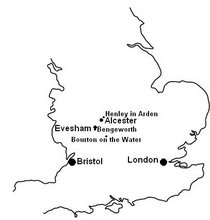
Wednesday, August 14th, 1765, became a red letter-day in the memory of the "Saints and faithful brethren" at Bourton. And the interest attaching to it, spread far and wide. There were but 14 churches in the Association, but there was twice that number of ministers present. There were the Rev Messrs Tommerson, of Cheshire; [James] Sleep, of Eisborough; [Benjamin] Wallin, of London; [William] Stanger, of Towcester; [Thomas] Davis, of Fairford; Thomas, of Henley-in-Arden; [John] Knight, of Warwick; [James] Turner, of Birmingham; [John] Ash, of Pershore; Jones, of Upton; [Samuel] George, of Wantage; Darby, of Witney; [Nathaniel] Overbury, of Tedbury; [Benjamin] Francis, of Horsley; [Thomas] Ferriby, of Sodbury; [John] Macgowan, of Bridgenorth; [Lawrence] Butterworth, of Bengeworth; [Thomas] Skinner, of Alcester; [Isaac] Woodman, of Sutton; [Nathaniel] Carpenter, of Middleton Cheney; [William] Hitchman, of Hilsley; [John?] Davis, of Campden; Caleb Evans, of Bristol; [James] Butterworth, of Bromsgrove; [Joshua] Thomas, of Leominster; [John] Heydon, of Tewksbury; [Benjamin] Whitmore, of Hooknorton; besides Beddome, Reynolds, and Strange, of Bourton. This was no mean gathering for a country village, in an age when railways were unknown. And there was a large congregation of hearers, as well as a great company of preachers. Good Mr Beddome says, that in addition to vehicles of all other kinds, "there were eleven or twelve post-chaises at our Association," clearly indicating that some had come from places not very near to Bourton.
The period of 30 years, from 1765 to 1795, is not destitute of interest, but, unhappily, the interest of those years is mostly of the mournful kind. The state of things in the country was gloomy and depressing. The price of bread was frightfully high, the result of war and deficient harvests. The poor were familiar with privation and suffering, the bare recital of which makes both our ears to tingle.
The very cattle seem to have been visited with unusual disease. Year after year days were set apart for solemn prayer and fasting.
The fasting, indeed, was no new or novel thing to some who engaged in these services. Many such things wore with them, and must have been still more, but for the alms given on these occasions. At Bourton chapel, there was invariably a collection for the poor on the solemn fast-day, and the proceeds were distributed principally in money, but some were supplied only with a shilling loaf. Auspicious day, that brought a shilling loaf at nightfall!
But there were "greater things than these," trials more fiery, sorrows more huge. "The ways of Zion mourned." Not that the congregation was "minished and brought low," but the church declined. Few, very few, were added during these years. During the period of 31 years, viz, from 1765 to 1795, both inclusive, there were 16 years in which not a single soul was added to the church by baptism. It was so in the years 1765, 1766, 1768, 1769, 1770, 1771, 1772, 1775, 1777, 1783,1786, 1790, 1791, 1793, 1794, and 1795. It will be seen that there was one period of five years without a single baptism, viz, from 1768, to 1772.
The letters to the Association during this period were most mournful; year after year hope was expressed, until "hope deferred made the heart sick." In 1786 the Association met at Alcester, and Mr Beddome, for the church, wrote as follows

"Beloved In Our Lord Jesus Christ,
"Our harps still hang upon the willows, for though God once smiled on us, and we sensibly experienced his quickening and comforting presence, he now frowns, and we mournfully complain with the Prophet, 'Verily thou art a God that hidest thyself.' In the years 1763 and 1764 we had thirty members added to our community, and thirteen in the year 1766, but since that we have been upon the decline. So that from 170 we are diminished to about 100 members, none being added, but two removed during the past year. We have once and again mentioned our flattering prospects; but the prisoners, though, we trust, prisoners of hope, don't manifest an inclination to go forth and shew themselves. Notwithstanding this, which is indeed matter of lamentation (and we hope you will sympathize with us, - and spread our case before the Lord), yet we have reason to be thankful that our auditory keeps up surprisingly.''

During the whole period of 31 years, 53 persons were added to the church by baptism, six were received by letter from other churches, 105 were removed by death, 12 were dismissed to other churches, and two were excluded for immorality.
The result was, that in the year 1795 the church consisted of 123 members: just 60 less than in the year 1764.

POTP 09

Chapter 4 begins with some statistics. In 1743, when Beddome arrived in Bourton there were 100 members. In 1751 there were 180 (as reported to the Association, meeting at Tewksbury). Brooks goes on

"The measure of prosperity vouchsafed to the church during the 14 years following was very variable, as indicated by the letters to the Association. Three years elapsed during which not a single soul was added to the church, viz, 1752, 1753, and 1754. During this period 15 were lost by death, and three by dismission, reducing their number to 162. Very trying to pastor and people was this period, but "The Lord can clear the darkest skies," and with 1755 came the time of refreshing, 22 persons were added by baptism. Among these were Mrs Beddome, Mrs Patience Kimber, of Burford, Mr Kyte, of the Upper Mill, Mrs Mary Kyte, and Elizabeth Wood, of the Folly Farm."
So by 1759 membership was 160, less by two than in 1753.
"The period of depression which had now set in, continued until 1764, when 28 were added by baptism. Many had been lost by death, and the church now contained 183 members, just three more than in the year 1751, being a clear increase of three members in 13 years.
During all this time, the congregations had been large and increasing. Seed-time and harvest are observable in the church as well as in the world. We must not condemn a man because he is not always reaping, "He that goeth forth and weepeth, bearing precious seed, shall doubtless come again with rejoicing, bringing his sheaves with him."
In the year 1763 the church enlarged the burying ground, by the purchase of a piece of land for the sum of £5, and to increase the available space within the chapel, they "turned the gallery stairs without doors." Mr John Collet gave the stones for walling in the new ground, and others gave the drawing. The cost of the whole, in money, was about £38. Of this sum, William Snook, Esq, contributed £10 and Mr Beddome £5.
We have seen our fathers building a new chapel in 1701, erecting a house for their minister in 1741, "enlarging and repairing" the chapel in 1748, and strengthening the same in 1750. We must now notice a work which exceeds in magnitude either of the preceding. The following extract from the church-book, will set it clearly before us—
"Oct 10, 1764. We entered upon a subscription for enlarging and rebuilding our meeting house, in which Mr Snook was the principal actor, and of which he was the most generous promoter. The old meeting-house, though altered and enlarged, was neither convenient nor sufficiently capacious, yet most were contented. However, through the indefatigable application of Mr Snook, the new building was erected."

The dimensions of the new chapel were 45 by 35 feet. Materials from the old chapel were used as far as possible. Exclusive of these, the cost of the new building was £473 14s. 10d. Towards this £69 was received as "Benefactions from abroad." These were almost exclusively from London. Dr Stennett procured and sent 20 guineas; George Baskerville, Esq, contributed 10 guineas, and sent 10 more from a friend. Of the £404 raised by the church and congregation, Snook gave £128 7s., ie £100 plus the pulpit, sounding-board, etc, which cost £28 7s. Beddome contributed £30. The rest was raised by smaller subscriptions, ranging from £20 to 5s.

"It must not be overlooked, however, that much work was given, as well as money. And but for this the cost of the building would have appeared to be much greater. "Mr Snook employed his team and servants almost continually. Mr Boswell sent his team 24 days; Dr Paxford 24 days; Mr Truby five days; Thomas Cresser one day; John Strange six days; Mr Eadburn two days; Mr Hurbert six days; Robert Taylor two days; Mr Bosbery one day; William Wood two days; John Hurbert, labourer, gave a week's work, and John Phillips gave the same with self and horse."

POTP 08

In the third chapter of his church history Thomas Brooks describes how in November, 1750, an attempt was made to induce Beddome to leave Bourton. His former pastor, Samuel Wilson, had died and the church at Goodman's Fields in London wanted Beddome to succeed him. Brooks reproduces many of the letters that passed between the churches in this matter. These are the letters used by Ken Dix in his study for the Sstrict Baptit Historical Society a few years ago and that are copied out in one of the church books.
1. The first letter is the original approach from the London church to Beddome. It was signed by five deacons and 30 members at a church meeting, November 11,1750. Brooks also gives the attached remonstrance or plea.
2. Next follows Beddome's letter saying that he would put the matter to the Bourton church.
3. The church took a month, according to Brooks, to prayerfully consider the matter before unanimously answering in the negative. The answer was drawn up by deacons John Reynolds, John Reynolds Jun and Richard Boswell (Beddome's father-in-law). That letter is also reproduced. It was signed by 37 male members at the church meeting, December 16, 1750.
4. Not content with this, the London church then sent a second letter (again reproduced) this time to the church at Bourton, arguing their case, in light of a resolution at their church meeting of February 3, 1750/1. It was signed by the deacons on behalf of the church.
5. This second application called forth a reply from Bourton, drawn up by the deacons again. This one was read, approved and signed, on the Lord's Day, February 24. Brook says that at the same time the pastor read his answer to the said letter, also in the negative, for which the Bourton church was thankful. Both are given in extenso.
Brooks comments that

“comparatively few ministers are ever called to pass through an ordeal as trying as the one disclosed in the above correspondence, and it may be safely affirmed, that none ever came out with more credit to themselves. By this circumstance, Mr Beddome's uprightness, disinterestedness, and simplicity, are placed above suspicion. We are not surprised to hear that his people were provoked to love and good works. "Shame and confusion" would have belonged to them, had they failed to love him heartily. They strove, however, with fresh zeal to promote his comfort. And first of all, they determined to get out of debt. This debt was contracted partly by the building of the minister's house in 1741, partly by the enlargement of the chapel in 1748, and partly by "strengthening" the chapel in 1750.”

Brooks then quotes Beddome on this:

“In 1750 an unfortunate circumstance happened, which increased the church's debt, for after we had repaired and enlarged the Meeting-house, the main beams of the galleries being poplar, and plastered in whilst they were too green, they rotted away as also many of the joists. So that there was a great danger of the galleries falling, nay, and of the roof too, which then bore upon the galleries. Upon this new beams and joists were provided, the galleries put a foot back, and their seats raised, and two upright pillars put to support the roof independently of the galleries. The charge of which was £25 6s 8d”'

He also quotes from Beddome's own record in the church book regarding subsequent events with regard to the call to London.

“Dec, 15th 1751 Our pastor acquainted us that he had lately received a letter from some of the members of Mr Wilson's church in London, giving him an account, that by reason of difference among the members of said church, about Messrs Reynolds and Thomas, some being for one and some for the other; they were likely to be greatly distressed if not broken in pieces, and that both parties would unite in him if he could now consent to leave his people. That this being the only probable method of preventing a breach, they were forced again to have recourse to him. He also acquainted us that last Wednesday, upon desire, he gave Mr Ball and Mr Hattersly, the meeting at Burford, who renewed their solicitations, pressing his coming to London, not only from all the arguments before used, but from others taken from the present urgent necessity of their affairs. Our pastor, therefore, desired us to pray over and consider the matter till Wednesday, the 25th instant, when he would call a Church-meeting, and receive our answer, by which at present he intended to be guided.
Dec 25th Returned for answer to said pastor, that we could not see the state of the London church to be so distressed as represented, and that if it was, we could not consent to cast ourselves into the same or greater distress in order to help them.”

07/07/2010

POTP 07

This is the final part of Chapter 2 of Brooks Pictures from the past

When Mr Beddome became pastor of the Church at Bourton he took up his residence at Lower Slaughter, in the house of Mr Head (this cannot be the nonconformist Joshua Head as he died in 1719 but this may well be a relation), where he continued till September, 1749; but then, as he intended marrying, he removed to Bourton. A dwelling had been provided by his people some years before. "In 1741, the Church resolved to build a dwelling house for the use of their minister, there being no convenient one either to be let or sold in Bourton for that purpose." Every item in the cost is carefully recorded, down to "odd things, bread, cheese, beer, etc." The sum total was something more than £350. This sum, with the exception of about £40 from a few of Mr Beddome's personal friends, was raised by the church and congregation. Mr Beddome has recorded every subscription (taking great care to preserve the identity of each donor), from "Mr John Reynolds sen, £45 0 0" to "Molly Hanks, the Mantua maker 2s 6d" and "Nanny Strange, Joseph's daughter, 2s."
While Beddome was thus preparing to be married and settled at Bourton, his father was seeking, with great perseverance, to lure him to Bristol. Such was the estimate formed of the value of his labours, that he was warmly solicited to become co-pastor of the Pithay church, Bristol. On this subject his father addressed many letters to him, one of which will show how earnestly he pleaded with his son.

“October 28,1748, My Dear Benjamin,
I wish from my heart, the Lord would incline you to come to this city. Here you would have a comfortable income, and a better people than you take them to be. They very much desire you. and are willing to make extraordinary efforts for your comfortable support. But my principal reasons, why I so much desire your removal are these: (1) It would save a large number of people from sinking (2) My children would be all together (3) It would be a great comfort to your poor mother to sit under your ministry (4) You would have less labour, an honest, good-hearted man to be your partner, much good conversation for your improvement, and an abundant harvest of souls, as well as anywhere else.”

But none of these things moved him. Seven years before this he had recorded his wish

My dwelling-place let Bourton be,
There let me live, and live to thee

And he was "in one mind" and none could turn him.
In the "wish" named above, he had also said first

Let the companion of my youth
Be one of innocence and truth;
Let modest charms adorn her face,
And give her thy superior grace.
By heavenly art first make her thine,
Then make her willing to be mine.

These conditions appear to have been met in some measure, by Miss Elizabeth Boswell, to whom he was "joined in matrimony," December 21, 1749.
She was the daughter of Mr Richard Boswell, of Bourton, who was a deacon of the Church, and a most valuable man. Had this engagement anything to do with his determination to abide at Bourton? Did Miss Boswell strongly object to quitting the "Golden Valley" for the smoky city? When Mr Beddome gave her that letter from his father, to read, and, with tears in his eyes, pointed out the reason No 3, involving the comfort of his "poor mother," did she smiling sweetly, say "For this cause shall a man leave his father and his mother?" We cannot tell. It is not in evidence; but we cannot help thinking that the Church at Bourton was fortunate in having " specially retained " on their side Miss Boswell, instructed by her father. It was not a light thing, in a secluded village, to have secured for so many years the services of Benjamin Beddome.
And here we must not omit the fact, that prior to this event the chapel became too strait for the congregation, and being "very much decayed in several places, they resolved to pull down a great part of it, and enlarge and repair it." This was done at a cost of £118 15s 6d in the year 1748, costing more than the original chapel in 1701. It is pleasing also to perceive that this church, favoured in the possession of an "able minister," was producing others who were destined to be the pastors of other churches. In 1750, the Rev John Ryland, after repeated trials of his gifts, was dismissed to the Baptist church at Warwick, to become its pastor; and the Rev Richard Haines, to the Church at Bradford, Wiltshire, for the same office there. In addition to these, Mr John Reynolds, jun, "having been under the care of Mr Foskett of Bristol," for the increase of his learning, "almost two years, was permitted by the Church to exercise his gift occasionally, till they saw fit to give him a more full and solemn call."

POTP 06

This is the next bit of Chapter 2

Here it may be well to record the fact, that, shortly before the “fixing of their pastor, Benjamin Beddome” the church at Stowe had become one with the church at Bourton. The transaction is thus recorded

“Copy of a paper signed by the members of Stowe church, March 19, 1742/3
“Whereas we, whose names are underwritten, (being formerly members of the Church of Christ meeting at Stowe, commonly known by the name of Baptists,) having by a church act dissolved ourselves, and looking upon ourselves no longer as a distinct church, have also made application to the Church of Christ meeting at Bourton for communion and fellowship with the said church. We do hereby confirm that our application, and profess, that we no longer look upon ourselves as a distinct body ; but as members of the said church at Bourton, in conjunction with which we desire to be fed with the sincere milk of the word, and attend upon those ordinances which were instituted as well for the glory of the Redeemer, as the comfort of our souls.”

This document is signed by 23 persons, male and female, and is followed by articles of agreement between Bourton and Stowe churches.

“I. No longer to look upon themselves as two distinct and separate bodies, but as one Church ; and as members of that one church, reciprocally to watch over one another, pass church acts, exercise church discipline, &c.
II. That the minister resident or preaching at Bourton, shall preach at Stowe in the afternoon one Lord's day in the month absolutely, and oftener, if providence order it so that the meeting at Bourton may be supplied at the same time.
III. That as long as there may be any persons living about Stowe, who cannot comfortably sit down at Bourton and there partake of the ordinance of the Lord's supper,' and are desirous to have that ordinance administered at Stowe; it shall be so administered by the pastor of the church at Bourton, at the most expedient seasons, three or four times a year.
IV. That whenever there may be twenty or thirty members, living nearer Stowe than Bourton, having a prospect of being supplied with an orderly minister of the same perswasion, and desirous of re-embodying themselves ; a liberty shall be granted them to renew and keep up a separate church state, as before this union.
V. That if any persons formerly belonging to Stowe church, shall refuse to comply with this act of that church ; and upon proper application, shall persist in their refusal, they shall be looked upon as withdrawing from the communion of the church, and their names expunged out of the list of members, unless they desire their dismission to any other church, which shall be granted them."
We are not surprised to find that this did not give perfect satisfaction. The Stowe people were certainly put upon very low diet. The result was that “after some time Stowe people complaining that one day in the month was not sufficient, and also proposing to raise something independent of Bourton, for the support of the ministry, if another opportunity might be granted them, it was agreed that they should be supplied twice a month. The minister not lessening his labours at Bourton on one of those days.”

We must not forget that the "flock" of which Benjamin Beddome had taken "the oversight" was spread over a spacious field. The Church contained about 100 members. They resided at Bourton, Lower Slaughter, Upper Slaughter, Naunton, Barton. Hawling, Saperton, Clapton, Farmington, Great Rissington, Little Rissington, Burford, Longborough, Dunnington, Swell, Stow, Broadwell, Icomb, Chipping Norton, and Hook Norton. The Church at Bourton was therefore composed of persons residing in 20 parishes – a fact often overlooked in the present day. We rejoice that it is not so now, our neighbours "have no such lengths to go, nor travel far abroad" because this mother-church sees her children rising all around.

POTP 05

Brooks continues in Chapter 2

During the period we have now reviewed, Mr Beddome had repeatedly visited Bourton-on-the-Water. His first visit was paid in the Spring of 1740, and many persons were added to the church during the three years following. During this time his ministerial labours seem to have been divided between Bourton and Warwick. In July, 1743, the church at Bourton invited him to become their pastor. He had now to choose between Bourton and Warwick. Upon this subject his father writes

“As to the continuance of your journeys between Bourton and Warwick, you are the best judge. If your strength will permit, and the people's desire remains strong, and there is a prospect of serving the interests of religion at both places, to my judgement, it may be best to continue some time longer; and if you pray fervently, and commit your way to the Lord, you will see the leadings of his providence. 'The meek will he teach his way.' Take notice of the feelings you are subject to, and the assistance you obtain at each place, and consider where the gospel is most needed and most likely to be received, for that place will yield most satisfaction to a gracious mind. We are not so much to consult our own ease and pleasure, as to honour Him who made us, and promote His interests.”

Having received many very pressing invitations from the church at Bourton to become their pastor, he at length acceded to their request, and was ordained September 23, 1743. On that occasion, Mr Foskett, of Bristol, gave the charge to the pastor, (from 1 Tim iv 12 "Let no man despise thy youth; but be thou an example of the believers, in word, in conversation, in charity, in spirit, in faith, in purity,") and offered the ordination prayer. Dr Joseph Stennett preached to the people, from Heb xiii 17; and other parts of the service were taken by Messrs Haydon, Cook, and Fuller, of Abingdon. His venerable father was not present on this interesting occasion, owing to his incapacity for travelling, but sent the following letter, expressing the feelings and desires of his heart

“I should have been glad to have attended your ordination, but cannot. I never expect to travel so far on horseback more. I hope what you are about to take upon you, will be a stimulus to you, to walk more closely with God than ever, and make you more sincerely and simply concerned for the good of the souls of men. I desire, with my whole heart, that an unction of the Holy Spirit may be poured out upon you at the laying on of the hands of the Presbytery; and that your faith therein may be strong.”

Our fathers were careful to state clearly, on such occasions, the engagement between the pastor and the church. In this case, a document was drawn up, adopted by the church, and signed by 18 of its members, in behalf of the whole, on the 16th day of September, 1743. The following is a copy.

“We, the church of Christ meeting at Bourton-on-the-Water, Having solemnly called, and set apart, our beloved brother, Benjamin Beddome, to the office of teaching elder to us, do hereby declare, that we don't intend to bring him under any such special obligation to us; but that if the providence of God calls him elsewhere, or he upon valuable considerations, doth desire his release from us, we will give up our right in him, as if he had never stood in any such relation to us. In witness whereof we have put our hands, etc.”

Well, it was something to know that they had not bored his ear through with an awl, and bound him to serve them for ever. It would be possible to get away.

POTP 04

This is the next part in Chapter 2
 
His father appears to have been a wise and faithful counsellor. The following is an extract from a letter written by him to his son about this time.

"I am pleased to hear you have given yourself to a Church of Christ; but more, in that I hope you first gave yourself up to the Lord to be his servant, and at his disposal. And now, I would have you remember, that when Christ was baptized he was soon tempted of the devil; and I believe many of his followers, in that, have been made conformable to their Head. So also may you, therefore, of all the evils you may find working in your heart, especially beware of spiritual pride and carnal security."

According to the custom of the Baptist churches, he was requested to preach before the church, and did so, January 9 and February 28, 1740. The result was, that the Church called him to the work of the ministry. His father seems to have thought this rather premature, and wrote to his son as follows

"May 21, 1740. Dear Benjamin,
"I am sorry Mr Wilson is in such a hurry to call you to the ministry. It would have been time enough just before you came away; but supposing it must be so, I think you should not preach in public above once or twice, at most, at your own place, and nowhere else, except Mr Stennett, or his people, ask you, and if the latter do it, you may serve them as oft as their necessities require. The Lord, I hope, will help .you to make a solemn dedication of yourself to him, and enter on the work of the Lord with holy awe and trembling. I hope to get sundry friends in this place to beg assistance for you, and a blessing, on Thursday next.”

Thus did he continually. How much may these paternal counsels and fervent prayers have contributed to the eminence and usefulness which marked the career of his beloved Benjamin! Nor were these faithful admonitions and wise counsels confined to what might be regarded as the weightier matters. He deemed nothing unimportant that stood related to the ministry, and might therefore either help or hinder its success.
It appears that Benjamin Beddome, like too many young preachers, fell into a hurried mode of delivery. The result was, that his voice, like a horse with the bit between his teeth, became unmanageable, while the effort of the preacher became painful to the hearer. His father became aware of it, as also of the fact that another evil habit was in process of formation, viz, that of making his sermons too long ; and came down upon him with great force, in two loving letters. We take from them the following extracts

"Bristol, May 17, 1742.
My Dear Benjamin, I wish from my heart I could prevail with you not to strain your voice so much in the delivery of your sermons; and if you would make them shorter, and less crowded with matter, it would be more acceptable and edifying to your hearers, and more safe and easy for yourself. Strive, then, to comply with this advice, which is given in great affection, and, I think, with judgment. If you deliver the great truths of the gospel with calmness, and with a soft, mellow voice, they will drop as the gentle rain or dew. For the good of souls, then, and for your own good, be persuaded to strive after this."

"August 6, 1742.
My Dear Benjamin, I cannot but advise, and carefully press you, to strive with all your might to soften your voice, and shorten your sermons; for it would be better both for you and your hearers. I say this, not merely from myself, but from many of the most judicious I know. I lately heard a great man say, that if you could deliver the matter you produce in the same manner as Mr Evans, you would be more popular and useful than ever you are likely to be if you retain your harsh mode of speaking. Mr Grant, not four days ago, said the same things in other words; and I well know, that those of your people, who have the best sense, (ie common sense) have said to several, that if you would strain yourself less, and shorten your sermons, it would be better for all. What all say, give ear to. Of one discourse I beg you will make two, and so take care of your health and comfort. Let two hours be the longest time you spend in the pulpit at any place. This I leave as my special charge; and as I write with all the love and tenderness of a father, I hope you will consider these things."

Benjamin Beddome had probably read before he left home Psalm 141:5, Let the righteous smite me; it shall be a kindness; and let him reprove me; it shall be an excellent oil, etc and thinking this an opportunity for exhibiting his acquiescence in the sentiment, he largely profited by the kindness of his father; he held his voice with a tighter rein, and applied the scissors to his sermons.

POTP 03

Brooks' Pictures of the past Chapter 2 begins

We have spoken of the church, we regret that we cannot speak as certainly of the ministry of the same period. The only name that has come down to us is that of Mr Flower, and the only reference to him is connected with a list of subscriptions promised for his support. It reads as follows

“Whereas we hope the worthy Mr Flower purposes to settle with us as pastor, we whose names are underwritten do voluntarily and willingly subscribe to pay yearly for the support of his ministry, viz”

We know, from statements made subsequently, that the church was destitute of a pastor for many years; and, in 1750, they testify that many of them could then remember the death of two or three pastors who were very eminent and valuable men. Thus much, and this is all, we know of the ministry of that age. But there was mercy in store for this people. They tell us that “notwithstanding their many cries to Almighty God, he was pleased to withhold direct answers of prayer, till at length he graciously raised up, eminently qualified, and unexpectedly sent, our dearly beloved and Rev pastor, Mr Beddome, to our assistance, and inclined him, after our many solicitations and calls, to became our pastor”
This eminent man (the Rev Benjamin Beddome) was born at Henley-in-Arden, Warwickshire, January 23, 1717/18. His father, the Rev John Beddome, had purchased in that place a large house, which he fitted up partly for his own residence, and partly as a place of worship. When Benjamin Beddome was about seven years of age, his father removed to Bristol, where he became co-pastor with Mr Beazely, of the Pithay church, in that city.
The son, after receiving a suitable education, was apprenticed to a Surgeon-apothecary in that city. Some 20 years of his life had passed away, when his heart was opened to attend to the things belonging to his peace. He thus records the "event".

“Mr Ware, of Chesham, preached at the Pithay, Bristol, August 7, 1737, with which sermon I was, for the first, deeply impressed. Text, (Luke xv 7) 'Likewise joy shall be in heaven over one sinner that repenteth, more than over ninety and nine just persons that need no repentance.'”

He heard the character of the penitent described, and it at once became his own. So intense were his feelings, that he selected the most retired part of the chapel to conceal his tears. He found much relief, we are told, in reading the Scriptures and in prayer; and soon the tears of penitence were dried up by the “Sun of Righteousness”.
His own heart changed, he soon began to feel for the spiritual condition of others; and became desirous of devoting himself to the work of the ministry. With a view to this, at the close of his apprenticeship, he became a student in the Baptist College, Bristol, then superintended by the Rev Bernard Foskett, who was formerly co-pastor with his father at Henley-in-Arden. Having pursued his studies for some time at Bristol, he removed to London, for the purpose of completing his education under the tuition of Mr John Eames, at the Independent Academy, in Tenter Alley, Moorfields. Strange to say, he had not at that time became a member of any Christian church. Soon after his removal to London, however, he joined the Baptist church in Little Prescot Street, Goodman's Fields, under the care of the Rev Samuel Wilson, by whom he was baptized in September or October, 1739.

01/07/2010

How many baptised?

In his book Pictures of the past, Brooks says that, according to Thomas Coles, Beddome baptised 250 in 55 years, an average of 4.5 a year.

POTP 02

Later in the book we have an interesting quotation from a letter sent from Bourton to the Association meeting in Oxford.

Since your former meeting, the Lord has added 17 to our number (the 14 mentioned last year as proposed, and three besides), most of these, however, had been some years before brought to God, but were prevented coming forward by the very unhappy condition of the church.
One (Thomas Kitchen) spoke of a sermon preached 20 years before by Mr Beddome, as the means of his conversion. He had never so much desired baptism as since he witnessed the baptism of 14 persons by Mr Coles, October 3, 1802. On that occasion he "wished himself among them." He, with two others, was baptised, April 3, and the most striking incident in connection with this service, was the contrast in the ages of two of the candidates. Thomas Kitchen was 75, and Elizabeth Wood 16 years of age. "We sang," says Mr Coles, "the following verse

To thee, the hoary head
Its silver honours pays;
To thee, the blooming youth
Devotes his brightest days;
And every age their tribute bring,
And bow to thee, all-conquering king!
(by Elizabeth Scott it was No 358 in Ash and Evans's Baptist Collection of Hymns, 1769, in 4 stanzas of 6 lines and by 'S')

POTP 01

Thomas Brooks' Pictures of the past begins
When the first church composed of Nonconformists residing in this locality was actually formed we cannot say with certainty. Puritans are known to have resided at Bourton, and in surrounding places, very early in the seventeenth century. A meeting for spiritual conversation and prayer was held at Slaughter in the beginning of it. In 1750, Mr Beddome wrote as follows (in the church book)
"That there has been in these parts a dissenting people for 150 years, Mr Reynolds Senior proves from the words of his grandfather, who was of a great age when he was a boy, and said that when he was a youth, he used to carry his grandmother to a meeting of Puritans at Slaughter, where they had used to assemble for spiritual conversation and prayer. Now from a computation of his own age and that of his grandfather, his great-great-grandmother must have attended at those meetings about 150 years ago."
We have no evidence that at that period they had forsaken the Established Church, and formed themselves into a separate society, but in the time of Oliver Cromwell there was a Baptist church, regularly constituted, existing at Bourton-on-theWater. This church belonged to an Association of Baptist churches which met at Warwick on the fourth of March, 1655. The churches whose ministers and messengers met on that occasion, were situated at Warwick, Moreton-in-Marsh, Bourton, Tewksbury, Hook-Norton, Derby, and Alcester.

Pictures of the Past

The history of the church at Bourton on the Water "Pictures of the past" by a one time minister, Thomas Brooks, is now fully available on Google Books here. A quick search reveals several interesting items. These will follow - we hope.