Among Beddome's contemporaries are the Butterworths, four ministers who were all sons (the eldest following his father's profession) of a blacksmith called Henry Butterworth of Rossendale in Lancashire. As a father of five sons myself (though not skilled with my hands) I can identify.
The ministers were
John Butterworth 1727-1803 At Coventry from 1752
James Butterworth d 1794 At Bromsgrove from 1755
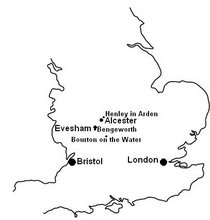
Lawrence Butterworth 1740-1828 At Bengeworth from 1764
Henry Butterworth d 1808 At Bridgnorth from 1768
John published an oft reprinted concordance and dictionary and a refutation of Priestley's Unitarianism. A diary entry of his is reproduced below
"My conscience was frequently awakened, and many resolutions I formed of living a holy life, but a few days or a week would wear off these impressions, and worldly things occupied my mind, so that the older I grew, the more wicked I became, though I was not averse to hearing the word and attended stated ministrations of it. We had at least two miles to go to worship, and occasionally four or five, and as that country is mountainous, I was entertained with the different objects presented to my sight, and pleased with the walk, though frequently glad when the service was ended. As near as I can recollect, I was then about fifteen years of age.
We had frequently heard of the Methodists and read of their preaching in the fields, and particularly that Mr Whitefield often preached to 10,000 people, or more, at Blackheath and other places. About 1745 they came into our country. Mr Wesley was published to preach near New Church, in Rossendale, at 5 o'clock one morning. I went to hear him. He had a numerous auditory, and preached from Romans 3.22: For there is no difference,' etc. I was struck with his discourse, and became a constant hearer of the Methodists when they came their rounds, and also attended their private meetings, yet I still attended Mr. Ashworth's ministry at other times. One day I thought of the holy conduct of a Thomas Foster, a member with Mr. Ashworth, who was neighbour to us and frequently visited my father. He, my father, and several more persons held a meeting of prayer and conference weekly, and would speak from some text of Scripture. Thomas Foster was very kind and liberal to the poor, though his property was very moderate. He was also fluent in prayer, and always appeared to be in a spiritual frame. This excited me to beg of God to give me His Holy Spirit in a manner I had never done before, and from that time I made conscience of daily prayer.
I now took a review of my past life. I reflected upon our careless manner of singing Psalms and Anthems, making a solemn mockery of God therein. I never after joined with my old companions, but immediately left all my worldly connections, and applied myself to the worship of God. This was such a change as I had never experienced before. I had never felt such an impression as at this time of the importance and excellence of godliness.
I had been a constant reader of books and had a taste for improvement of knowledge, and being in a book society I had the advantage of reading a variety of books both on divinity and science. I read several of Dr Watts' works. I learned shorthand, and often copied some of Mr.Burkitt's Comments, and was disposed to religion, but still it was only in speculation, without real heart-work. I believe I was generally esteemed a religious character, but it was far otherwise in fact.
The same night, after the workings of mind respecting Mr. Foster, I went to hear one John Nelson, a Methodist preacher, a man who had gone through much persecution, had been pressed for a soldier, but notwithstanding many threatenings, maintained his integrity, and often reproved both men and officers for their profanity, and in time obtained his discharge. He preached from Matthew 8.2: 'Lord, if Thou wilt. Thou canst make me clean,' and many were affected under the discourse. I thought they all seemed more affected than myself, that the discourse seemed to have no good effect on me. The hardness of my heart had always been my trouble, and because of this all the sermons I had heard were ineffectual. I returned home with a heavy spirit, crying to God that He would take away my heart of stone and give me a heart of flesh.
I then experienced a longing after holiness, a desire to be holy as God is holy. I hoped to live without sin, which I then thought was attainable in this life. I used to govern my thoughts daily as much as in me lay, and these words impressed my mind: 'Blessed are they which do hunger and thirst after righteousness, for they shall be filled.' I found great freedom in secret prayer, but had not yet attempted to pray in public. I was much pressed to this, but was unwilling to engage. Through much entreaty I was at length prevailed upon, but was in great confusion and concluded I would not attempt again. After some time, I thought it was very desirable to enjoy a gift for public prayer. How else could prayer meetings be maintained? Accordingly I besought the Lord to bestow that talent upon me for the glory of His name. Soon after this I felt an inclination to be engaged when called upon. We had a prayer meeting before public worship at the Baptist chapel which I attended, and being asked to pray, I complied, and found equal freedom as in private, and herein I found God to be a prayer-hearing God.
The doctrine of assurance of faith and of knowing our own sins pardoned, was much insisted upon by the Methodist preachers. This I wanted to know, for I was not certain that I was a subject of grace, but I determined to be in the way of earnest prayer, and attendance on all the means in my power. I sometimes thought I would not cease praying, nor hold my peace till the Lord should speak peace and pardon to my soul, and give me assurance of His favour. One night I resolved to continue all night till God appeared, but about 2 o'clock sleep overtook me, and my resolution was broken. I have often thought that there was too much self-labour in all this, if not presumption in dictating to God. I still found unbelief a great burden, laboured hard to believe, but could not, for indeed I was ignorant of the nature of faith, not knowing that it is a lost sinner's casting the load of his sin upon Christ for pardon and acceptance with God.
One morning I was deep in thought on this subject, reasoning with myself why I was still in unbelief, when these words dropped upon my mind:— 'By grace ye are saved through faith, and that, not of yourselves, it is the gift of God.' This word 'gift' revolved in my mind. A gift, thought I, is not merited, if it were, it would be a debt, and not a gift. I had leaned all along towards the doctrine of merit, and of obtaining grace by good works, but now I saw faith to be an undeserved gift, and that God might bestow it on my vilest neighbours, and leave me in my moral duties without faith. This led me to think that there was some truth in the doctrine of election, and that it was not upon foresight of faith and obedience, but of pure sovereignty, and that faith and obedience were the fruits and effects of election, and not causes thereof. My sentiments began to change from Arminianism to Calvinism.
One evening I was reading in the Bible, and cast my eyes upon these words of our Lord, in John 6.47: "Verily, verily, I say unto you, he that believeth in Me hath everlasting life." I was struck with that passage. It was as if spoken within me. I did immediately believe that Jesus Christ was a suitable, precious and almighty Saviour. I trusted in Him alone for salvation, and therefore in Him I had everlasting life... .I went to bed that night with a joyful heart. I was transported with the love of Christ, and thought how wonderful and astonishing it was that Christ should be my Saviour, and not only mine now, but mine for ever! This was about my nineteenth year, in the bloom of youth and health.
But some time after this I fell into a sore temptation, with which I was exercised for three months together, and which greatly affected my health. It came upon me in the following manner:— One day going to meeting these words dropped upon my mind, 'If ye be without chastisement whereof all are partakers, then ye are bastards and not sons.' These words, I thought, were spoken to me, for I had no chastisement nor affliction either in body or mind! Then surely, thought I, the root of the matter is not in me, and I fear I have not had true repentance... .I cried to God day and night, but He hid Himself, and I was troubled.
One day I was reading in a book called The Marrow of Modern Divinity, a sentence from Luther was quoted which was this:— 'I would run into the arms of Christ if He stood with a drawn sword in His Hand.' This thought came bolting into my mind—so will I too— and those words of Job occurred: 'Though He slay me yet will I trust in Him.' My burden dropped off. My soul was filled with joy and peace through believing in Christ, a venturesome believing, as Mr Belcher calls it....
About this time I had strong desires of preaching Christ to my fellow sinners... .Accordingly I prayed to the Lord to give me grace and talents for this important work, and at times I spoke a few words at our private meetings....
At last I informed a few friends that I would carry on a meeting at my father's house next Lord's Day in the afternoon. More people came than I had expected. However, with much diffidence, I attempted to speak from John 6.40. Before I had finished, my father and mother came from their meeting, much surprised to find me preaching. I was invited to preach again in the evening about a mile distant, and I complied. These words had been impressed on my mind:— 'As every man hath received the gift, even so minister the same one to another, as good stewards of the manifold grace of God' 1 Peter 4.10."